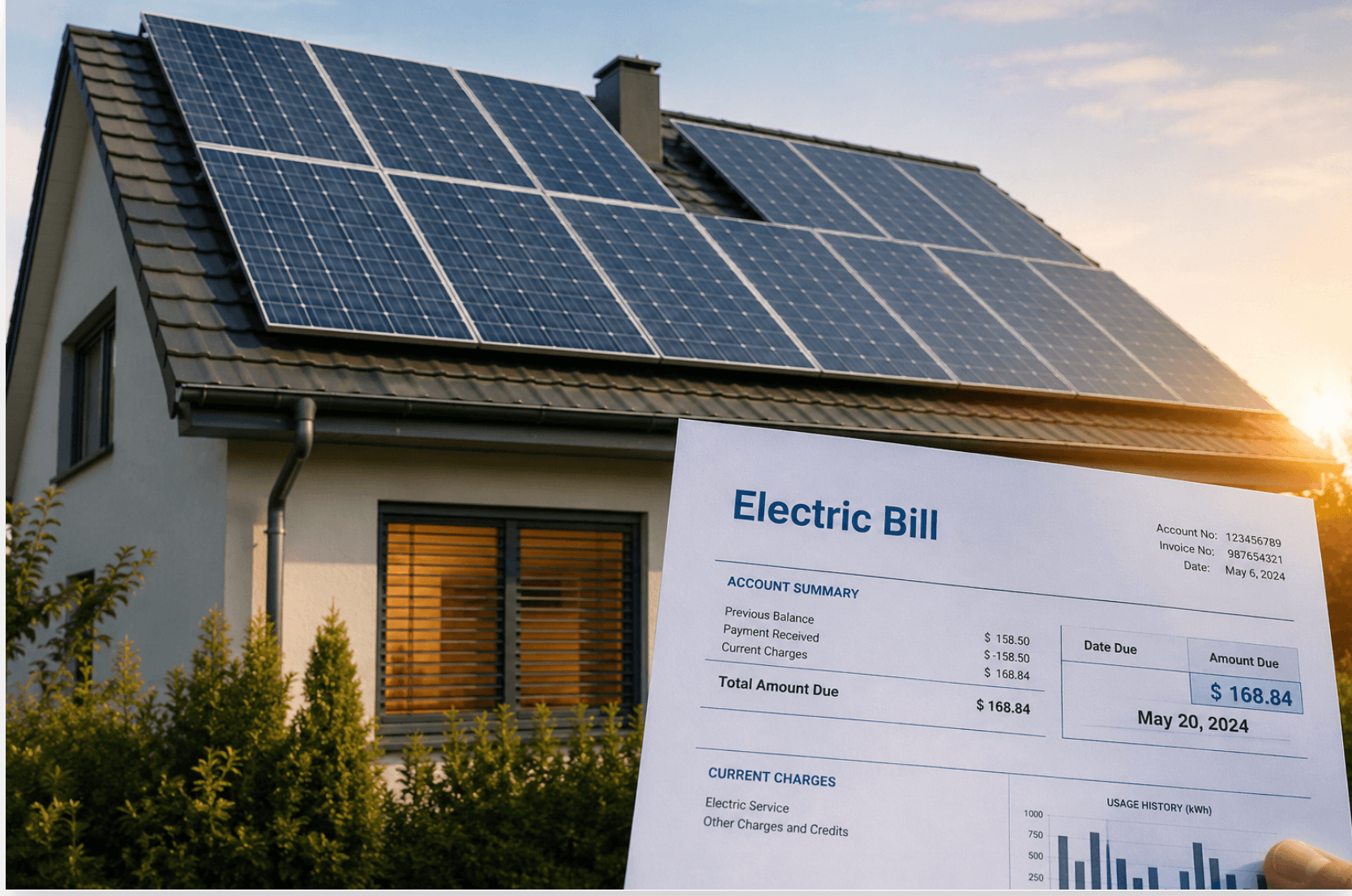
If you’re thinking about going solar, one question matters more than almost any other: how do solar panels actually affect your electric bill?
The short answer is that solar panels reduce or even eliminate the amount of electricity you buy from your utility company, but the way that plays out on your monthly statement depends on how your system is set up and how your local utility handles the energy you produce.
This guide breaks down exactly how solar panels interact with your electric bill, what changes you’ll see, and how to estimate your real savings.
How Do Solar Panels Work With Electric Bills?
Solar panels lower your electric bill by generating electricity you’d otherwise have to purchase from the grid.
When your panels produce more power than your home uses, that surplus is typically sent back to the grid, and many utilities credit you for it through a program called net metering.
The combination of using your own free solar power and earning credits for excess production is what drives down or zeroes out your monthly bill.
How Solar Panels Generate Electricity
Solar panels are made of photovoltaic (PV) cells, usually silicon-based, that convert sunlight directly into electricity. Here’s the basic flow:
- Sunlight hits the panels, knocking electrons loose and creating a direct current (DC) of electricity.
- An inverter converts DC into AC (alternating current), which is the type of electricity your home appliances actually use.
- The electricity powers your home in real time, feeding your lights, refrigerator, air conditioning, and everything else.
- Surplus power flows to the grid when your panels produce more than you’re using at that moment.
The key thing to understand is that solar production happens during daylight hours, while your home consumes energy around the clock.
That mismatch is exactly why your relationship with the grid and your utility bill still matters even after going solar.
How Solar Affects Your Electric Bill: The Three Scenarios
Your Panels Produce Exactly What You Use
In this ideal moment, your home consumes all the solar electricity as it’s generated. You buy nothing from the grid and send nothing back. Your meter effectively stands still.
Your Panels Produce More Than You Use
This usually happens midday, when the sun is strong and household demand is low. The excess electricity flows back into the grid.
Depending on your utility’s policy, you either earn a credit (net metering) or are paid a set rate for that exported energy.
Your Panels Produce Less Than You Use
At night, on cloudy days, or during high-demand evenings, your panels can’t keep up. You draw the difference from the grid and pay your utility’s standard rate unless you’ve banked enough credits earlier to offset the cost.
Understanding Net Metering (The Bill Game-Changer)
Net metering is the billing arrangement that makes solar so financially attractive in many regions. Here’s how it works:
- When you send excess solar power to the grid, your meter runs backward, building up credits.
- When you pull power from the grid at night, those credits are spent first.
- At the end of the billing cycle, you’re charged only for your net consumption, the difference between what you pulled from the grid and what you sent back.
If your panels send back as much as you draw over the month, your energy charges can drop to nearly zero.
Some utilities allow credits to roll over month to month, which is especially helpful in summer when production is high, and you can bank credit for winter.
Net metering policies vary widely by country, state, and utility, so it’s essential to check your local rules before estimating savings.
The Charges That Don’t Disappear
A common surprise for new solar owners: your bill rarely hits exactly zero, even with a well-sized system.
That’s because most utilities apply fixed charges that have nothing to do with how much energy you consume. These can include:
- Connection or service fees, a flat monthly charge for being tied to the grid.
- Minimum delivery charges and costs for maintaining the poles, wires, and infrastructure.
- Taxes and regulatory fees, small line items that still apply.
So even a household that produces all its own power will usually see a modest baseline charge each month. Going solar dramatically shrinks your bill; it doesn’t always abolish it entirely.
Grid-Tied vs. Off-Grid vs. Hybrid Systems
How your solar setup connects to the grid determines your billing experience.
- Grid-tied systems stay connected to the utility, allowing net metering and grid backup. These produce the most predictable bill savings and are the most common residential choice.
- Off-grid systems are completely disconnected from the utility and rely on battery storage. There’s no electric bill at all, but no grid backup either, so the system must be sized carefully.
- Hybrid systems combine solar panels with battery storage and a grid connection. You can store excess energy for nighttime use and still draw from or export to the grid, giving you maximum flexibility and resilience.
Adding a battery means you store your own midday surplus and use it after dark, reducing how much you buy from the grid even further.
How to Estimate Your Solar Savings
To get a realistic picture of how solar will change your bill, work through these steps:
- Pull your last 12 months of electricity bills and calculate your average monthly and annual usage in kilowatt-hours (kWh).
- Identify your utility rate per kWh, including any tiered or time-of-use pricing.
- Estimate your system’s production based on your roof size, panel wattage, sun exposure, and local climate.
- Check your net metering policy to understand how credits are valued.
- Subtract fixed charges that will remain regardless of production.
The result gives you a strong estimate of your new monthly bill and how quickly your system will pay for itself.
Time-of-Use Rates and Solar
Many utilities now charge different rates depending on the time of day, with electricity costing more during peak evening hours.
This interestingly affects solar economics: the power you export midday may be credited at a lower rate, while the power you pull in the evening costs more.
Pairing solar with a battery lets you store cheap midday energy and avoid buying expensive peak-hour power, maximizing your savings under these rate structures.
Will Solar Eliminate Your Electric Bill?
For many homeowners with a properly sized, grid-tied system and favorable net metering, solar can offset 90% to 100% of energy charges.
But because of fixed connection fees, most people still receive a small monthly bill. Off-grid and hybrid-with-battery setups can get closer to eliminating utility costs, at the expense of a higher upfront investment.
Final Thoughts
Solar panels work with your electric bill by replacing the power you’d otherwise buy from the grid and, through net metering, crediting you for the surplus you produce.
The exact savings depend on your system size, your local utility’s policies, and whether you add battery storage.
While a small fixed charge often remains, the bottom line on your monthly statement can shrink dramatically once your panels are up and running.
The smartest next step is to review your past year of electricity bills, confirm your local net metering rules, and request a custom production estimate for your roof. That’s how you turn the general promise of solar savings into a number you can count on.
