If you have ever looked at a solar quote or an electric bill and seen the phrase “net energy,” you are not alone in wondering what it actually means.
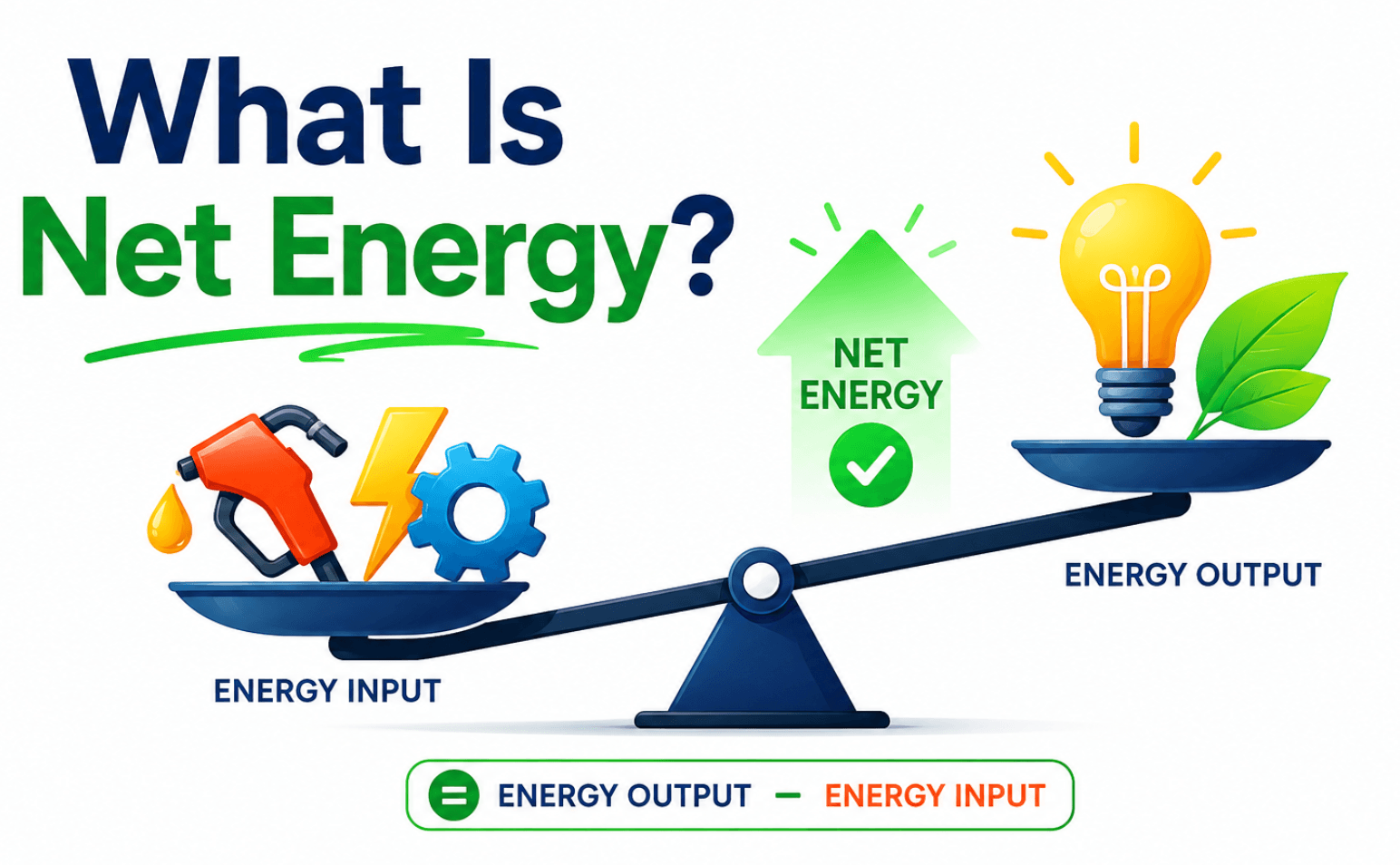
Net energy is the difference between the electricity your solar system produces and the electricity your home consumes over a given period.
When you produce more than you use, you have a net surplus that can be sent to the grid. When you use more than you produce, you have a net draw that you pull from the grid.
Understanding this single number is the key to reading your bill, sizing a solar system correctly, and knowing exactly how much you will save.
This guide breaks down what net energy is, how it is measured, how it connects to net metering, and why it matters for anyone going solar.
What Is Net Energy?
Net energy is your total energy production minus your total energy consumption. It is usually measured in kilowatt-hours (kWh), the same unit your utility uses to bill you.
The formula is straightforward.
Net Energy = Energy Produced − Energy Consumed
- A positive result means you generated more electricity than you used (a net export, or surplus).
- A negative result means you consumed more than you generated (a net import, or draw from the grid).
- A result near zero means your production and consumption were closely matched.
For a solar homeowner, net energy is the number that determines whether you owe the utility money, break even, or build up credits for later use.
Why “Net” Matters: Production and Consumption Rarely Line Up
Solar panels produce the most power in the middle of a sunny day. But most households use the most electricity in the early morning and the evening, when people are home, cooking, running appliances, and using lights. This mismatch is the whole reason net energy exists as a concept.
During peak sun hours, your panels often generate more than your home needs at that moment. That extra electricity has to go somewhere.
With a grid-tied system, it flows back onto the grid. At night, when your panels produce nothing, you draw electricity back from the grid. Net energy captures the running total of those flows.
Net Energy vs. Net Metering: What’s the Difference?
People often use these terms interchangeably, but they are not the same thing.
Net energy is the physical measurement of the kilowatt-hours produced minus the kilowatt-hours consumed.
Net metering (or net energy metering, NEM) is the billing policy that decides how you are credited or charged for that net energy.
Net energy metering is a billing arrangement that credits solar owners for the surplus electricity they export to the grid, letting those credits offset the power they import at other times, such as at night or on cloudy days.
In short: net energy is the quantity, and net metering is the rule that puts a dollar value on it.
How Net Energy Is Measured: The Bidirectional Meter
A standard electric meter only counts electricity flowing one way from the grid into your home. Solar homes use a bidirectional (two-way) meter that tracks both directions: the energy you import from the grid and the energy you export to it.
At the end of each billing cycle, the utility looks at the two totals. If you exported more than you imported, you have net positive energy and typically earn a credit. If you imported more, you have net negative energy and pay for the difference.
A Simple Two-Month Example
Here is how net energy plays out across a sunny month and a cloudy one for a typical home:
| Month | Solar Produced | Home Used | Net Energy | Result |
|---|---|---|---|---|
| Sunny | 1,000 kWh | 800 kWh | +200 kWh | 200 kWh credit |
| Cloudy | 550 kWh | 800 kWh | −250 kWh | Credit applied; billed for 50 kWh |
Illustration only. Actual production, consumption, and credit values vary by location, system size, and utility policy.
In the sunny month, the home banked a 200 kWh credit. In the cloudy month, that credit absorbed most of the shortfall, so the homeowner only paid for 50 kWh instead of 250. That is the power of tracking net energy over time.
How Your Net Energy Gets Valued
Not all net energy credits are worth the same amount. How much your surplus is worth depends on your utility’s policy, and these policies have been changing across many regions. The most common structures are the following.
Full retail net metering
Every kilowatt-hour you export is credited at the same rate you pay for grid power, a one-to-one trade. This is the most favorable structure for homeowners and has historically driven solar adoption.
Net billing
Exported energy is credited at a lower rate than what you pay to import. Many newer programs use this structure, which makes it more valuable to consume your own solar power on site rather than export it.
Time-of-use (TOU) crediting
The value of exported energy depends on when it is sent to the grid. Power exported during high-demand evening hours can be worth more than power exported at midday.
Because credit rules vary so widely by region and utility, always confirm the exact policy that applies to your address before you size or buy a system.
Why Net Energy Matters When You Go Solar
It tells you your real savings
Your bill is based on net energy, not on how much your panels produce in total. A system that perfectly offsets your consumption brings your energy charges close to zero.
It guides correct system sizing
Oversizing a system makes little sense if your surplus is credited at a low rate; undersizing means you keep paying for grid power. Knowing your net energy target helps you size for the best return.
It shapes your case for a battery
If your utility pays little for exported energy, storing your surplus in a home battery and using it at night can be worth more than sending it to the grid.
It clarifies your payback period
The faster you offset your consumption with self-produced energy, the sooner your system pays for itself.
How to Improve Your Net Energy Position
- Shift heavy-usage laundry, dishwashing, EV charging, and pool pumps to daylight hours when your panels are producing.
- Add battery storage to capture daytime surplus and use it after sunset, reducing what you draw from the grid.
- Improve efficiency with LED lighting, better insulation, and efficient appliances so your home needs less energy overall.
- Size your system to your actual annual consumption rather than guessing, ideally using a year of past utility bills.
Frequently Asked Questions
Is net energy the same as net metering?
No. Net energy is the measured difference between what you produce and consume. Net metering is the billing policy that determines how the net energy is credited or charged.
Can my net energy be negative?
Yes. A negative net energy figure simply means you consumed more electricity than your system produced during that period, so you drew the difference from the grid.
Do I get a cash payment for surplus net energy?
In most cases, no. Utilities typically give you bill credits for exported energy rather than a cash payout, and those credits offset future electricity charges. Some programs offer a small payment for any unused credits at the end of a true-up period.
Does net energy zero out my entire bill?
Not always. Even with a net positive energy balance, most utilities charge fixed monthly fees such as connection or service charges that remain regardless of how much solar you export.
The Bottom Line
Net energy is the heartbeat of every grid-tied solar system: the simple subtraction of what you use from what you make.
Master that concept, and the rest of solar net metering, system sizing, batteries, and payback starts to make sense.
Before you sign a solar contract, find out exactly how your local utility measures and credits net energy. That single piece of knowledge is what turns a solar quote into a confident, informed decision.
