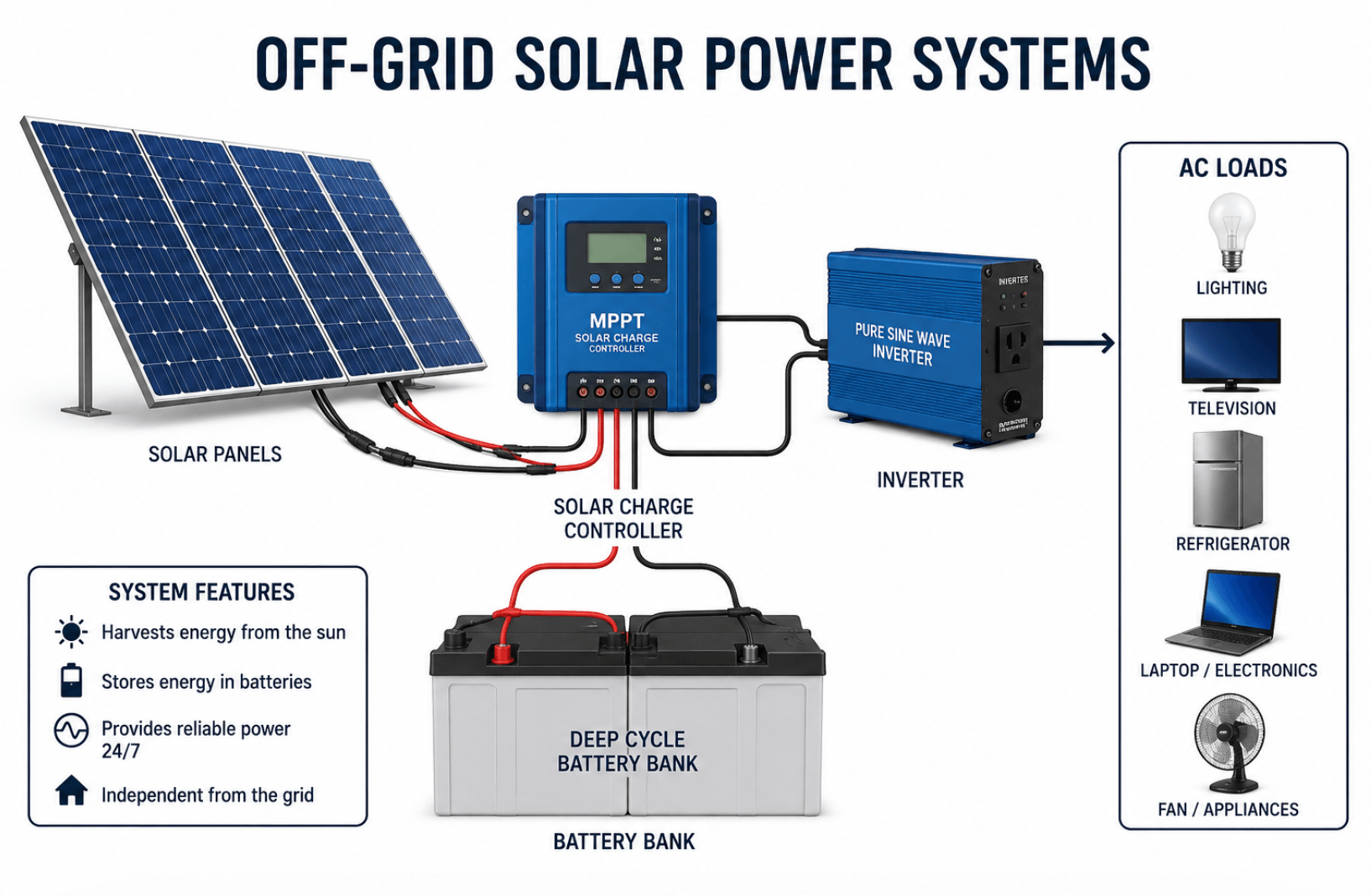
If you’ve ever imagined cutting ties with your utility company, generating your own electricity, and never worrying about another power bill, off-grid solar power systems are the technology that makes that possible.
But going off-grid isn’t as simple as slapping a few panels on your roof and calling it a day. It’s a carefully engineered system that requires the right components, thoughtful sizing, and a realistic understanding of what it can and cannot do.
In this guide, you’ll get a complete breakdown of how off-grid solar power systems work, what they actually cost, their honest advantages and disadvantages, and the real-world design insights that most beginner guides skip entirely.
What is an off-grid solar power system?
An off-grid solar power system, also called a standalone solar system, is a self-contained electricity generation and storage setup that operates completely independently of the public utility grid.
Unlike grid-tied solar systems, which send surplus electricity back to the grid and draw power from it at night or during cloudy weather, off-grid systems must generate, store, and manage 100% of the energy a home or facility needs. This makes battery storage and system sizing absolutely critical.
Off-grid solar is most common in.
- Rural properties and remote homesteads beyond the reach of grid infrastructure
- Cabins, ranches, and vacation homes are used seasonally
- Developing regions where grid access is unreliable or nonexistent
- Tiny homes, van conversions, and mobile off-grid living setups
- Emergency backup systems that operate independently of grid outages
How Off-Grid Solar Power Systems Work
Understanding the components is essential before you can design, purchase, or evaluate any off-grid system.
Solar Panels (PV Array)
Solar photovoltaic (PV) panels are the energy capture layer of the system. Each panel consists of silicon solar cells that convert sunlight into direct current (DC) electricity via the photovoltaic effect.
The panels are wired in series (to increase voltage), in parallel (to increase current), or in a combination of both, depending on your charge controller’s input requirements and your battery bank’s voltage.
Common panel configurations for off-grid systems
| System Voltage | Typical Panel Configuration |
|---|---|
| 12V | 1 panel in series |
| 24V | 2 panels in series |
| 48V | 4 panels in series |
The total wattage of your PV array must be sized to replenish your daily energy consumption while accounting for your local peak sun hours (PSH), a value that varies dramatically by geography.
Charge Controller
The charge controller is the brain of your off-grid solar power system. It sits between the solar panels and the battery bank and performs two critical jobs:
- Regulates charging voltage to prevent overcharging and battery damage
- Prevents reverse current from draining the batteries at night
There are two main types
PWM (Pulse Width Modulation)
Older, cheaper technology. Works best when the panel voltage closely matches the battery bank voltage. Suitable for small, budget-conscious systems.
MPPT (Maximum Power Point Tracking)
More advanced and significantly more efficient (up to 30% better energy harvest). Converts excess panel voltage into additional charge current. The clear choice for any system above 400W.
For most serious off-grid builds in 2024 and beyond, MPPT is the standard.
Battery Bank
The battery bank is where your harvested solar energy is stored for use when the sun isn’t shining, at night, on overcast days, and during extended low-light periods.
Battery selection is one of the most consequential decisions in any off-grid solar power system. Your main options:
Flooded Lead-Acid (FLA)
- Lowest upfront cost
- Requires regular water topping and equalization charges
- Shorter lifespan (3–7 years) and heavier weight
- Still widely used in off-grid applications due to price
Sealed AGM / Gel Lead-Acid
- Maintenance-free, can be installed in enclosed spaces
- Slightly better performance than FLA but similar lifespan
- Higher cost than FLA
Lithium Iron Phosphate (LiFePO₄)
- Longest lifespan (2,000–5,000+ charge cycles)
- Usable depth of discharge (DoD) up to 80–100% vs. 50% for lead-acid
- Lighter, faster charging, and more stable chemistry
- Significantly higher upfront cost, but often lower cost per kWh over time
Battery capacity is measured in amp-hours (Ah) and must be sized for your system voltage and your “days of autonomy,” how many consecutive cloudy days your system needs to survive without solar input.
Inverter
Since most household appliances run on alternating current (AC), you need an inverter to convert the DC electricity from your battery bank into usable AC power.
Pure sine wave inverters are the standard for off-grid homes. They produce clean AC output that is compatible with sensitive electronics, motors, and appliances, just like grid power.
Modified sine wave inverters are cheaper but incompatible with many modern devices. Not recommended for whole-home systems.
Many modern off-grid installations use a hybrid inverter/charger, a single unit that combines the inverter, battery charger, and sometimes a transfer switch that can accept input from a backup generator.
Backup Generator (Optional but Practical)
Most experienced off-grid dwellers also have a propane or diesel generator as a backup for extended cloudy periods or unexpected high-load situations.
A properly sized generator can recharge a depleted battery bank in a few hours and add a critical layer of reliability to the system.
How Power Flows Through an Off-Grid System
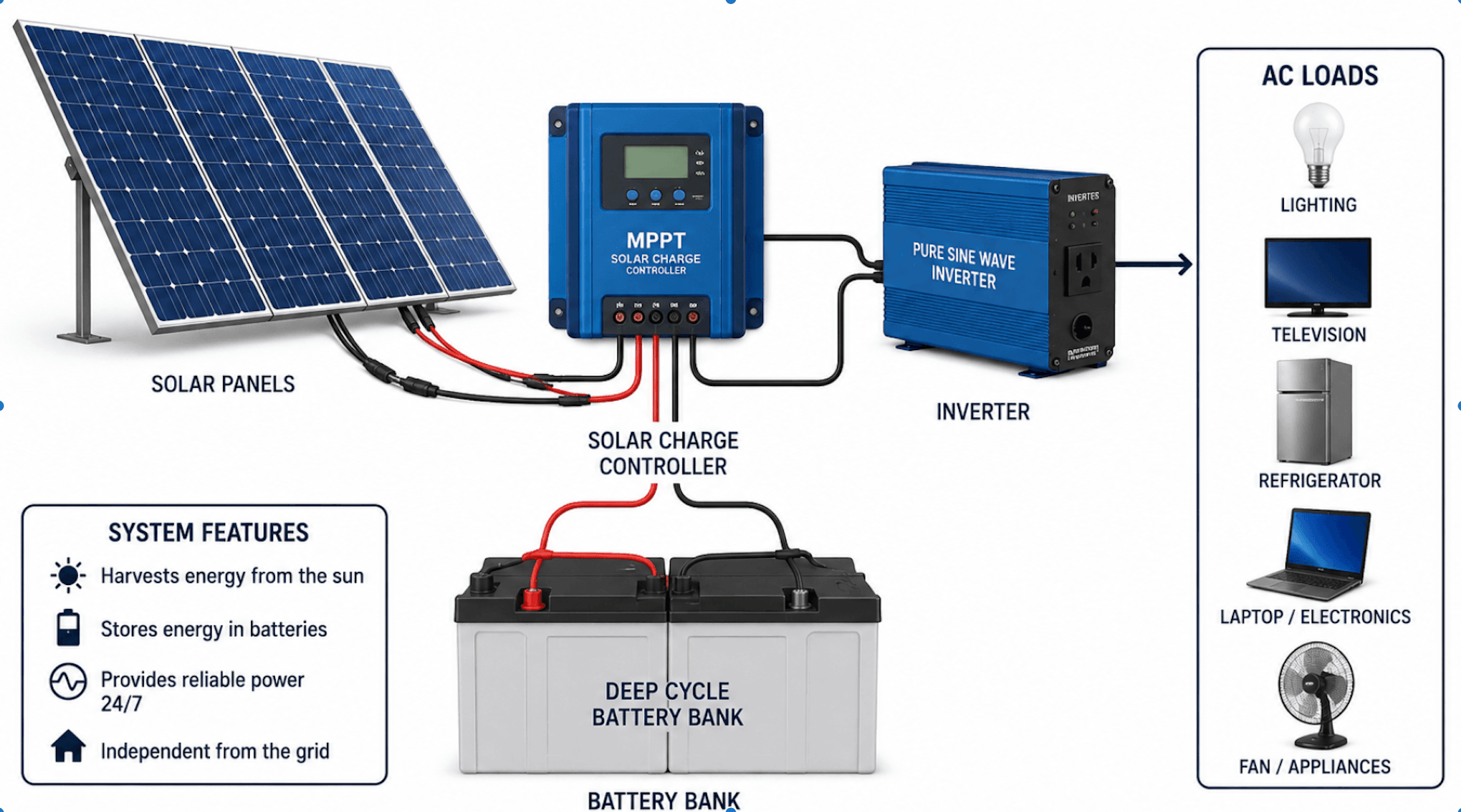
Here’s the basic energy flow from generation to consumption.
Sunlight → Solar Panels (DC electricity) → Charge Controller → Battery Bank (stored DC) → Inverter → AC Loads (lights, appliances, outlets).
At night or during low light
Battery Bank (stored DC) → Inverter → AC Loads
If a generator is connected
Generator (AC) → Inverter/Charger (rectifies to DC) → Battery Bank → Inverter → AC Loads
Off-Grid Solar Power System Costs
Cost is where reality meets enthusiasm. Off-grid solar power systems have a wide price range depending on system size, component quality, and whether you DIY or hire a professional installer.
Small Cabin or Weekend Property (1–3 kWh/day)
| Component | Estimated Cost |
|---|---|
| 400–800W Solar Panels | $300 – $700 |
| MPPT Charge Controller | $100 – $200 |
| Battery Bank (100–200Ah LiFePO4) | $700 – $1,500 |
| Pure Sine Wave Inverter (1000–2000W) | $200 – $500 |
| Wiring, Fuses, Mounting Hardware | $150 – $400 |
| Total (DIY) | $1,500 – $3,300 |
Mid-Size Off-Grid Home (5–10 kWh/day)
| Component | Estimated Cost |
|---|---|
| 2–4 kW Solar Array | $1,500 – $3,500 |
| MPPT Charge Controller (60–80A) | $250 – $600 |
| Battery Bank (400–600Ah LiFePO4 at 48V) | $4,000 – $9,000 |
| Inverter/Charger (3000–5000W) | $800 – $2,500 |
| Wiring, Breakers, Mounting | $500 – $1,200 |
| Installation (if professional) | $2,000 – $6,000 |
| Total | $9,000 – $22,800 |
Large Off-Grid Homestead (15–30+ kWh/day)
For properties running well pumps, HVAC, workshops, or multiple buildings, system costs typically range from $25,000 to $60,000+, depending on location, sun availability, and system redundancy requirements.
The Hidden Costs Most Buyers Underestimate
Battery replacement
Lead-acid batteries need replacement every 4–7 years. Factor this into your lifetime cost calculation.
Generator fuel and maintenance
A backup generator running 100–200 hours per year will cost $500–$1,500 annually in fuel and servicing.
Panel degradation
PV panels lose approximately 0.5–0.8% of output per year. Factor this into your 25-year system lifetime projections.
Monitoring and control equipment
Smart battery monitors, remote monitoring platforms, and automatic transfer switches add $200–$1,000 to a professional installation.
Pros of Off-Grid Solar Power Systems
Complete Energy Independence
You are not subject to utility rate increases, grid outages, or policy changes. In regions with high and rising electricity rates, this can represent enormous long-term savings.
Access to Power in Remote Locations
For properties where grid connection costs $20,000–$100,000+ in line extension fees, an off-grid solar system often pays for itself on day one in avoided infrastructure costs.
Reduced Long-Term Energy Costs
Once the system is paid off (typically 5–12 years depending on system size and local electricity rates), your electricity is essentially free for the life of the panels, 25+ years.
Environmental Benefits
Off-grid solar power systems produce zero operational carbon emissions. When paired with energy-efficient construction and appliances, they represent one of the lowest-footprint energy solutions available to residential consumers.
Resilience Against Grid Failures
With your own generation and storage, you’re completely unaffected by blackouts, grid attacks, or utility infrastructure failures. This is increasingly compelling as grid reliability becomes a concern in many regions.
No Monthly Electricity Bills
For full-time off-grid residents, eliminating the monthly utility bill is a significant quality-of-life and financial planning advantage.
Cons of Off-Grid Solar Power Systems
High Upfront Capital Cost
The cost of batteries, especially quality lithium iron phosphate systems, means off-grid solar has significantly higher upfront costs than a standard grid-tied system without storage.
Energy Management Requires Behavioral Change
Off-grid living means being aware of your energy budget. Running a clothes dryer, electric water heater, and electric stove simultaneously on a cloudy week is a recipe for a depleted battery bank. Conscious energy use is a lifestyle adjustment.
Battery Maintenance and Replacement
Even the best LiFePO₄ batteries have a finite lifespan. Lead-acid batteries require regular maintenance. Battery replacement is a real lifecycle cost that must be budgeted for.
Cloudy Periods and Seasonal Variation
In northern latitudes or cloudy climates, winter months with short days and frequent overcast can put serious strain on an off-grid system. Oversizing your array and battery bank or investing in a reliable backup generator is essential.
No Net Metering Benefits
Grid-tied solar users can sell surplus electricity back to the grid (where net metering exists). Off-grid systems produce no such financial return from excess generation.
Permitting and Insurance Complexity
Depending on your jurisdiction, off-grid systems may require building permits and electrical inspections and may complicate homeowner’s insurance. Some lenders are also reluctant to finance properties with off-grid electrical systems.
Real-World Design Insights
This is where most beginner guides fall short. Here are the practical, experience-driven design principles that make the difference between a system that performs and one that consistently disappoints.
Always Size Your System to Real Consumption, Not Wishful Thinking
One of the most common off-grid design mistakes is underestimating energy consumption. Don’t just list your appliances; measure them.
Use a plug-in energy monitor (Kill A Watt or similar) to measure your actual devices for a week.
Hidden energy hogs like refrigerators with worn door seals, older chest freezers, and well pumps with long run cycles can easily add 2–4 kWh/day that doesn’t appear in theoretical load calculations.
Design tip
Once you’ve calculated your daily load in kWh, add a 25% buffer before sizing your panels and battery bank. Systems designed to meet theoretical requirements consistently underperform.
Your Battery Bank Is the Bottleneck
Inexperienced off-grid buyers often over-invest in solar panels and under-invest in batteries. Panels are only useful if you have storage capacity to absorb what they produce.
A 5kW array charging a 100Ah lead-acid bank will waste the majority of its midday production because the bank fills too quickly.
Design tip
In most off-grid homes, the battery bank represents 40–60% of the total system budget. If you find yourself trying to cut costs by reducing battery capacity, cut elsewhere or delay the project until you can do it right.
Understand Your Local Peak Sun Hours (PSH)
PSH is not “hours of daylight.” It is the equivalent number of hours per day that your location receives 1,000 W/m² of solar irradiance, the standard test condition for panel ratings.
- Southern Mexico, Southwest USA, North Africa: 5.5–7.0 PSH
- Central Europe, Pacific Northwest: 3.0–4.5 PSH
- Far northern latitudes (winter): 1.0–2.5 PSH
A 1kW array produces ~5.5 kWh/day at 5.5 PSH and only ~3 kWh/day at 3 PSH. Ignoring this variable leads to catastrophic undersizing in practice.
Tool to use
NASA’s POWER data tool, or PVWatts Calculator, provides location-specific PSH data that you should always reference when sizing an off-grid system.
Design for Your Worst Month, Not Your Average
A common mistake is sizing an off-grid solar system to average annual production. Instead, identify your worst solar month (typically December or January in the northern hemisphere) and design your system to meet your load during that period.
If your December PSH is 3.5 and your July PSH is 6.5, your system must be capable of running on 3.5 PSH even if that means oversizing relative to summer production.
The 48V System Architecture Is Almost Always Worth It
Many beginners start with 12V systems because the components seem familiar (automotive batteries, cheap controllers).
But for any off-grid system above 1–2 kWh/day, a 48V system architecture offers significant advantages:
- Lower current for the same power (P = V × I), meaning thinner, cheaper wiring
- More efficient inverter operation
- Better compatibility with larger battery banks
- Future expansion is simpler and less costly
Rule of thumb
If your planned inverter is larger than 1,500W, design for 48V from the start.
Panel Orientation and Shading Are Non-Negotiable
A single shaded cell in a panel can reduce the output of an entire string by 50–75%, depending on bypass diode configuration. In off-grid systems where every watt matters, shading analysis isn’t optional.
- Use microinverters or DC power optimizers if partial shading is unavoidable
- In the northern hemisphere, mount panels facing true south (not magnetic south) at an angle approximately equal to your latitude
- Consider seasonal tilt adjustments (most effective in high-latitude installations)
Plan for Generator Integration from Day One
Even if you don’t want to run a generator often, design your system to accept one. A properly wired generator input through your inverter/charger allows emergency recharging during extended cloudy periods without rewiring. The incremental cost of including this capability upfront is minimal; retrofitting it later is expensive.
Invest in a Good Battery Monitor
A quality battery state-of-charge (SoC) monitor, like a Victron BMV-712 or a Renogy BT-2, is one of the highest-return investments in any off-grid system.
Without accurate SoC data, you are operating blind. You won’t know when to curtail loads, when the generator needs to run, or how your bank is degrading over time.
Is an Off-Grid Solar Power System Right for You?
Off-grid solar is the right choice when
- Your property is remote, and grid connection is expensive or unavailable
- You value energy independence and are willing to manage your consumption thoughtfully
- You can absorb a higher upfront cost in exchange for long-term energy autonomy
- Your location has adequate sunlight (4+ PSH annual average)
Off-grid solar is probably not the right choice when:
- You’re already grid-connected, and the economics of a simpler grid-tied system make more sense
- Your location has very low winter sun hours and high heating loads
- You need 100% uninterrupted power for medical equipment or mission-critical applications without a robust backup generator strategy
- Your budget forces you to undersize the battery bank significantly
Final Thoughts
Off-grid solar power systems represent one of the most transformative technologies available to homeowners, homesteaders, and anyone who values self-reliance.
When designed correctly with honest load calculations, properly sized batteries, and realistic expectations about seasonal variation, they perform reliably for decades.
The key is going in with your eyes open. The upfront cost is real. The lifestyle adjustments are real. The battery lifecycle costs are real.
But so is the freedom of generating your own power, the protection from utility rate increases, and the deep satisfaction of living independently of infrastructure systems that most people never question.
Whether you’re designing a 400W cabin system or a 20kW homestead installation, the principles in this guide give you the foundation to make informed, confident decisions.

1 thought on “Off-Grid Solar Power Systems: How They Work, Real Costs, Pros, Cons & Design Insights”