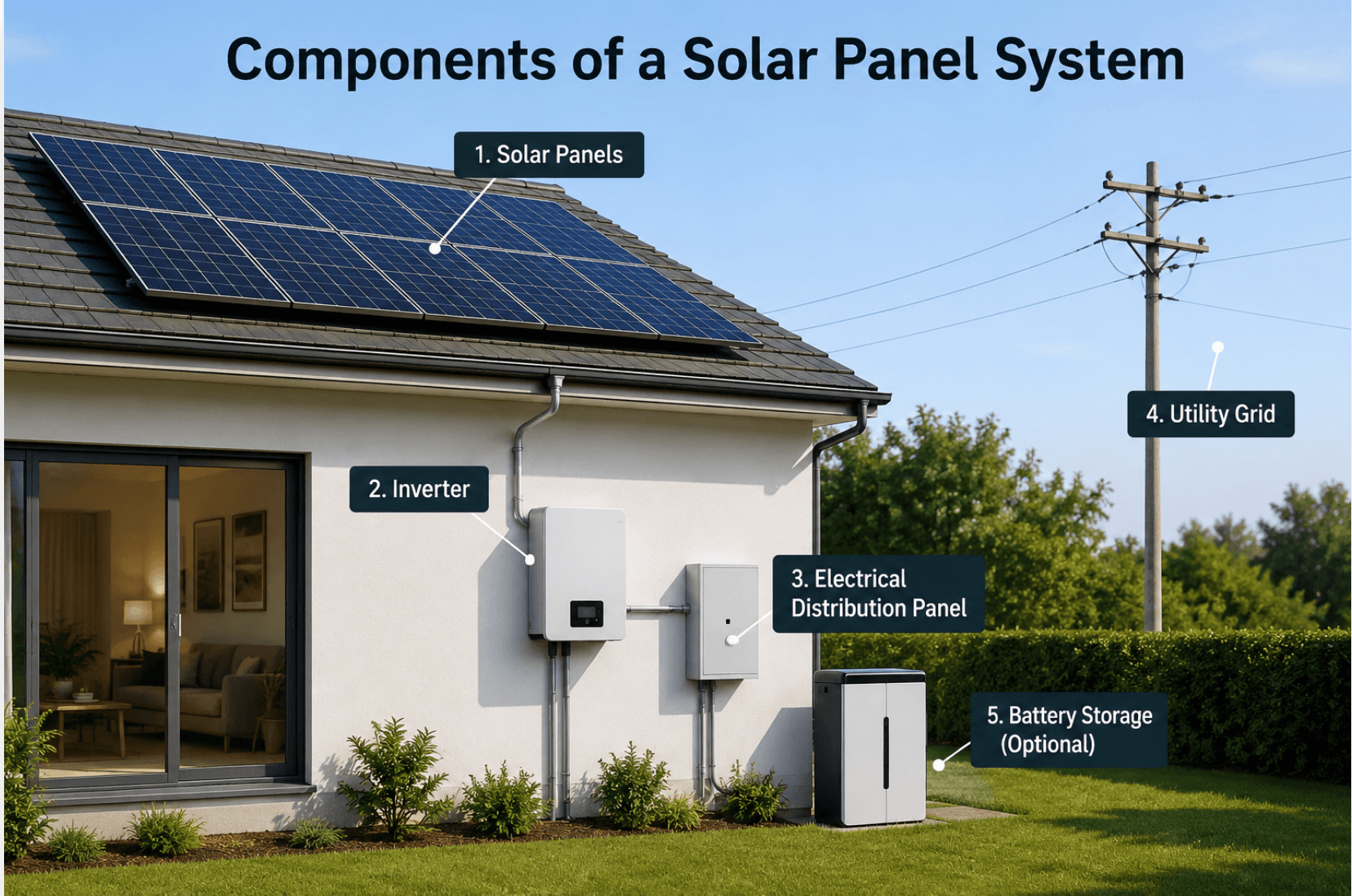
When most people picture a solar setup, they imagine the blue or black rectangles sitting on a roof. But those panels are only one piece of a much larger machine.
Understanding the full set of solar panel components helps you size a system correctly, troubleshoot problems, and avoid overpaying for parts you don’t need.
This guide breaks down every major component of a residential or small-commercial solar power system, what each does, and how the pieces work together to convert sunlight into usable electricity.
What Are the Main Components of a Solar Panel System?
A complete solar power system is made up of seven core component groups:
- Solar panels (PV modules)
- Solar inverter
- Charge controller (for battery systems)
- Battery storage (optional)
- Mounting and racking hardware
- Wiring, connectors, and combiner boxes
- Monitoring and metering equipment
Some systems, like a simple grid-tied setup, skip the charge controller and batteries entirely. Others, like off-grid cabins, rely heavily on them.
The right mix depends on whether you’re connecting to the utility grid, storing energy, or both.
Solar Panels (PV Modules)
The solar panel, or photovoltaic (PV) module, is the part that captures sunlight and converts it into direct current (DC) electricity. Each panel is built from smaller units called solar cells, usually made of crystalline silicon.
There are three common cell types.
Monocrystalline
Highest efficiency (typically 19–23%) and a sleek black appearance. Best for limited roof space.
Polycrystalline
Slightly lower efficiency and a bluish tint, but usually cheaper per watt.
Thin-film
Lightweight and flexible, with lower efficiency. Common in specialty and large-scale applications.
A single panel is rated in watts (commonly 350–450W for residential modules). Multiple panels wired together form a solar array, which determines your system’s total generating capacity.
Solar Inverter
The inverter is arguably the most important component after the panels themselves. Panels produce DC electricity, but your home and the grid run on alternating current (AC). The inverter converts DC into usable AC power.
There are three main inverter types.
String inverters
One central unit handles a whole string of panels. Affordable and reliable, but if one panel underperforms (from shade or dirt), the whole string drops.
Microinverters
A small inverter is mounted on each panel, so every panel operates independently. Better for roofs with shading or multiple orientations.
Power optimizers
A hybrid approach: each panel gets an optimizer, but a central string inverter still does the DC-to-AC conversion.
The inverter also handles safety functions, grid synchronization, and (in many models) system monitoring.
Charge Controller
A charge controller is only needed in systems with battery storage. It sits between the panels and the batteries, regulating the voltage and current flowing into the batteries to prevent overcharging and damage.
There are two technologies.
PWM (Pulse Width Modulation)
Simpler and cheaper, best for small systems where panel and battery voltages are closely matched.
MPPT (Maximum Power Point Tracking)
More efficient and more expensive. MPPT controllers can extract up to 30% more energy by continuously adjusting to the panel’s optimal operating point. Recommended for most modern off-grid and hybrid systems.
Battery Storage
Batteries store excess energy for use at night or during outages. They’re essential for off-grid systems and increasingly popular in grid-tied setups for backup power and energy independence.
Common battery chemistries include.
Lithium iron phosphate (LiFePO₄)
The current standard for home storage: long lifespan, deep-discharge capability, and minimal maintenance.
Lead-acid
Cheaper upfront but heavier, shorter-lived, and requires more maintenance.
Key specs to compare are usable capacity (kWh), depth of discharge (DoD), round-trip efficiency, and cycle life.
Mounting and Racking Hardware
Mounting hardware physically secures your panels to a roof or the ground and sets the correct tilt angle for maximum sun exposure.
Quality racking is critical; it must withstand wind, snow, and decades of weather without corroding or loosening.
Main options include.
Roof mounts
Attached to rafters with flashing to keep the roof waterproof.
Ground mounts
Free-standing frames, ideal when roof space or orientation isn’t suitable.
Tracking mounts
Motorized systems that follow the sun across the sky for higher output, at higher cost and complexity.
Wiring, Connectors, and Combiner Boxes
The “plumbing” of a solar system ties everything together. This includes:
DC and AC wiring
Rated for outdoor and high-temperature use.
MC4 connectors
The industry-standard weatherproof connectors that link panels together.
Combiner boxes
Consolidate multiple panel strings into a single output and house fuses or breakers.
Disconnect switches
Required by code to safely isolate the system for maintenance.
Proper wiring and overcurrent protection are not optional—they’re central to system safety and electrical code compliance.
Monitoring and Metering
Modern systems include monitoring hardware (often built into the inverter) that tracks energy production, consumption, and system health through an app or web dashboard.
Grid-tied systems also use a bi-directional meter (or net meter), which records both the electricity you draw from the grid and the surplus you send back, the basis for net metering credits in many regions.
How the Components Work Together
Here’s the energy flow in a typical system.
- Panels capture sunlight and produce DC electricity.
- In battery systems, a charge controller routes power safely to batteries.
- The inverter converts DC to AC for household use.
- Excess power flows to the grid through the meter or into storage.
- Monitoring tracks the whole process so you can spot issues early.
Each component must be properly sized and matched. An undersized inverter, for example, can bottleneck an otherwise powerful array.
Frequently Asked Questions
What is the most important component of a solar panel system?
The panels generate the power, but the inverter is the system’s brain, handling conversion, safety, and grid interaction. Both are equally critical to a functioning system.
Do all solar systems need a charge controller?
No. Charge controllers are only required when batteries are present. Standard grid-tied systems without storage don’t use one.
Can I add batteries to an existing solar system later?
Often, yes, but it depends on your inverter. Hybrid (or “battery-ready”) inverters make retrofitting easy. A standard string inverter may require additional equipment or replacement.
How long do solar panel components last?
Panels typically carry 25-year warranties. Inverters last 10–15 years, and modern lithium batteries last 10–15 years. Mounting hardware can last the life of the system.
Final Thoughts
A solar power system is far more than the panels on the roof. From the inverter that powers your home to the racking that holds everything in place, every component plays a role in safe, efficient, long-lasting energy production.
Knowing what each part does puts you in a stronger position to design a system, evaluate a quote, or troubleshoot performance, whether you’re going grid-tied, off-grid, or hybrid.
