When I first started building out my solar setup, I made a costly mistake: I wired my batteries without fully understanding how the configuration would affect my system’s performance.
After a lot of trial, error, and research, I now have a solid grasp of solar batteries in series vs. parallel, and I want to save you the headache I went through.
Whether you’re powering an RV, an off-grid cabin, a boat, or a backup energy system, the way you connect your solar batteries will determine everything: your voltage, your runtime, your wiring needs, and how efficiently your whole setup runs. Let me break it all down for you in plain language.
What’s the Difference Between Solar Batteries in Series vs. Parallel?
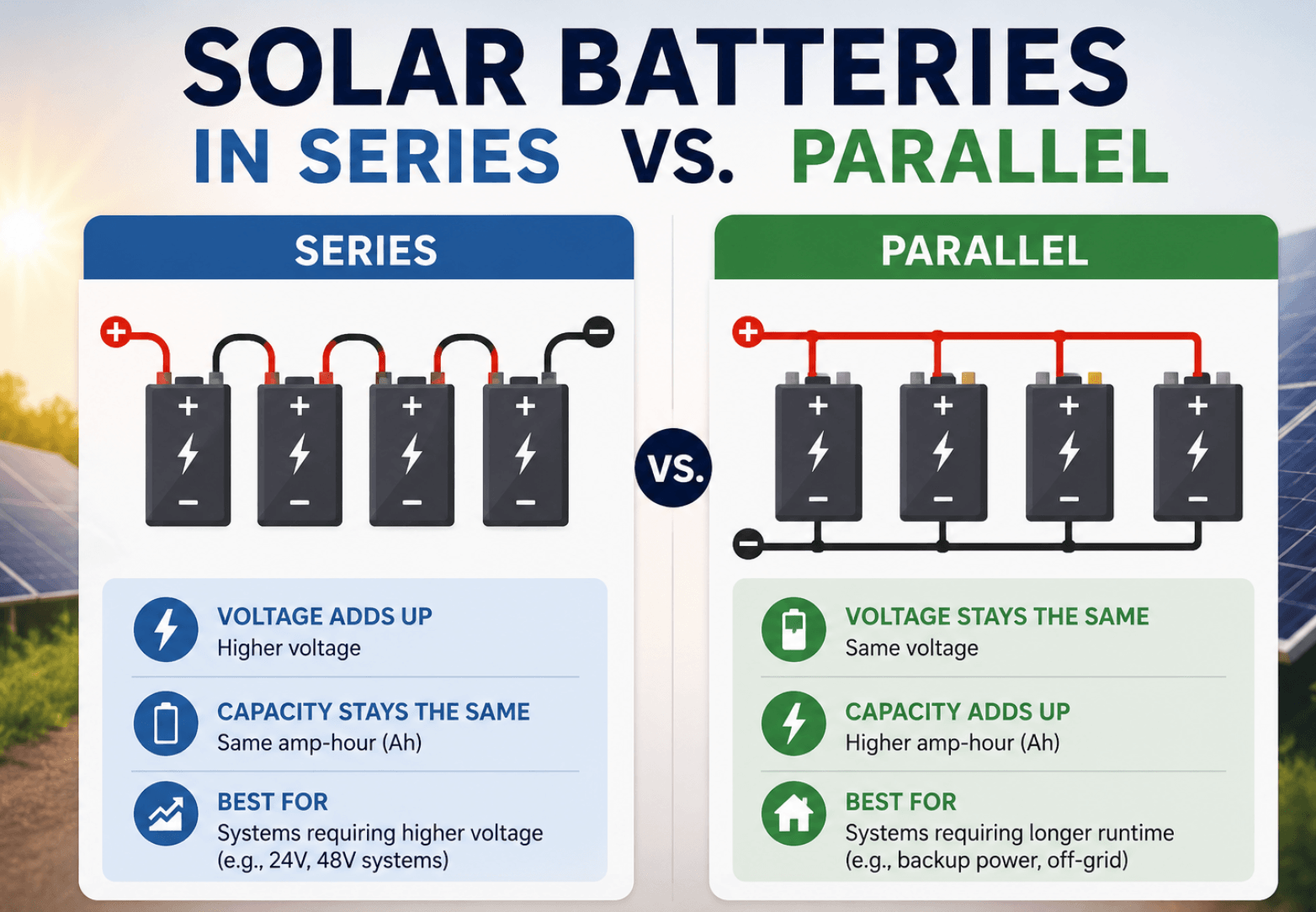
Here’s the most important thing to understand: wiring solar batteries in series increases your voltage, while wiring them in parallel increases your capacity (measured in amp-hours). The total energy measured in watt-hours stays the same in both configurations.
I like to think of it this way: series is like stacking batteries end-to-end to make them “taller” (more voltage), while parallel is like laying them side by side to make them “wider” (more capacity).
Here’s a real-world example that made it click for me: take two 12-volt, 100 Ah batteries.
- Wired in series: 24 volts, 100 Ah → 2,400 watt-hours total
- Wired in parallel: 12 volts, 200 Ah → 2,400 watt-hours total
Same total energy, different delivery. Which is better for you depends on your specific setup, and I’ll explain exactly how to figure that out.
One more critical rule I learned: always use batteries with the same voltage and capacity rating in any battery bank.
Mixing different batteries can cause uneven charging, overheating, and premature battery failure. I made this mistake early on, and it cost me two batteries.
How to Wire Solar Batteries in Series
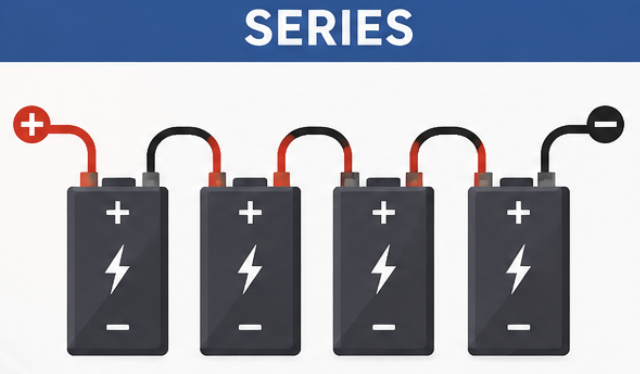
Wiring solar batteries in series is straightforward once you visualize it. You connect the positive terminal of one battery to the negative terminal of the next.
Keep daisy-chaining until you’ve connected all batteries in the bank. Then measure the total output voltage between the negative terminal of the first battery and the positive terminal of the last.
Quick examples:
- Two 12V, 100 Ah batteries in series = 24V system at 100 Ah
- Three 12V, 100 Ah batteries in series = 36V system at 100 Ah
Each battery you add in series adds its voltage to the total, but the amp-hour capacity stays fixed at the rating of a single battery.
Advantages of Wiring Solar Batteries in Series
Higher voltage is where the real efficiency gains are. Since power equals voltage multiplied by current (P = V x I), a higher voltage system draws less current to deliver the same power.
Less current means you can use thinner, cheaper wiring, and you lose less energy to voltage drop over long cable runs.
Here’s the example that really opened my eyes: a 360-watt device operating at 12 volts draws 30 amps. That same device at 24 volts only draws 15 amps.
That’s half the current, which makes a huge difference in your wiring requirements and system efficiency.
Solar charge controllers tell the same story. An MPPT controller rated at 50 amps can only handle 600 watts of solar panels at 12V.
But at 24V, that same controller can handle 1,200 watts. If you’re building a larger solar array, going series almost always makes sense.
Disadvantages of Wiring Solar Batteries in Series
The main downside I ran into personally was compatibility. When I had a 24V battery bank, I couldn’t directly run my 12V appliances without adding a DC-DC converter.
If most of your equipment runs at 12V, a series configuration creates extra complexity and cost. You’ll need to either ensure all your devices are rated for the higher voltage or invest in a quality converter.
How to Wire Solar Batteries in Parallel
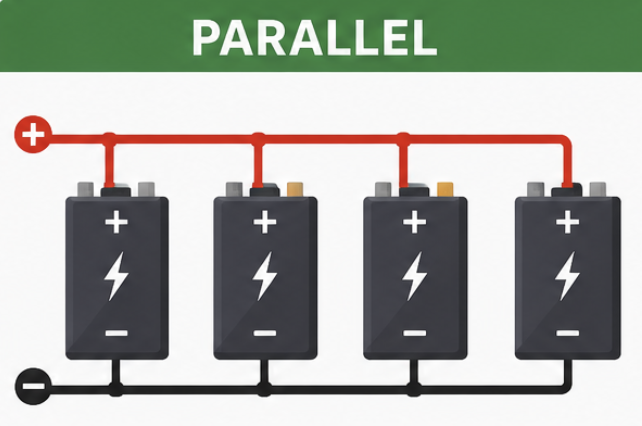
Wiring solar batteries in parallel is just as simple, but it works in the opposite direction. You connect all positive terminals and all negative terminals.
Since all terminals at the same polarity are linked, you can measure the output voltage from any positive-to-negative combination; they’ll all read the same.
Quick examples
- Two 12V, 100 Ah batteries in parallel = 12V system at 200 Ah
- Three 12V, 100 Ah batteries in parallel = 12V system at 300 Ah
Advantages of Wiring Solar Batteries in Parallel
The number one advantage of a parallel configuration is extended runtime. Every battery you add doubles, triples, or quadruples the total amp-hour capacity.
If your system currently lasts four hours on a single battery, two batteries in parallel give you eight hours at the same voltage.
There’s also a resilience advantage I really appreciate. If one battery in a parallel bank fails or underperforms, the rest of the bank can continue supplying power.
Your system doesn’t go dark just because one battery has an issue. That redundancy is valuable in off-grid situations where replacing a battery isn’t always quick or easy.
Parallel is also the simpler choice for most boat and RV setups. If all your equipment runs at 12V, wiring batteries in parallel keeps everything compatible without needing converters or voltage step-downs.
Disadvantages of Wiring Solar Batteries in Parallel
The main drawback is the higher current draw that comes with lower voltage. At 12V, your cables carry more amps, which means you need thicker (more expensive) wire and better fusing.
Voltage drop over long cable runs is also a bigger concern. For high-power applications, think systems above 3,000 watts. The extra current load in a parallel setup becomes a real engineering challenge.
Another thing to be aware of: as you add more batteries in parallel, the total available current increases dramatically.
This makes proper fusing absolutely critical. An accidental short in a large parallel bank can be dangerous. There’s an enormous amount of energy available to flow through that fault.
How Many Solar Batteries Can You Wire in Series?
This depends on your battery manufacturer’s specifications. For example, Battle Born allows up to four of their lithium batteries in series, creating a 48V system, which is commonly used in larger solar setups and off-grid home systems.
Always check your manufacturer’s documentation before exceeding their recommended limit. Going beyond spec can void your warranty and, more importantly, damage your batteries.
How Many Solar Batteries Can You Wire in Parallel?
Technically, there’s no hard limit on parallel connections. The more batteries you add, the more capacity and runtime you gain.
In practice, very large parallel banks require careful planning. Charging times increase with every battery added, and you need robust fusing and balanced cable runs to ensure each battery charges and discharges evenly.
I always recommend using equal-length cables when connecting batteries in parallel. Unequal cable lengths create unequal resistance, which means some batteries work harder than others, leading to uneven wear and shorter overall battery life.
Can You Wire Solar Batteries in Both Series AND Parallel?
Yes, and this is actually how many larger solar battery banks are built. You cannot wire the same batteries in both series and parallel simultaneously (that would short the system), but you can wire sets of batteries in series, then connect those sets in parallel.
For example, take two pairs of 12V batteries wired in series, each pair becomes a 24V “unit.” You then wire those two 24V units in parallel.
The result is a 24V system with double the amp-hour capacity. Think of each series set as a single super-battery, and then connect those super-batteries in parallel.
The key rule
Every parallel group must have the same voltage. If one set is 24V and another is 12V, connecting them in parallel will cause serious damage.
Charging Solar Batteries in Series vs. Parallel
As long as you’re using the correct charger voltage, charging works essentially the same in both configurations.
The key is ensuring your charger matches the system voltage: a 24V charger for a series bank, a 12V charger for a parallel bank.
For series charging: connect the positive charger cable to the positive terminal of the first battery, and the negative cable to the negative terminal of the last battery in the series chain.
For parallel charging, the same approach works best positive to the first battery, negative to the last. This ensures the charge is distributed evenly across the bank rather than being concentrated at one end.
For very large battery banks, a multi-bank charger can significantly reduce charging times. Always follow your battery manufacturer’s charging guidelines. Lithium batteries, in particular, have specific charge profiles that should be respected.
FAQ: Do Solar Batteries Last Longer in Series or Parallel?
This is one of the most common questions I get asked, and the honest answer is: it’s roughly the same.
Series connections operate at higher voltage, which is slightly more efficient, giving series-connected batteries a marginal edge in runtime. But in practice, the difference is minimal when both configurations are properly built.
Here’s the math that shows why.
Imagine two 12V, 100 Ah batteries powering a 240-watt device.
- In series: 24V, 100 Ah. Current draw = 10A. Runtime = 100 Ah ÷ 10A = 10 hours
- In parallel: 12V, 200 Ah. Current draw = 20A. Runtime = 200 Ah ÷ 20A = 10 hours
Same runtime. The configuration doesn’t change the total energy available. It just changes how that energy is delivered.
Battery longevity over time depends much more on charge habits, depth of discharge, temperature, and battery quality than on whether you’ve wired the series or parallel.
Solar Batteries in Series vs. Parallel: Which Configuration Is Right for You?
Based on my own experience and everything I’ve researched, here’s my simple framework:
- Choose series if: you’re running a large solar array (over 600W), you want thinner wiring, or your devices support higher voltages like 24V or 48V.
- Choose parallel if: all your appliances run at 12V, you want maximum runtime, you want redundancy in case a battery fails, or you’re in a simpler setup like a camper or small boat.
- Choose series-parallel if: you need both higher voltage and more capacity, common in home off-grid systems and large RV solar setups.
Whatever you choose, plan your system carefully before you buy anything. Map out your power needs, your solar array size, your charge controller specs, and the voltage your devices require.
Getting the right configuration from the start saves you money, protects your batteries, and makes your solar setup far more reliable.
Have questions about your specific setup? Drop them in the comments below. I answer everyone.
