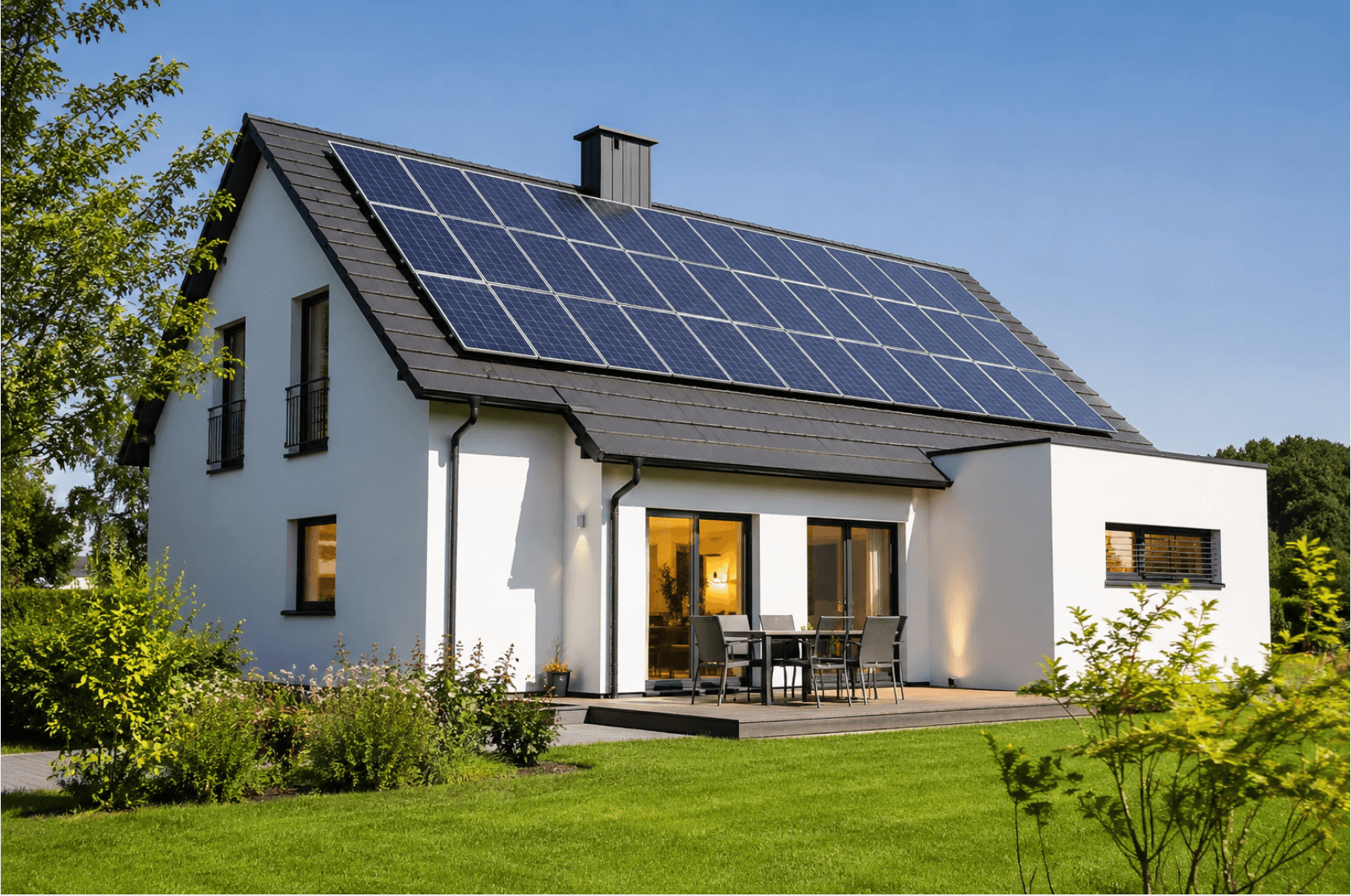
I’ve designed and installed solar systems, and I’ve also lived with one. So when people ask me what a house with solar panels is actually like, I don’t give them the brochure answer.
I tell them what changes the day the system switches on, what the salesperson glossed over, and where the real money and headaches are.
This is that walkthrough. If you’re researching solar before committing tens of thousands of pesos (or dollars) to your roof, read this first.
What Actually Changes When You Put Solar on a House
A house with solar panels isn’t just a house with shiny rectangles on the roof. Five things change at once:
Your roof becomes a power plant
Panels (modules) convert sunlight into DC electricity. A typical residential system runs 4 kW to 10 kW depending on roof space and consumption.
An inverter shows up somewhere
This is the brain of the system; it converts DC from the panels into the AC your home actually uses. It usually lives on a wall in the garage, utility room, or an exterior shaded spot. You’ll hear a faint hum and see a small display or app showing live production.
Your meter starts running backwards (sometimes)
Under net metering arrangements, excess power you don’t use flows back to the grid and credits your bill.
In Mexico, under CFE’s net metering contract for systems under 0.5 MW, this is how most homes offset their consumption.
Your electricity bill changes shape, not just size
You don’t usually go to zero. You shift from “paying for kWh” to “paying for the gap your panels didn’t cover plus fixed charges.”
You inherit a maintenance item
It’s light, but it’s not zero, and I’ll cover it below.
The Three System Types (And Which One Your House Probably Needs)
This is where most homeowners get confused, so here’s the engineer’s plain version.
Grid-tied (the default)
Connected to the utility, no batteries. Cheapest, highest return, simplest. When the grid goes down, so does your system (anti-islanding safety). This is what 80%+ of urban homes should install.
Hybrid (grid + battery)
Same grid connection, but with battery storage so you keep power during outages and can store cheap/excess energy. Costs more, payback is longer, but it’s worth it if your area has frequent blackouts.
Off-grid (no utility at all)
Batteries are mandatory, and the system must cover 100% of your needs with a margin. Only makes sense for remote homes where a grid connection is expensive or impossible.
Most homes asking “Should I get solar?” want grid-tied. If a salesperson is pushing batteries on a home with a stable grid, ask them to justify the payback math.
What Output to Actually Expect
Here’s where I see the most disappointment. A “5 kW system” does not produce 5 kW all day. That’s the peak under ideal sun.
A realistic rule of thumb: in a sunny region (much of Mexico, the US Southwest, southern Europe), each 1 kW of installed panels produces roughly 4 to 6 kWh per day, averaged across the year. So a 5 kW system yields maybe 20–30 kWh daily, but it dips on cloudy days and in winter.
Three things quietly steal your output.
Orientation and tilt
South-facing (in the Northern Hemisphere) at a tilt near your latitude is ideal. East/west costs you 10–20%.
Shade
Even partial shade on one panel can drag down a whole string, depending on wiring and whether you have optimizers/microinverters.
Dust and soiling
In dry, dusty climates, this is real. I’ve measured 5–15% losses on panels that hadn’t been cleaned in months.
The Cost and Payback Reality
I won’t quote a single number because pricing varies wildly by country, incentives, and roof complexity, so verify current local pricing before you budget. But the structure of the math is universal:
- Upfront cost = equipment + installation + permits/interconnection.
- Annual savings = the electricity you no longer buy (this is where high-tariff homes win big; if you’re in CFE’s DAC tariff, solar pays back fast).
- Payback period = upfront cost ÷ annual savings, typically landing in the 3–7 year range for a well-sized grid-tied system in a sunny area.
- Everything after payback is effectively free electricity for the remaining 20+ years of panel life.
The single biggest lever on your payback is your current tariff. The more you pay per kWh today, the faster solar pays for itself. Run your own numbers against your last 12 months of bills, not a generic estimate.
Living With It: Maintenance Most People Get Wrong
A house with solar panels is low-maintenance, not no-maintenance. From the field:
Cleaning
Rain handles most of it. In dusty or dry seasons, a gentle rinse a few times a year recovers lost output. Don’t scrub with abrasives or spray cold water on hot panels.
Inverter
This is the component most likely to fail first, with a typical lifespan of 10–15 years versus 25+ for panels. Budget for one replacement over the system’s life.
Monitoring
Check the app monthly. A sudden production drop usually means shading, soiling, or a tripped inverter; catch it early.
Inspection
A visual check of mounting, wiring, and connections every year or two prevents the rare but expensive problems.
Mistakes I See Homeowners Make
After enough installs, the same errors repeat.
Oversizing to “go fully green.”
Under net metering, banking huge surpluses you can’t use is often wasted money. Size to your actual consumption.
Ignoring the roof condition
If your roof needs replacing in 5 years, do it before you mount panels. Removing and reinstalling a system is pure cost.
Choosing the cheapest installer
Bad wiring, undersized cable, and sloppy mounting cause most long-term failures, not the panels themselves.
Not reading the interconnection contract
Understand exactly how your utility credits exported energy before you sign.
So, Should Your House Have Solar Panels?
If you own your home, have a reasonable roof, get decent sun, and pay a meaningful electricity bill, the answer is usually yes.
A grid-tied system is one of the few home upgrades that pays you back and keeps paying. The cases where I’d pause: a roof near end-of-life, heavy unavoidable shade, very low electricity bills, or plans to move within a couple of years.
The smartest first step costs nothing: pull your last 12 electricity bills, total the kWh, and that tells you the size of the system your house actually needs. Everything else follows from that number.
