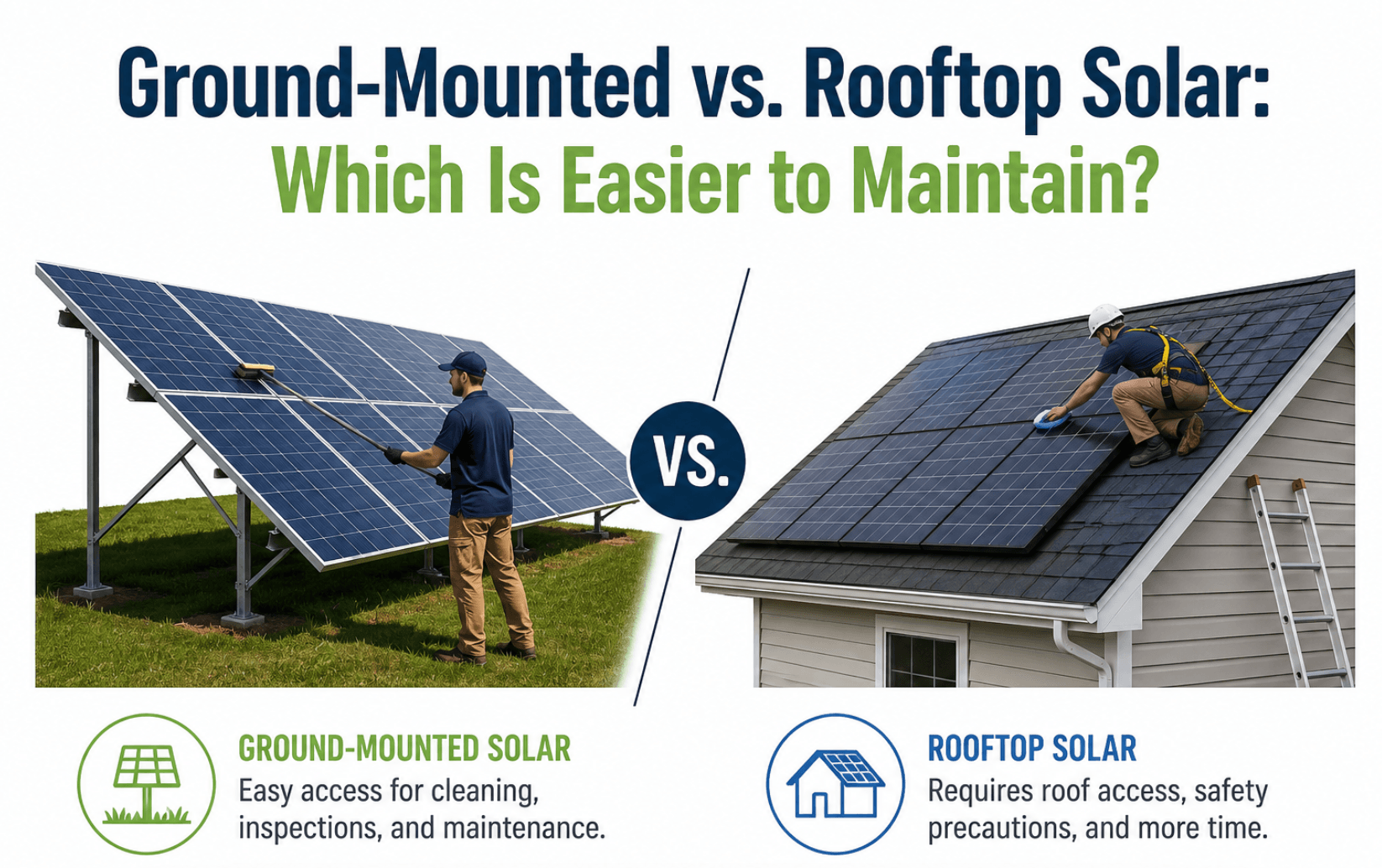
You’ve made the smart decision to go solar, but now comes a question that often gets overlooked during the buying process: which type of solar installation is actually easier to maintain over the long haul?
Whether you’re choosing between a ground-mounted array in your backyard or panels bolted to your rooftop, maintenance is a hidden cost and time commitment that deserves serious thought.
A poorly maintained solar system can lose 20–30% of its energy output, meaning your ROI takes a hit every single month.
In this guide, we break down the maintenance realities of both systems: cleaning, inspection access, repair complexity, weather durability, and total long-term costs so you can make the right choice for your property, lifestyle, and budget.
What “Solar Maintenance” Actually Involves
Before diving into the comparison, it helps to understand what routine solar maintenance actually entails. Both system types require:
Cleaning
Dust, bird droppings, pollen, and debris reduce light absorption and lower energy output.
Visual inspections
Checking for cracked glass, loose wiring, corrosion, or physical damage.
Inverter monitoring
Inverters are the most failure-prone component and need periodic checks.
Structural integrity checks
Racking and mounting hardware must stay tight and rust-free.
Performance monitoring
Comparing actual vs. expected kWh output to catch hidden issues early.
The difference lies in how hard each of these tasks is, depending on where your panels are installed.
Ground-Mounted Solar: Maintenance Overview
Ground-mounted solar panels sit on a freestanding structure, either fixed-tilt or on a solar tracker installed at ground level somewhere on your property.
Ease of Access: A Major Advantage
This is where ground-mounted systems shine. Because the panels are at or near ground level, you can.
- Walk up to the array without ladders or safety equipment
- Visually inspect every panel from multiple angles
- Hose down or manually scrub panels without risk of falling
- Identify physical damage, shading, or soiling immediately
For residential owners, farmers, or rural landowners, this accessibility is a game-changer. You can clean your panels on a Saturday morning the same way you’d wash your car, no professional required.
Cleaning Frequency and Method
Ground-mounted arrays often accumulate more dust and debris than rooftop systems because they sit lower to the ground (closer to soil, grass clippings, and ground-level airborne particles). However, because access is easy, cleaning is also faster and cheaper.
Recommended cleaning frequency
Every 1–3 months, depending on your local environment. Desert climates and agricultural areas with heavy dust may require monthly cleaning.
Read more: How to clean solar panels
DIY-friendly methods
- Garden hose with soft spray nozzle (early morning is ideal)
- Soft-bristled brush with deionized or distilled water
- Automated panel cleaners (more common on large commercial arrays)
Repairs and Component Replacement
If a panel cracks or a junction box fails, replacing it on a ground-mounted system is relatively straightforward.
A technician doesn’t need roof access equipment, and in many cases, a single worker can manage the job. This typically reduces labor costs for repairs.
Trackers (if your system uses single-axis or dual-axis trackers) add mechanical complexity that rooftop systems don’t have.
Motors, pivot points, and sensors require periodic lubrication and calibration, usually annually.
Structural Inspection
Ground-mounted racking is embedded in concrete footings or driven into posts. Over time, you’ll want to check the following.
- Post corrosion (especially in coastal or high-humidity regions)
- Footing integrity after freeze-thaw cycles
- Fastener tightness on the racking frame
These inspections are easy to do yourself with a visual walkthrough and a torque wrench once a year.
Ground-Mounted Maintenance: Summary
| Factor | Ground-Mounted |
|---|---|
| Access | Easy, no ladders needed |
| Cleaning effort | Moderate (more debris, but easy to clean) |
| Repair complexity | Low |
| Inspection difficulty | Low |
| Tracker maintenance | Additional (if applicable) |
| DIY-friendly? | Yes |
Rooftop Solar: Maintenance Overview
Rooftop solar is the most common residential installation type. Panels are mounted directly on your roof, either flush or slightly elevated on a tilt rack.
Ease of Access: The Core Challenge
Rooftop solar maintenance is inherently more difficult and potentially dangerous. To clean or inspect your panels, you either need to.
- Climb onto your roof safely using appropriate ladders and footwear
- Hire a professional solar maintenance company
- Use an extension-pole cleaning brush from the ground (limited effectiveness)
For steep or high roofs, DIY cleaning is genuinely risky. Falls from roofs are among the leading causes of home improvement injuries.
Many homeowners with rooftop systems end up paying for professional cleaning 1–2 times per year simply because the access problem is too real to ignore.
Cleaning Frequency and Method
Rooftop panels typically accumulate less ground-level debris, but rainfall alone is rarely enough to keep them clean, especially in low-rainfall climates.
Bird droppings are a persistent issue, and in high-pollen seasons, a fine coating of organic residue can build up quickly.
Recommended cleaning frequency
Every 2–4 months, or after significant dust storms, wildfire smoke events, or bird activity.
Rooftop cleaning methods
- Hire a professional solar cleaning company ($150–$350+, depending on system size)
- Use an extension wand with a soft brush and water from the ground (works for low-pitch roofs)
- Schedule cleaning with your general roof maintenance visits
Repairs and Component Replacement
Rooftop solar repairs are more expensive primarily because of access costs. Any technician working on your roof needs to.
- Proper fall protection equipment
- Potentially two workers for safety
- Possible roof-walking damage mitigation (some roofing materials don’t handle foot traffic well)
A cracked panel on a rooftop system will cost more to replace than the same repair on a ground-mounted system, simply due to elevated labor costs.
Additionally, rooftop installations carry a unique risk: roof penetrations. Every bolt anchoring your racking system creates a potential water intrusion point.
If your roof is aging or the flashing isn’t maintained, leaks can develop, an issue ground-mounted systems never face.
Rooftop + Roof Maintenance Intersection
One often-overlooked maintenance burden: if you need to replace your roof while solar panels are installed, they must be removed and reinstalled.
This can cost $1,500–$6,000+, depending on system size, and is an expense unique to rooftop installations.
Structural Inspection
Rooftop solar adds weight to your roof structure, typically 2–4 lbs per square foot. Inspecting the racking, flashing, and anchor points requires roof access and ideally an eye for water damage indicators around penetrations (staining, soft spots in the decking, etc.).
Most homeowners schedule this inspection as part of an annual roof check, either with a solar technician or a licensed roofer.
Rooftop Maintenance: Summary
| Factor | Rooftop Solar |
|---|---|
| Access | Difficult, requires ladders/professionals |
| Cleaning effort | Moderate-High (less debris, but access is harder) |
| Repair complexity | Moderate-High (access and roof penetration concerns) |
| Inspection difficulty | Moderate |
| Roof penetration risk | Yes, flashing must be monitored |
| DIY-friendly? | Partially (low-pitch roofs only) |
Head-to-Head Comparison: Ground-Mounted vs. Rooftop Solar Maintenance
| Maintenance Factor | Ground-Mounted | Rooftop |
|---|---|---|
| Physical access | ✅ Easy | ⚠️ Difficult/Risky |
| DIY cleaning | ✅ Yes, easily | ⚠️ Possible only on low-pitch roofs |
| Professional cleaning cost | Lower | Higher |
| Repair labor cost | Lower | Higher |
| Structural inspection | ✅ Simple | ⚠️ Requires roof access |
| Roof damage risk | ✅ None | ⚠️ Penetration leak risk |
| Debris accumulation | Slightly higher | Slightly lower |
| Tracker maintenance | ⚠️ Required if applicable | ✅ Not applicable |
| Panel replacement ease | ✅ Easy | ⚠️ More costly |
| Roof removal required? | ✅ No | ⚠️ Yes, if roof replaced |
| Overall maintenance ease | ✅ Easier | Moderate-Difficult |
Long-Term Maintenance Cost Comparison
Over a 25-year system lifespan, maintenance costs can add up significantly. Here’s a rough estimate for a typical 10 kW system:
Ground-Mounted (10 kW, No Tracker)
- Annual cleaning (DIY): ~$20–$50 in water and supplies
- Annual inspection (DIY): Free
- Major repair every 10 years (panel or inverter): ~$500–$1,500
- Estimated 25-year maintenance cost: $1,500–$4,000
Rooftop Solar (10 kW)
- Annual professional cleaning (1–2x per year): $300–$700/year
- Annual inspection (professional): $100–$200/year
- Major repair or panel replacement: $800–$2,500
- Roof removal/reinstall at roof replacement: $2,000–$6,000
- Estimated 25-year maintenance cost: $10,000–$25,000+
These are rough estimates and vary significantly by region, roof type, and local labor rates, but the pattern is clear: ground-mounted systems are meaningfully cheaper to maintain over the long term, even though they often cost more upfront to install.
When Rooftop Solar Is Still the Right Choice
Despite the maintenance advantages of ground-mounted systems, rooftop solar remains the best choice in many real-world scenarios:
You don’t have available land
Most urban and suburban properties don’t have the space for a ground-mounted array. A rooftop is often the only option.
Your HOA or local code restricts ground arrays
Many communities prohibit ground-mounted solar for aesthetic reasons.
Your roof has many productive years left
If your roof is under 10 years old and in excellent condition, the penetration risk is minimal, and a rooftop system makes strong financial sense.
You prefer minimal visual impact
Rooftop installations are less visible from the street and yard, which matters to many homeowners.
Your roof angle optimizes production
South-facing roofs at ideal tilt angles in the northern hemisphere can match or even exceed the output of a ground-mounted fixed-tilt system.
When Ground-Mounted Solar Is the Better Choice
You have available land and prioritize easy access
Rural homeowners, farmers, and those with larger properties benefit most from ground-mounted systems.
Your roof is aging or will need replacement within 10 years
Installing panels on a roof that’s near the end of its life is asking for expensive removal and reinstallation.
You want maximum DIY control over maintenance
Ground-mounted systems put maintenance in your hands without safety risks.
You want to optimize panel orientation independently of your roof angle
Ground mounts can be pointed exactly south and tilted to the perfect angle for your latitude.
You’re installing a larger-scale system (20+ kW)
Larger arrays are often impractical or impossible on residential roofs.
Pro Tips for Reducing Solar Maintenance (Either System)
Regardless of which system you choose, these best practices will reduce your maintenance burden:
Install a remote monitoring system
Real-time production data lets you spot underperforming panels immediately before small issues become big problems. Most modern inverters include app-based monitoring.
Choose anti-reflective, hydrophobic-coated panels
Some premium panels come with surface coatings that repel dust and water, dramatically reducing cleaning frequency.
Trim vegetation regularly
For ground-mounted systems, keep grass and weeds from growing up and shading lower rows. For rooftop systems, keep tree limbs trimmed back.
Schedule an annual professional inspection
Even if you handle cleaning yourself, a professional eye on your wiring, connectors, and inverter once a year can catch issues that DIY inspections miss.
Document your baseline output
Know your system’s expected monthly production during the first year. Use this as your benchmark; a 10%+ drop without explanation is worth investigating.
Frequently Asked Questions
How often should ground-mounted solar panels be cleaned?
In most climates, every 1–3 months is ideal. Dusty or agricultural environments may require monthly cleaning. The good news: With ground-mounted systems, you can do it yourself quickly with a garden hose.
Do rooftop solar panels require professional cleaning?
Not always, but it depends on your roof pitch and personal comfort level with heights. Low-pitch roofs in single-story homes can sometimes be cleaned safely with extension poles from the ground. Steep or high roofs should be serviced by a professional for safety reasons.
Does ground-mounted solar require more maintenance than rooftop?
Not necessarily more, just different. Ground-mounted panels may collect more ground-level dust, but they’re easier to clean.
Rooftop systems accumulate less debris but are harder and more expensive to access. Overall, ground-mounted systems are easier and cheaper to maintain.
What happens if I need to replace my roof after installing rooftop solar?
Your panels will need to be removed by a licensed solar installer, your roof replaced, and then the panels reinstalled.
This process typically costs $1,500–$6,000 and is one of the most overlooked costs of rooftop solar ownership.
Are solar trackers worth the extra maintenance?
Single-axis trackers can boost ground-mounted system output by 25–35%, which often justifies the added maintenance of motor and mechanical component upkeep.
Dual-axis trackers offer marginally higher gains and significantly more complexity, usually only worthwhile for commercial applications.
How long do solar panels last, and does the type of installation affect lifespan?
Most solar panels are warrantied for 25–30 years and can produce power for 30–40 years. Installation type doesn’t significantly affect panel lifespan, but ground-mounted panels may experience slightly more thermal cycling from better airflow underneath, which some studies suggest may be slightly beneficial.
Can I monitor my solar system remotely?
Yes. Most modern inverters from brands like SolarEdge, Enphase, and Fronius include cloud-connected monitoring apps that let you track production in real time, set alerts for underperformance, and review historical data. This applies to both ground-mounted and rooftop systems.
Conclusion
When it comes to raw maintenance ease, ground-mounted solar wins clearly. The ability to access, clean, and inspect your panels safely without ladders or professional help gives ground-mounted systems a significant advantage in long-term ownership experience and cost.
That said, rooftop solar remains the right choice for the majority of homeowners simply because land constraints, zoning, and budget realities make it the most practical option.
If you go rooftop, the key is to factor maintenance into your total cost of ownership from day one: budget for professional cleanings, monitor your system closely, and check your roof condition before installation.
Whichever system you choose, proactive maintenance is what separates a solar investment that performs for 30 years from one that disappoints. The panels themselves are durable, but your habits around them make all the difference.

1 thought on “Ground-Mounted vs. Rooftop Solar: Which Is Easier to Maintain?”