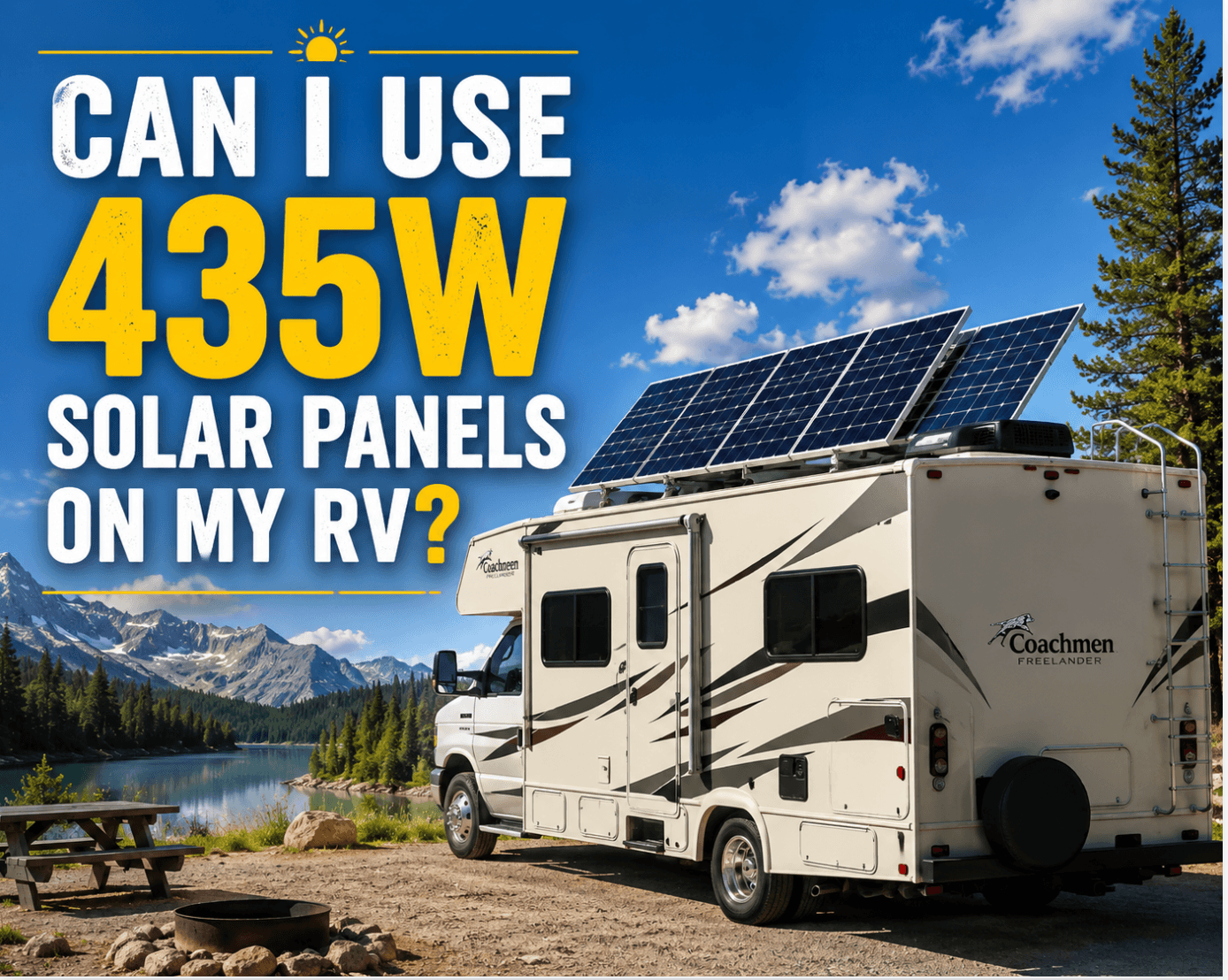
Yes, you can, and many full-timers do exactly this to squeeze maximum wattage onto a limited roof.
But “can” and “should” aren’t the same question. A 435W panel is a residential-class module, and bolting one to an RV roof brings real advantages alongside three constraints most blog posts conveniently skip: physical size, the type of charge controller you’ll need, and how well your roof handles a single large panel versus several small ones.
I’ve spent over a decade in solar. I earned my ANCE solar certification back in 2014 and spent a couple of years engineering solar systems professionally before moving into industrial automation. So let me give you the engineer’s version, not the marketing version.
The quick verdict
| Question | Answer |
|---|---|
| Will a 435W panel physically work on an RV? | Usually, yes, if your roof has the length |
| Do you need a special charge controller? | Yes, an MPPT controller, not a PWM. |
| Is the voltage safe for a 12V battery system? | Yes, with MPPT. Never wire it directly. |
| Is it the best choice for every rig? | No. Roof shape and shading matter a lot. |
Why is a 435W panel even on your radar
The RV solar market spent years dominated by 100W and 200W panels because they were small, light, and easy to lay out. That’s changing.
As residential panel efficiency climbed, the same physical footprint started producing far more power, and 415W–445W modules became the value sweet spot in the broader solar market.
The appeal for RVers is simple: fewer panels, fewer connections, less mounting hardware, and more watts.
One 435W panel replaces roughly four 110W RV panels. Fewer junctions mean fewer failure points, and as someone who’s chased down corroded connectors on more than one roof, I can tell you that matters over years of vibration and weather.
Constraint #1: Will it actually fit?
This is where most people get tripped up. A 435W panel is big.
A typical 435W residential-format panel runs around 1722 × 1134 mm (about 67.8 × 44.6 inches), give or take depending on cell layout and manufacturer. That’s a meaningful chunk of real estate.
Before you buy anything, get on your roof with a tape measure and map out:
- Total clear length and width of usable mounting space
- Obstructions: vents, AC units, antennas, skylights, fans
- Walking paths if you ever need roof access
- Tilt clearance if you plan to add tilt mounts later
A 30-foot Class A motorhome usually swallows one or two of these panels comfortably. A 19-foot travel trailer with a roof full of vents and an AC shroud may not have a single uninterrupted rectangle big enough. Measure first. Always.
Engineer’s tip
Lay a cardboard cutout of the exact panel dimensions on your roof before purchasing. It costs nothing and prevents the most expensive mistake in RV solar: buying a panel that won’t fit around your vent.
Constraint #2: Weight and roof loading
A 435W panel typically weighs around 21–24 kg (46–53 lbs). That’s not trivial, but it’s well within what a properly framed RV roof handles, and it’s often less total weight than the equivalent wattage spread across four smaller panels with four sets of mounting brackets.
Two things to verify
Your roof structure
Fiberglass and aluminum-framed roofs are generally fine. If you have any doubts about rot or soft spots, address that before mounting anything.
Mounting points
A single large panel concentrates load on fewer brackets. Use proper rails or corner brackets rated for the load, and seal every penetration with self-leveling lap sealant.
Constraint #3: The charge controller, this is non-negotiable
Here’s the part you cannot skip, and where I see beginners burn out equipment.
A 435W panel does not output 12 volts. These residential-class panels operate at a much higher voltage, commonly somewhere in the 30–42V range at maximum power point (Vmp), with open-circuit voltage (Voc) higher still, often in the high 30s to high 40s.
Your RV battery bank is almost certainly 12V or 24V. You cannot connect a 38V panel to a 12V battery directly—you’ll either get terrible performance or damage something.
The solution is an MPPT (Maximum Power Point Tracking) charge controller. MPPT controllers do two essential jobs:
- Down-convert the panel’s high voltage to your battery’s voltage.
- Harvest the extra current that conversion frees up, so you actually capture the panel’s full output.
A cheaper PWM controller will not work with a high-voltage residential panel. PWM essentially drags the panel down to battery voltage and throws away the difference.
You’d lose a huge fraction of your 435 watts. For a panel like this, MPPT isn’t optional; it’s the whole reason the setup works.
Sizing the controller
Rough math for a single 435W panel on a 12V system:
Charge current ≈ Panel watts ÷ Battery voltage
435W ÷ 12V ≈ 36.25A
So you’d want at least a 40A MPPT controller for a single 435W panel on a 12V bank, with headroom.
On a 24V battery bank, the current roughly halves (~18A), letting a smaller, cheaper controller do the same job, one of several reasons serious off-grid RVers move to 24V systems.
Always check the controller’s maximum input voltage rating against your panel’s Voc, factoring in cold weather (Voc rises as temperature drops).
Constraint #4: Shading behaves differently
This one’s subtle but important. A large single panel is a single electrical unit. If a vent, branch, or AC shroud throws a shadow across part of it, output for the whole panel can drop sharply, not just the shaded sliver.
Several smaller panels, by contrast, isolate shading damage to individual units. On an RV roof cluttered with obstructions that cast moving shadows throughout the day, that’s a genuine consideration.
So the honest tradeoff is
- Clean, open roof? → A big 435W panel is fantastic. Fewer parts, more watts, simpler install.
- Cluttered roof with lots of shade sources? → Two or three smaller panels may out-produce one big one in real-world conditions.
So, what kind of RVer is a 435W panel right for?
It’s a strong choice if you:
- Have a long, relatively clear roof (Class A, larger fifth wheels, big travel trailers)
- Run an MPPT controller (or are buying one)
- Want to minimize roof penetrations and connections
- Are you comfortable with a 24V system, or are you sizing a beefy 12V MPPT controller
- Boondock often and want maximum harvest per square foot
Look at smaller panels instead of yourself.
- Have a short or heavily obstructed roof
- Deal with frequent partial shading
- Want flexibility to lay panels around vents and units
- Are working with a small van or teardrop build
Don’t forget the rest of the system
A panel is one piece. To actually use that 435W of harvesting capacity, the rest of your system has to keep up:
- Battery bank large enough to store a meaningful day’s harvest (lithium/LiFePO₄ is the standard for serious RV solar now)
- Wiring gauge sized for the current undersized wire is a fire risk and a performance killer
- Inverter, if you’re running AC appliances
- Fuses and disconnecting at the battery and panel are non-negotiable safety hardware
A 435W panel feeding a tiny 50Ah battery through thin wire is like putting a firehose into a teacup. Size the whole system together.
The bottom line
Yes, you can absolutely use a 435W solar panel on your RV, and on the right rig, it’s one of the smartest ways to maximize power from limited roof space.
The two things that make or break it are simple: confirm the panel physically fits your roof, and pair it with a properly sized MPPT charge controller.
Get those two right; mind the shading, and a residential-class panel will quietly out-earn a roof full of small ones for years.
Measure twice, buy once, and never wire a high-voltage panel straight to your battery.
Seki Hudson is an ANCE-certified solar technician (2014) who worked as a solar systems engineer before moving into industrial automation. He writes about practical, real-world solar at SolarFuturista.
