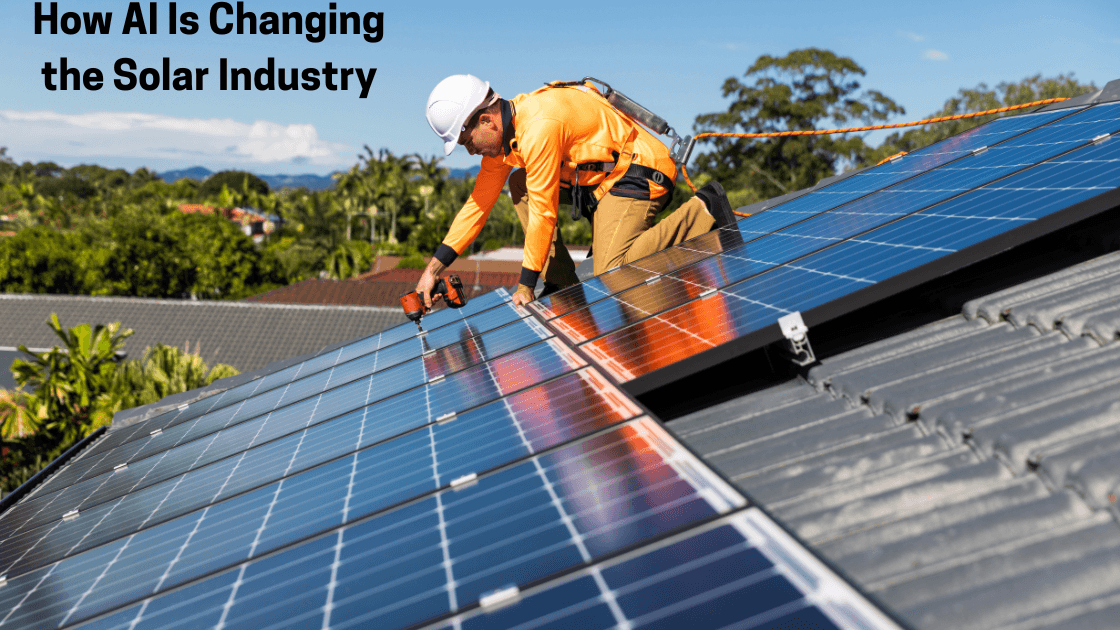
Solar has always been a technology story. Cheaper panels, better inverters, and longer-lasting batteries pushed adoption forward.
But the shift happening right now is different. The panels on your roof aren’t changing much this year; the intelligence wrapped around them is changing enormously.
Artificial intelligence has quietly moved from a buzzword in solar marketing decks to a working layer within real systems that design installations, forecast output, catch faults before they cost you money, and decide, minute by minute, when to store, use, or sell your power.
As someone who has spent years working in both industrial automation and solar system design, I can tell you the change is less about robots taking over and more about software making solar dramatically more predictable and more profitable.
Here’s a grounded look at how AI is changing the solar industry in 2026, what’s genuine progress, and what it means whether you own a rooftop system or manage a utility-scale plant.
Why AI and Solar Fit Together So Well
Solar’s biggest weakness has always been variability. The sun doesn’t produce on a fixed schedule. Clouds, seasons, temperature, and dust all move your output around.
Traditional systems handled this with rough estimates and reactive maintenance: you found out a panel was underperforming when your bill crept up, or a technician happened to notice.
AI is a natural fix because solar generates enormous amounts of data. Every inverter, meter, and sensor produces a continuous stream of numbers, and machine learning is exceptionally good at finding patterns in exactly that kind of data.
Feed an algorithm enough weather history, irradiance readings, and performance logs, and it learns to predict what your system will do next and to notice when something is quietly going wrong.
AI turns solar from a passive, static energy source into a dynamic system that predicts, adapts, and optimizes itself.
Smarter System Design and Site Assessment
One of the most immediate places AI shows up is before a single panel is installed.
System design and site evaluation traditionally relied on manual work, a technician assessing your roof, shading, and orientation, then hand-building a layout and proposal.
AI-powered design tools now analyze satellite and aerial imagery, automatically detect roof geometry and shading obstacles, and generate an optimized panel layout in minutes rather than hours.
For homeowners, this means faster, more accurate quotes. For installers, AI-driven design software lets sales teams produce interactive, accurate proposals on the spot, which shortens the path from first conversation to signed contract.
It also cuts down on costly return visits: AI analysis of site photos helps field crews capture the right data the first time, reducing repeat “truck rolls.”
Energy Forecasting You Can Actually Trust
If there’s one area where AI has proven itself, it’s forecasting.
Machine learning models predict a solar plant’s energy generation using weather conditions, time of day, temperature, and historical performance.
Instead of a vague seasonal estimate, operators get accurate short-term forecasts of how much power a system will produce.
That accuracy matters for three reasons: it lets you optimize battery charging and discharging, manage grid integration cleanly, and avoid the costly mismatch of over- or under-producing relative to demand.
Research consistently shows AI-based forecasting frameworks outperform older statistical models, especially for horizons beyond a couple of hours where traditional methods break down. For the grid as a whole, better forecasting means better stability as more solar comes online.
Predictive Maintenance: Catching Problems Before They Cost You
This is my favorite application, because it maps directly onto what I do in industrial automation, and the value is concrete.
Old-school solar maintenance was either reactive (fix it after it breaks) or calendar-based (send someone out every X months whether or not anything is wrong). Both waste money.
Predictive maintenance flips the model: AI models analyze real-time data like temperature, voltage, and current to detect anomalies and predict equipment failures before they occur.
The result is condition-based maintenance: you intervene only when the data says a component actually needs attention.
That reduces unnecessary site visits, focuses resources on the panels or inverters that matter, and extends the lifespan of expensive components.
Industry analyses suggest AI-driven predictive maintenance can cut maintenance costs by up to 40% while improving uptime, and in large plants, AI-driven optimization can lift overall efficiency by roughly 5–15%, which at utility scale translates into serious money.
Automated Inspections With Drones and Computer Vision
Inspecting a large solar array by hand is slow and easy to get wrong. AI has largely automated it.
Drones equipped with thermal cameras fly over an array while computer-vision models analyze the imagery to spot defects, hotspots, cracked cells, faulty connections, and dirt or shading losses that are invisible from the ground.
Companies specializing in aerial thermal imaging and analytics can now scan an entire plant and pinpoint the exact modules that need attention, turning what used to be days of manual inspection into an automated report.
For residential and commercial owners, the same principle applies at a smaller scale: automated monitoring flags underperforming panels, so you’re not silently losing generation for months.
Intelligent Energy Management and Smart Inverters
Generating power is only half the equation in 2026. The other half is deciding what to do with it, and that’s where AI-enabled smart inverters and energy management systems shine.
In markets with dynamic electricity pricing, manual scheduling simply can’t keep up. AI-driven energy management automatically charges your battery when electricity is cheap, then discharges or exports it during peak-price windows, squeezing far more value out of the same hardware.
For businesses, AI-powered peak shaving reduces expensive demand charges by intelligently limiting grid draw at the right moments.
This intelligent control layer is quickly becoming the deciding factor when people choose a solar-plus-storage system.
Two systems with identical panels and batteries can deliver very different returns depending on how smart the software managing them is.
New Business Models: VPPs and Energy Trading
Zoom out, and AI is doing something bigger than optimizing individual systems — it’s creating entirely new ways for solar to make money.
AI can aggregate thousands of distributed rooftop systems into a virtual power plant (VPP), coordinating them so they behave like a single, dispatchable generator the grid can rely on. It also enables real-time automated energy trading, where systems buy and sell power based on live market conditions.
In this model, your solar array stops being just an appliance that lowers your bill and becomes a small revenue-generating asset.
This is one of the most important ways AI is changing the solar industry: it’s redefining the underlying economics, not just the engineering.
AI in Solar at a Glance
| Area | Traditional Approach | AI-Powered Approach | Main Benefit |
|---|---|---|---|
| System design | Manual roof assessment | Automated imagery analysis & layout | Faster, more accurate quotes |
| Forecasting | Seasonal estimates | ML weather-based prediction | Reliable output planning |
| Maintenance | Reactive or scheduled | Predictive, condition-based | Lower costs, less downtime |
| Inspections | Manual walk-throughs | Drone + computer vision | Faster fault detection |
| Energy management | Fixed scheduling | Dynamic AI optimization | Higher ROI on storage |
| Business model | Bill reduction only | VPPs & energy trading | New revenue streams |
The Challenges Nobody Should Ignore
I’d be doing you a disservice to present AI in solar as pure upside. A few real hurdles remain before it becomes universal.
Data quality is the first: an AI model is only as good as the sensor data feeding it, and messy or sparse data produces unreliable predictions.
Cybersecurity is the second: connecting thousands of solar assets to intelligent, internet-connected control systems widens the attack surface, and grid-connected hardware needs to be secured seriously.
There’s also policy and regulatory uncertainty around how VPPs and automated trading are treated in different markets.
And finally, for cost for small residential systems, some of the more advanced AI tooling still makes the most financial sense at larger scales, though that gap is closing fast.
None of these are dealbreakers. They’re the normal growing pains of a technology moving from early adoption into the mainstream.
What This Means for You
If you’re a homeowner, the practical takeaway is to pay attention to the software, not just the panels.
Ask installers about monitoring, smart inverters, and how their system handles battery scheduling. That intelligence layer increasingly determines your real-world savings.
If you’re an installer or operator, AI has shifted from “nice to have” to competitive necessity. The companies pulling ahead are the ones using AI for design, forecasting, and predictive maintenance to cut costs and scale.
And if you’re simply solar-curious, understand that the technology you’d buy today is fundamentally smarter than what existed even a few years ago. More predictable, more self-managing, and better at protecting your investment.
Frequently Asked Questions
How is AI used in the solar industry?
AI is used across the entire solar value chain: automated system design, energy-production forecasting, predictive maintenance, drone-based inspections, smart energy management, and grid optimization.
It analyzes the large volumes of data solar systems generate to make them more efficient, reliable, and cost-effective.
Does AI make solar panels more efficient?
AI doesn’t change the physical efficiency of a panel, but it improves overall system efficiency, often by around 5–15% in larger plants, by optimizing performance, catching faults early, and managing energy intelligently. It gets more usable value out of the same hardware.
Can AI predict solar panel failures?
Yes. AI-based predictive maintenance analyzes real-time data such as temperature, voltage, and current to detect anomalies and forecast equipment failures before they happen, reducing downtime and extending component lifespan.
Is AI worth it for a home solar system?
For most homeowners, the AI benefits arrive through smart inverters, monitoring apps, and battery-management software rather than a standalone purchase.
These features improve savings and reliability, and they’re increasingly standard in modern residential systems.
Will AI replace solar installers and technicians?
No. AI automates data-heavy and repetitive tasks like design drafts, inspections, and monitoring, but skilled technicians are still essential for installation, physical repairs, and judgment calls. AI is a tool that makes their work faster and more accurate, not a replacement.
The Bottom Line
The most important way AI is changing the solar industry isn’t any single feature. It’s the overall shift from guesswork to intelligence.
Solar is becoming a system that predicts its own output, spots its own problems, and optimizes its own economics.
For anyone invested in clean energy, that’s a genuinely exciting direction: the sun still does the work, but now something smart is making sure none of it goes to waste.
