I worked in the solar industry for many years, and one of the most common systems I used to design was the grid-tied solar panel system. In this post, I share things that you need to know about this system.
If you’ve been researching solar energy, you’ve probably come across the term “grid-tied solar system” more than once.
It’s the most common type of solar installation in homes and businesses worldwide, and for good reason.
Grid-tied systems are generally the most affordable, most efficient, and most practical option for people who have access to a reliable utility grid.
But are they the right fit for your situation?
In this guide, you’ll learn exactly how grid-tied solar power systems work, what makes them different from off-grid and hybrid alternatives, what you can realistically expect to pay, and how to decide whether going grid-tied makes sense for your home or business.
What Is a Grid-Tied Solar Power System?
A grid-tied solar power system (also called an on-grid or utility-interactive system) is a solar installation that is electrically connected to your local utility grid.
Unlike off-grid systems, which operate independently of the power company, grid-tied systems work in tandem with the grid.
This means your home or business draws electricity from both your solar panels and the utility grid, depending on how much solar energy is being produced at any given moment.
When your panels produce more electricity than you need, the excess gets sent back to the grid, and in many places, you receive credit for it.
Grid-tied systems are the most widely installed type of solar system in the world, accounting for the vast majority of residential and commercial solar installations.
How Grid-Tied Solar Systems Work
Understanding how a grid-tied system operates helps you make smarter decisions about sizing, usage, and savings. Here’s the step-by-step process.
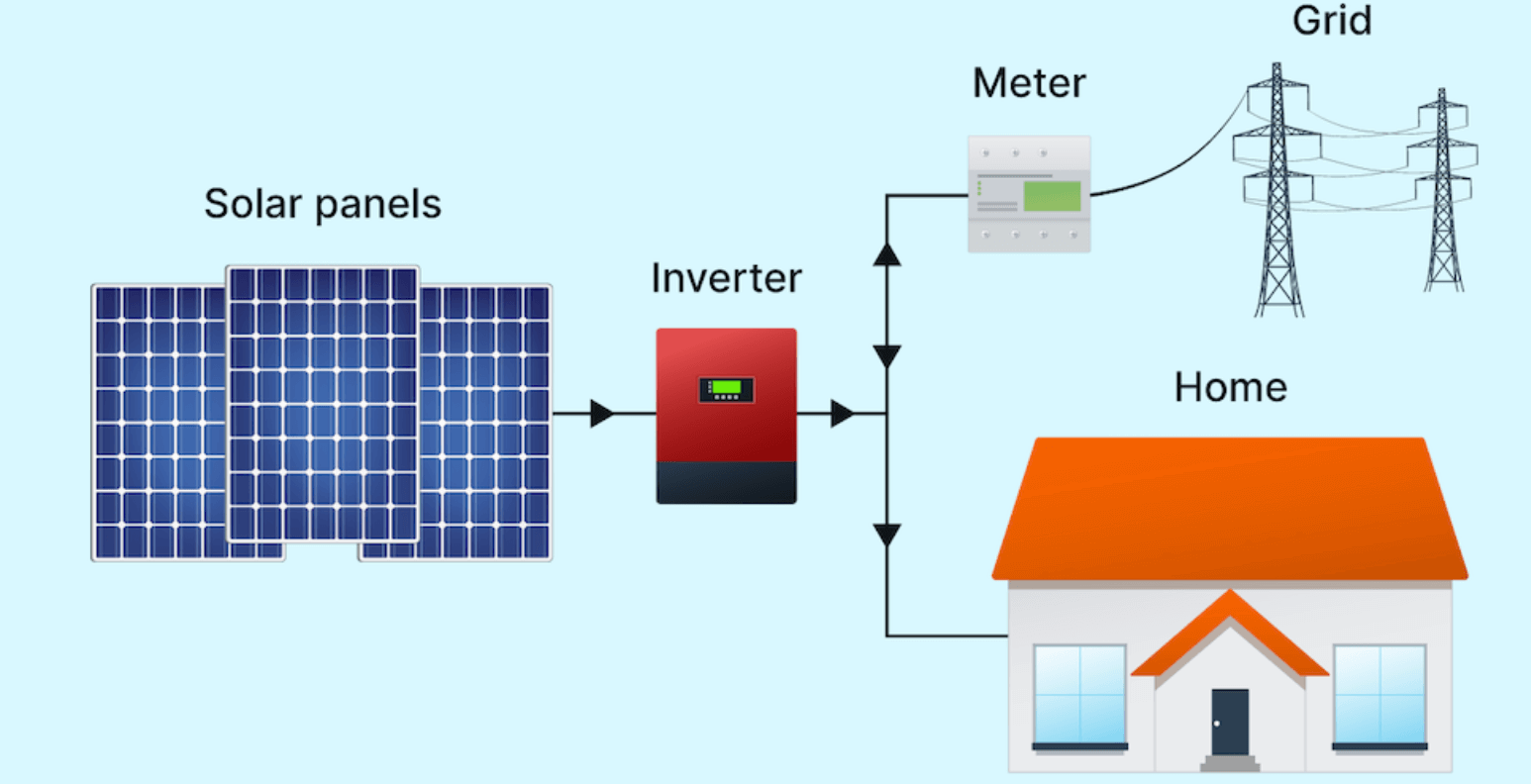
Step 1: Solar Panels Capture Sunlight
Your rooftop (or ground-mounted) solar panels absorb sunlight and convert it into direct current (DC) electricity through the photovoltaic (PV) effect.
The amount of electricity produced depends on panel efficiency, available sunlight, angle of installation, shading, and temperature.
Step 2: The Inverter Converts DC to AC
DC electricity cannot power your standard household appliances. The solar inverter converts the DC output from your panels into alternating current (AC), the type of electricity your home uses. In grid-tied systems, the inverter also synchronizes with the frequency and voltage of the utility grid.
Step 3: Your Home Uses Solar Power First
Once converted, the AC electricity flows into your home’s electrical panel. Your appliances, lights, and devices use this solar-generated electricity first, before drawing from the grid. Any surplus is automatically exported.
Step 4: The Grid Acts as a Virtual Battery
When your panels produce more electricity than your home consumes, such as on sunny afternoons when no one is home.
The excess power flows out through your utility meter and into the grid. When your panels don’t produce enough (at night, on cloudy days, or during high-demand periods), your home draws power from the grid as usual.
This back-and-forth relationship is seamless and automatic. You don’t need to manage it manually.
Step 5: Your Utility Bill Reflects Net Usage
At the end of your billing cycle, you pay only for the net energy consumed, that is, grid electricity used minus solar electricity exported. This is the basis of net metering policies (more on this below).
Key Components of a Grid-Tied System
A complete grid-tied solar installation consists of several integrated components.
Solar Panels (PV Modules)
The panels themselves are made up of photovoltaic cells, typically monocrystalline or polycrystalline silicon, that convert light into electricity. Monocrystalline panels are more efficient and more common in modern residential systems.
Grid-Tie Inverter
This is the brain of the system. Grid-tie inverters are specifically designed to synchronize with the utility grid.
They also include safety features that automatically shut the system down during a power outage (more on why this matters later).
There are three main types:
- String inverters: one central inverter for all panels; most affordable
- Microinverters: individual inverters on each panel; better for shaded roofs
- Power optimizers + central inverter: a hybrid approach for partial shading
Racking and Mounting System
Aluminum or steel mounting hardware secures your panels to your roof (or ground frame) at the optimal angle for your location.
Utility Meter (Bidirectional)
A standard electricity meter only reads consumption. A net meter or smart meter tracks electricity flowing in both directions to and from the grid, allowing your utility company to calculate your net usage.
AC Disconnect and Main Electrical Panel
Safety disconnects allow the system to be isolated from the grid or home wiring for maintenance or emergencies. The solar output ties into your existing breaker panel.
Monitoring System (Optional but Recommended)
Most modern systems come with a monitoring app or dashboard that shows real-time and historical production data useful for detecting performance issues and tracking your savings.
Grid-Tied vs. Off-Grid vs. Hybrid: What’s the Difference?
Before committing to a grid-tied system, it helps to understand how it compares to the alternatives.
| Feature | Grid-Tied | Off-Grid | Hybrid |
|---|---|---|---|
| Connected to utility grid? | Yes | No | Yes |
| Battery storage required? | No | Yes | Optional |
| Works during power outages? | No (standard) | Yes | Yes (with battery) |
| Upfront cost | Lower | Higher | Highest |
| Best for | Urban/suburban areas | Remote locations | Reliability + savings |
| Net metering eligible? | Yes | No | Yes |
| Ongoing fuel/generator needed? | No | Sometimes | No |
Grid-tied is ideal if you have reliable grid access and want maximum return on investment.
Off-grid makes sense if you’re in a remote location where connecting to the grid is expensive or impossible.
A hybrid (grid-tied with battery backup) gives you the best of both worlds, net metering benefits plus backup power during outages, but at a higher cost.
Benefits of Grid-Tied Solar Systems
Grid-tied systems are popular for good reasons. Here are the most significant advantages.
Lower Upfront Cost
Because you don’t need batteries, a grid-tied system is significantly cheaper to install than off-grid or hybrid alternatives.
Batteries remain one of the most expensive components in solar storage systems, and eliminating them reduces both the purchase price and long-term maintenance costs.
Net Metering Savings
In many regions, utilities credit you for excess solar energy exported to the grid. Depending on your net metering policy and energy consumption patterns, this can dramatically reduce or even eliminate your electricity bill.
The Grid as Unlimited Backup
You’ll never run out of power. The utility grid provides a reliable, essentially unlimited backup supply for times when your panels aren’t producing enough — nights, rainy days, and high-demand moments.
Simpler System Design
Fewer components means fewer things that can break down. Grid-tied systems are mechanically simpler, which translates to lower maintenance requirements over time.
Shorter Payback Period
Without the added cost of batteries, grid-tied systems typically achieve payback in 6 to 12 years, depending on your location, electricity rates, and available incentives, often making them the most financially sensible choice.
Scalability
Grid-tied systems can be sized to match your current consumption and expanded later as your energy needs grow. You can also add a battery system in the future if you want backup capability.
Reduced Carbon Footprint
Every kilowatt-hour of solar energy you generate displaces electricity that would otherwise come from fossil fuels. Over a 25-year lifespan, a typical residential solar system offsets tens of tons of CO₂ emissions.
Drawbacks and Limitations
No technology is perfect. Here are the honest trade-offs you should understand before going grid-tied.
No Power During Outages (Standard Systems)
This surprises many people. A standard grid-tied inverter is designed to shut down automatically when the grid goes down.
This is a deliberate safety feature called “anti-islanding protection”; it prevents your system from back-feeding electricity into power lines that utility workers might be trying to repair.
The result: even if the sun is shining and your panels are fully operational, you’ll have no power during a grid outage.
If backup power is important to you, you’ll need either a battery system or a hybrid inverter with an emergency outlet feature.
Dependent on Net Metering Policies
The financial attractiveness of a grid-tied system is closely tied to your utility’s net metering policy. In some regions, utilities are reducing net metering rates or adding fees for solar customers. Always verify the current policy in your area before investing.
Grid Reliability Still Matters
If your area experiences frequent or prolonged outages, a purely grid-tied system leaves you vulnerable. In those cases, a hybrid system with battery backup may offer better resilience.
Approval and Interconnection Requirements
Connecting to the utility grid requires approval and permits. The interconnection process varies by utility and can take weeks to months in some areas.
How Much Does a Grid-Tied Solar System Cost?
Solar costs vary significantly based on system size, panel brand, inverter type, installer, and location. Here is a general overview based on market data for residential installations.
Average Cost by System Size (Before Incentives)
| System Size | Typical Home Size | Estimated Cost (USD) |
|---|---|---|
| 3 kW | Small apartment/condo | $6,000 – $9,000 |
| 5 kW | Small to medium home | $10,000 – $15,000 |
| 7 kW | Medium home | $14,000 – $21,000 |
| 10 kW | Large home | $20,000 – $30,000 |
| 15 kW | Very large home / small business | $28,000 – $42,000 |
Note
These are general estimates for the U.S. market. Prices vary significantly by country, region, and installer.
Key Cost Factors
Panel type
Monocrystalline panels cost more than polycrystalline but produce more power per square meter. For space-constrained roofs, higher efficiency often justifies the premium.
Inverter type
String inverters are the most affordable. Microinverters cost 20–30% more but can increase output on partially shaded roofs.
Installation complexity
Multi-story homes, steep roofs, and complex layouts increase labor costs.
Permits and interconnection fees
These vary by municipality and utility.
Financial Incentives That Reduce Your Cost
Available incentives vary by country and region but commonly include the following.
- Federal/national tax credits (e.g., the U.S. Investment Tax Credit, currently 30%)
- State or provincial rebates
- Net metering credits
- Accelerated depreciation (for businesses)
- Low-interest green energy loans
In Mexico, where VAT exemptions and state-level subsidies exist for solar in certain contexts, the economics can be favorable, particularly for business properties.
Payback Period
A grid-tied system without batteries typically pays back in 6 to 12 years in most markets. Given that quality solar panels carry 25-year performance warranties, this means 13+ years of essentially free electricity.
Net Metering: Getting Credit for the Energy You Export
Net metering is one of the most important concepts for anyone considering a grid-tied solar system. Here’s how it works:
When your solar panels produce more electricity than your home uses, that excess flows into the utility grid.
Your utility meter runs backward (or records the export separately), and you receive a credit for the electricity you contributed.
At the end of the billing period, you’re charged only for your net consumption, the difference between what you consumed from the grid and what you exported to it.
Net Metering Variations
Net metering policies are not uniform. Some common structures include the following.
Full retail net metering
You receive credit at the same retail rate you pay for electricity. Most favorable for solar owners.
Wholesale/avoided cost credit
You receive credit at a lower wholesale rate. Less financially attractive.
Net billing
Credits are calculated and applied differently, often with monthly or annual reconciliation.
Feed-in tariff (FiT)
A fixed rate paid for every kWh you export, set by the government or utility. The rate may be higher or lower than retail.
Always verify your local net metering policy with your utility before sizing your system. Oversizing your system in a low-interest-rate environment can hurt your financial return.
Is a Grid-Tied Solar System Right for You?
Use this framework to evaluate whether a grid-tied system fits your situation:
You’re a Good Candidate If
You have reliable grid access
If power outages are infrequent in your area, a grid-tied system gives you all the financial benefits with minimal risk.
Your electricity bills are high
The higher your current bill, the faster your payback period and the greater your long-term savings.
You have good solar access
Your roof or property receives direct sunlight for most of the day, without significant shading from trees or neighboring buildings.
You plan to stay in your home long-term
Solar adds value to your property, but you capture the most financial benefit by being there for the full payback period and beyond.
Attractive incentives are available
Tax credits, rebates, and favorable net metering policies all shorten your payback period.
Your roof is in good condition
A solar installation that requires a roof replacement in 5 years isn’t cost-effective. Address roof issues before installing panels.
You May Want to Consider Alternatives If
Power outages are frequent in your area
Consider a hybrid system with battery backup for resilience.
You want complete energy independence
An off-grid system, while more expensive, eliminates all reliance on the utility company.
Your net metering policy is unfavorable
In some markets, low export credit rates make a battery-first strategy more financially logical.
You rent your property
Installing solar as a renter is generally not practical. Look into community solar subscriptions instead.
Your electricity rates are very low
In areas with very cheap grid electricity, the ROI on solar is longer and less compelling.
Frequently Asked Questions
Can I go completely off the grid with a grid-tied system?
No. A grid-tied system is, by definition, connected to the utility grid. If your goal is complete energy independence, you need an off-grid system with battery storage.
What happens to my grid-tied system during a power outage?
Standard grid-tied inverters automatically shut down during an outage for safety reasons. Your system will not produce power until the grid is restored. If outage protection is important to you, look at hybrid inverters or add battery storage.
How long do grid-tied solar systems last?
Quality solar panels are rated for 25 to 30 years of operation, with manufacturers guaranteeing at least 80% of the original output at the end of that period. Inverters typically last 10 to 15 years and may need replacement once during the system’s lifetime.
Do I need to maintain a grid-tied solar system?
Grid-tied systems require minimal maintenance. Panels should be kept reasonably clean (rain handles most of this naturally), and you should have a professional inspection every few years. The monitoring app will alert you to any performance drops.
Will solar panels work on cloudy days?
Yes, but at reduced output. Solar panels still generate electricity under cloudy conditions, typically 10 to 25% of their rated capacity. The grid supplements the shortfall automatically.
How do I size a grid-tied solar system?
Start with your average monthly electricity consumption (found on your utility bill) and work with a solar installer or use a solar calculator to determine the system size needed to offset a target percentage of that usage. Most homeowners aim to offset 80 to 100% of their annual consumption.
Is my roof suitable for solar?
The ideal roof is south-facing (in the Northern Hemisphere), has a pitch between 15 and 40 degrees, has little to no shading, and is in good structural condition.
East- and west-facing roofs can also work well with modest output reductions. A professional site assessment will determine your specific situation.
Final Verdict
Grid-tied solar power systems represent the most cost-effective and practical entry point into solar energy for the vast majority of homeowners and businesses with access to a reliable utility grid.
They’re simpler, cheaper, and faster to recoup than off-grid or hybrid alternatives. When paired with favorable net metering policies and available tax incentives, a grid-tied system can deliver strong financial returns while meaningfully reducing your environmental impact over its 25+ year lifespan.
The one significant trade-off is vulnerability during grid outages, a limitation that’s worth weighing honestly if you live in an area with unreliable power infrastructure.
For those situations, adding battery storage or opting for a hybrid inverter is worth the additional investment.
If you have reliable grid access, high electricity bills, a solar-friendly roof, and reasonable incentives available in your area, a grid-tied solar system is almost certainly worth serious consideration.
The sun is going to shine whether you harvest it or not. A grid-tied solar system is one of the most reliable ways to make sure that energy works for you.

3 thoughts on “Grid-Tied Solar Power Systems: How They Work, Benefits, Costs, and Whether They’re Right for You”