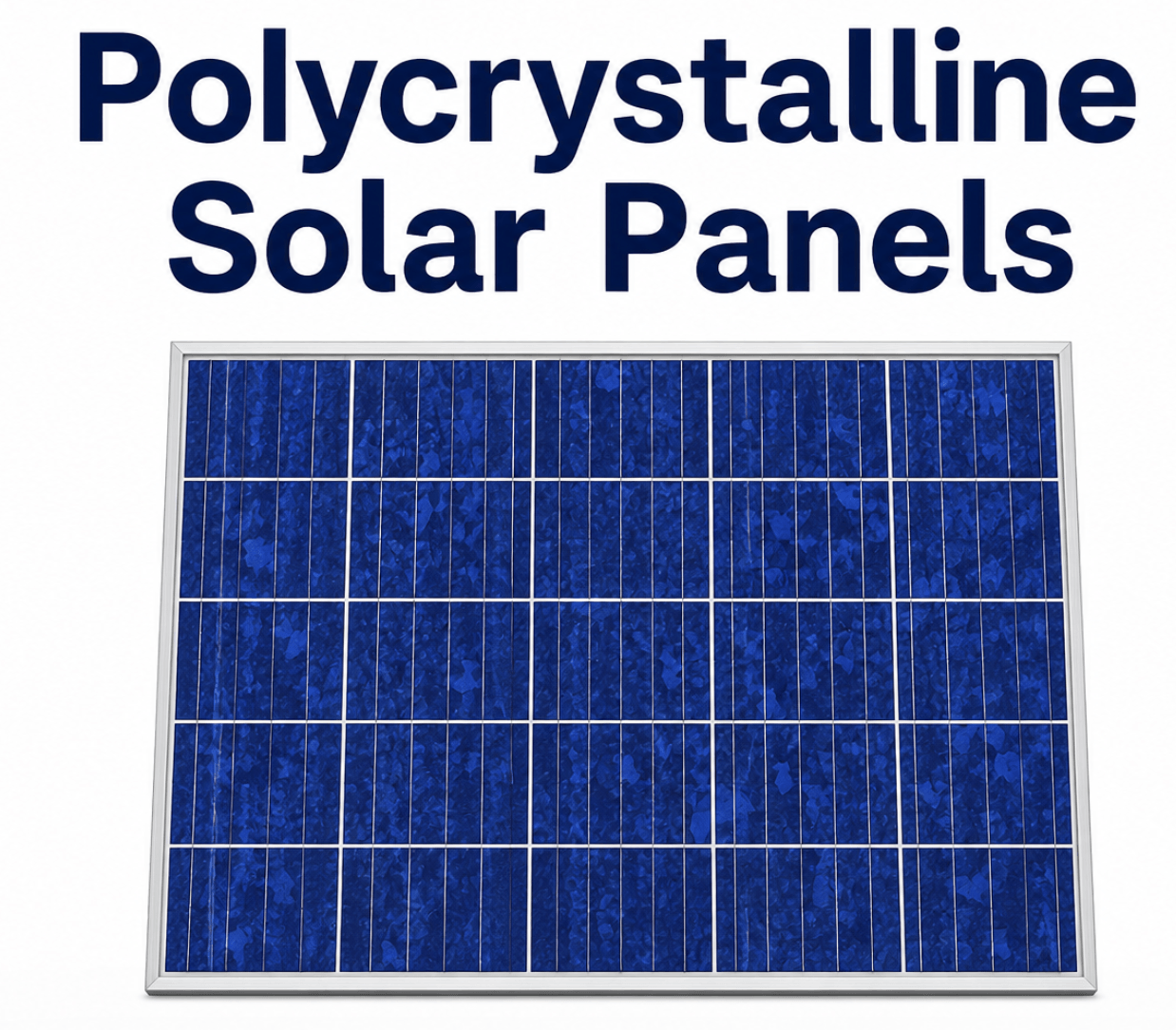
If you’ve ever looked at a rooftop covered in bluish, shimmering solar panels, you were most likely looking at polycrystalline solar panels.
For decades, they were the backbone of the residential solar industry. But with technology evolving so fast, many homeowners are now asking: are polycrystalline panels still a good choice?
In this guide, we break down everything you need to know, from how polycrystalline solar panels are made to their efficiency, cost, lifespan, and how they compare to today’s monocrystalline alternatives.
What Are Polycrystalline Solar Panels?
Polycrystalline solar panels, also called multi-crystalline panels, are a type of photovoltaic (PV) solar panel made by melting multiple silicon fragments together and allowing them to cool and solidify into wafers. Those wafers are then cut into individual solar cells and assembled into a complete panel.
The result is a panel with a distinctive blue, speckled, mosaic-like appearance caused by the light scattering off the multiple crystal boundaries within each cell. This visual characteristic is the easiest way to identify a polycrystalline panel at a glance.
Unlike monocrystalline panels, which are made from a single, continuous silicon crystal grown through the more complex Czochralski method, polycrystalline panels use a simpler casting process.
Molten silicon is poured into square molds, cooled, and sliced. This simplicity is what historically made them cheaper to manufacture.
How Do Polycrystalline Solar Panels Work?
At the core of every polycrystalline solar panel are photovoltaic cells made from silicon. Here’s how the energy conversion process works:
Sunlight hits the silicon cells
The silicon absorbs photons (light particles) from the sun.
Electrons are knocked loose
The absorbed energy frees electrons from their atoms, creating an electrical charge.
Electric current flows
The panel’s internal structure directs the flow of electrons as direct current (DC) electricity.
An inverter converts the power
A solar inverter transforms the DC electricity into alternating current (AC), which is what your home appliances use.
The key difference with polycrystalline cells is that because the silicon contains multiple crystal boundaries, electrons face more resistance as they move through the material.
This is why polycrystalline panels are slightly less efficient than their monocrystalline counterparts. There are simply more obstacles in the path of the electrical flow.
Polycrystalline Solar Panel Efficiency
Efficiency is one of the most important specs to understand when evaluating any solar panel. It tells you what percentage of the sunlight hitting the panel is converted into usable electricity.
Polycrystalline panels typically achieve efficiency ratings between 15% and 18%. The highest efficiency ever recorded for a polycrystalline panel was 20.4%, achieved back in 2019, and progress had been relatively slow for decades before that.
By comparison, today’s monocrystalline panels commonly reach efficiencies of 20% to 25%, with top-tier models pushing even higher.
What does this mean in practice? A lower efficiency rating means you need more panels to generate the same amount of electricity. If your roof space is limited, this can be a significant constraint.
Polycrystalline vs. Monocrystalline Solar Panels: Key Differences
Here’s a straightforward comparison of the two most common panel types.
| Feature | Polycrystalline | Monocrystalline |
|---|---|---|
| Appearance | Blue, speckled | Black or dark blue, uniform |
| Efficiency | 15–18% | 20–25% |
| Power Output | ~240–345W | 320W–700W+ |
| Cost | Lower upfront | Higher upfront |
| Lifespan | 25–30 years | 30–40 years |
| Heat Tolerance | Lower | Higher |
| Space Required | More panels needed | Fewer panels needed |
The performance gap is significant. Monocrystalline panels have power ratings starting at around 320W and going well beyond 500W for premium models. Polycrystalline panels, by contrast, generally top out around 345W for residential use.
Pros of Polycrystalline Solar Panels
Despite being eclipsed by monocrystalline technology, polycrystalline panels still have real advantages in certain situations:
Lower Upfront Cost
The simpler manufacturing process means lower production costs, which historically translated into a lower price per panel. For buyers on a tight budget, polycrystalline has been the go-to entry point into solar.
Less Manufacturing Waste
The casting process wastes less silicon than the single-crystal growing method used for monocrystalline panels. This makes polycrystalline panels a slightly more resource-efficient option from a production standpoint.
Wide Availability (of Existing Stock)
Polycrystalline panels remain widely available, particularly for replacement panels in existing installations or in markets where older inventory is still being sold.
Decent Lifespan
A lifespan of 25–30 years is still a solid return on investment, especially compared to thin-film panels, which typically last only 10–20 years.
Cons of Polycrystalline Solar Panels
There are also important limitations to be aware of.
Lower Efficiency
The biggest drawback. Needing more panels to produce the same power means higher installation costs and more roof space consumed.
Worse Performance in Heat
Polycrystalline panels have a higher temperature coefficient than monocrystalline panels. This means their output drops more sharply as temperatures rise, a real concern in hot climates like much of Latin America, the Middle East, and South Asia.
Shorter Lifespan Than Monocrystalline
At 25–30 years, they lag behind the 30–40-year lifespan of monocrystalline modules.
Declining Market Presence
The market has spoken loudly. Global sales of polycrystalline panels have dropped dramatically from nearly 60% of global solar sales in 2015 to effectively zero percent of new production by 2021.
The International Energy Agency noted in 2024 that polycrystalline panels have essentially disappeared from the new-panel market.
Are Polycrystalline Solar Panels Still Worth It in 2026?
This is where it gets nuanced.
For new installations in 2026, the honest answer is: monocrystalline panels are almost always the better choice.
The price gap between the two technologies has narrowed significantly over the years, and monocrystalline panels now offer superior efficiency, higher power output, longer lifespans, and better performance in high-temperature environments, often for only a marginally higher upfront cost.
However, polycrystalline panels can still make sense in specific scenarios.
- You have ample roof or ground space, and efficiency per square meter isn’t a limiting factor
- Budget is extremely tight, and you need the lowest possible upfront investment
- You’re replacing panels in an existing polycrystalline array and need matching specs
- Off-grid or rural applications where cost per watt matters more than compactness
For most homeowners and businesses evaluating solar for the first time, the slightly higher investment in monocrystalline technology tends to pay off over the system’s lifetime through greater energy production and a longer operational lifespan.
How Long Do Polycrystalline Solar Panels Last?
Polycrystalline solar panels typically last 25 to 30 years, which is a respectable lifespan for any energy-generating asset.
Most manufacturers offer a 25-year performance warranty, guaranteeing that the panel will still produce at least 80% of its original rated output at the end of the warranty period.
Over time, all solar panels experience some degree of degradation, a gradual decline in output. For polycrystalline panels, the annual degradation rate is generally around 0.5% to 0.7% per year, slightly higher than that of the best monocrystalline panels.
Polycrystalline Solar Panel Maintenance Tips
Polycrystalline panels require relatively little maintenance, but a few simple practices will help maximize their performance.
Clean regularly
Dust, bird droppings, and debris reduce panel efficiency. A gentle rinse with water every few months is usually sufficient. Avoid abrasive materials that could scratch the glass.
Inspect for damage
Periodically check for cracks, discoloration, or loose connections. After storms, a visual inspection is always a good idea.
Monitor your system’s output
Most modern inverters come with monitoring apps. If your output drops unexpectedly, it may indicate a panel problem or shading issue.
Check for shading
Overgrown trees or new structures near your installation can create shading that significantly impacts performance. Trim vegetation as needed.
Have a professional inspect annually
An annual check by a qualified solar technician can catch issues before they become costly problems.
The History of Polycrystalline Solar Panels
Understanding where polycrystalline panels came from helps explain why they’re fading from the market and why that shift happened so rapidly.
Polycrystalline panels dominated global solar sales for decades because they were significantly cheaper to produce than monocrystalline alternatives.
As recently as 2015, they accounted for nearly 60% of all solar panel sales worldwide. Their blue appearance became synonymous with “solar panels” for a generation of homeowners.
The decline began gradually, down to around 50% market share by 2018, then accelerated sharply. By 2021, polycrystalline panels had effectively vanished from new production, as monocrystalline manufacturing costs dropped and the performance gap widened.
Today, monocrystalline panels command over 85% of global market share, and virtually all high-efficiency innovation is concentrated in that technology.
Frequently Asked Questions About Polycrystalline Solar Panels
Are polycrystalline solar panels blue?
Yes. The blue, speckled appearance of polycrystalline panels comes from the light interacting with the multiple silicon crystals within each cell. This is one of the easiest ways to identify this type of panel.
Can I mix polycrystalline and monocrystalline panels in the same system?
Technically, yes, but it’s not recommended. The different electrical characteristics of the two panel types can reduce overall system efficiency by 2–5%. If you must mix them, using separate MPPT charge controllers for each panel type can help minimize losses.
Are polycrystalline panels good for hot climates?
They’re acceptable, but not ideal. Polycrystalline panels lose more output as temperatures rise compared to monocrystalline panels.
In consistently hot climates, monocrystalline technology is generally the smarter long-term investment.
What is the typical power output of a polycrystalline panel?
Most polycrystalline panels have power ratings in the range of 240W to 345W, lower than today’s monocrystalline panels, which commonly start at 320W and can exceed 700W for premium models.
Are polycrystalline panels being phased out?
For new production, essentially yes. As of 2021, virtually no new polycrystalline panels were being manufactured at a commercial scale.
Existing installations will continue operating for decades, but new buyers will almost exclusively find monocrystalline options on the market.
Final Verdict: Polycrystalline Solar Panels in 2026
Polycrystalline solar panels played a pivotal role in making solar energy affordable and accessible to millions of people worldwide.
Their simpler manufacturing process and lower cost were instrumental in driving the early growth of the residential solar market.
But technology has moved on. In 2026, monocrystalline panels offer better efficiency, higher power output, longer lifespans, and superior performance in hot conditions, and the price premium has largely disappeared.
If you’re starting a new solar project, monocrystalline is almost certainly the better path. But if you’re maintaining an existing polycrystalline system, replacing panels, or working with a very tight budget and ample space, polycrystalline panels can still serve you well for decades to come.
The solar future is bright, and understanding the tools available to you is the first step toward making the right investment for your energy needs.
