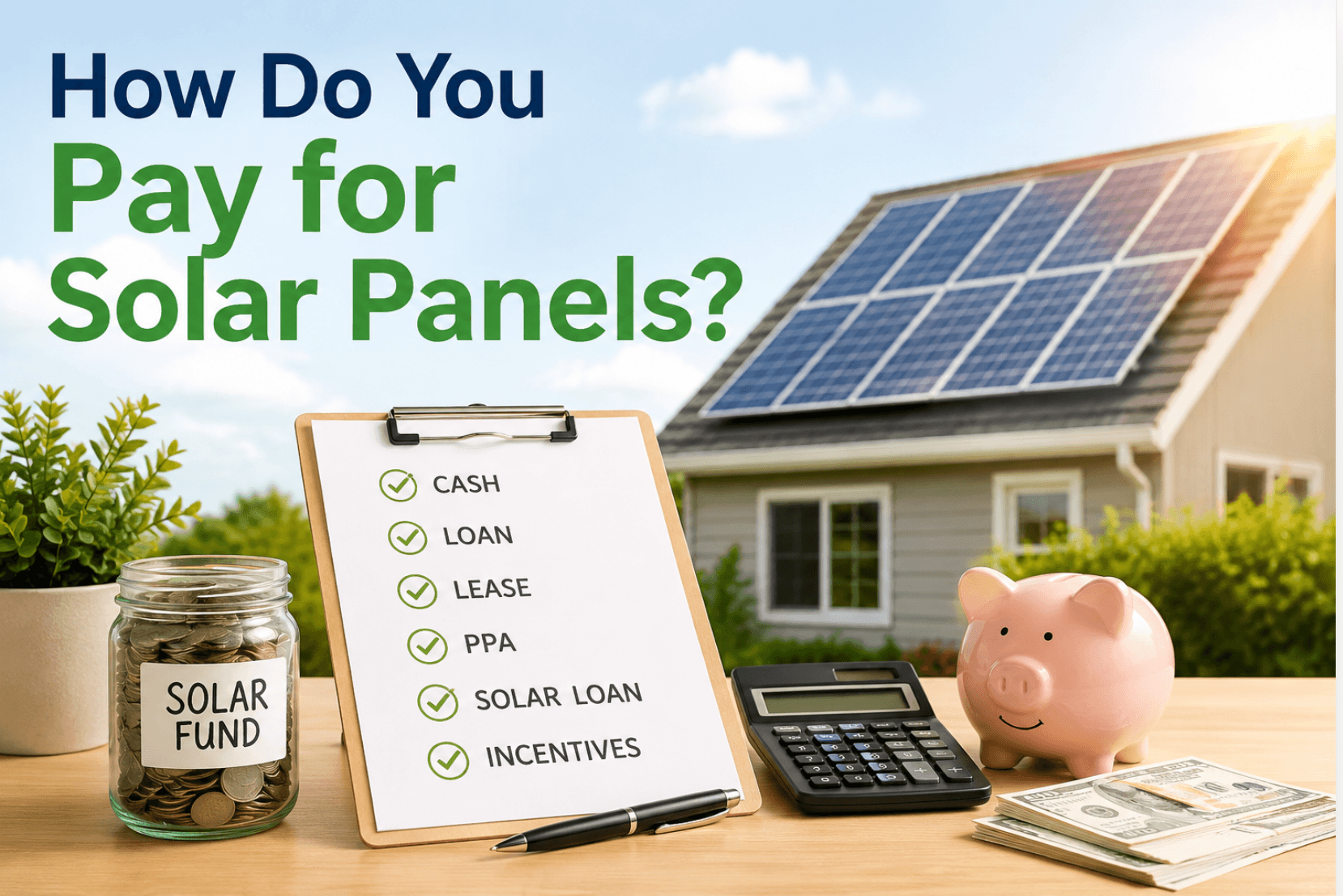
If you’re considering going solar, one of the first questions you’ll ask is simple but important: how do you pay for solar panels?
The good news is that you have more options today than ever before. Whether you have cash on hand, prefer to finance over time, or want little to no money down, there’s a payment path that fits almost every budget.
In this guide, I’ll walk you through every major way to pay for a solar panel system, the pros and cons of each, and how to decide which option saves you the most money over the life of your installation.
How Do You Pay for Solar Panels?
There are five primary ways to pay for solar panels:
- Cash purchase: pays upfront and owns the system outright
- Solar loan: finance the system and own it as you pay it off
- Solar lease: rent the system for a fixed monthly payment
- Power Purchase Agreement (PPA) — pay only for the electricity the panels produce
- Home equity financing (HELOC or home equity loan): borrows against your home’s value
Each option changes who owns the system, how much you save, and whether you qualify for incentives. Let’s break them down.
Paying Cash for Solar Panels
Paying cash means you cover the full cost of the system upfront, typically between $15,000 and $30,000 before incentives for a residential installation.
Pros
Maximum lifetime savings
With no interest or financing fees, you keep every dollar the panels save on your electricity bills.
You own the system immediately
which means you qualify for tax credits, rebates, and any net metering benefits.
Higher home value
Owned solar systems typically increase a property’s resale value.
No monthly payments beyond your reduced utility bill.
Cons
High upfront cost
Not everyone has tens of thousands of dollars available.
Opportunity cost
That money could potentially earn returns if invested elsewhere.
Best for
Homeowners who have the savings available and want the fastest payback period and highest long-term return.
Solar Loans
A solar loan lets you finance your system with little or no money down while still owning the panels.
You make monthly payments over a term, usually 5 to 25 years, and once the loan is paid off, the system is fully yours.
Pros:
- Own the system while spreading out the cost, so you still qualify for tax credits and incentives.
- Low or no money down options are widely available.
- Monthly loan payments often cost less than your previous electricity bill.
Cons:
- You pay interest, which raises the total lifetime cost compared to paying cash.
- A credit check is required, and your rate depends on your credit score.
Best for
Homeowners who want ownership benefits but don’t want to pay everything upfront. There are two common loan structures:
- Secured solar loans use your home or the system as collateral, offering lower interest rates.
- Unsecured solar loans require no collateral but typically carry higher rates.
Solar Leases
With a solar lease, a solar company installs and owns the panels on your roof. You pay a fixed monthly amount to use the system, and the provider handles maintenance and repairs.
Pros
- Little to no upfront cost.
- Maintenance is handled by the leasing company.
- Predictable monthly payment.
Cons
- You don’t own the system, so the tax credits and incentives go to the leasing company, not you.
- Lower overall savings than owning.
- Can complicate a home sale, since the buyer must agree to take over the lease.
Best for
Homeowners who want solar with minimal upfront cost and effort and who prioritize convenience over maximum savings.
Power Purchase Agreements (PPAs)
A PPA is similar to a lease, but instead of paying a fixed amount to use the equipment, you pay for the electricity the system generates at a set per-kilowatt-hour rate, usually lower than your utility’s rate.
Pros
- No upfront cost.
- You only pay for the power produced.
- Maintenance and monitoring are included.
Cons:
- You don’t own the system or qualify for incentives.
- Rates may escalate annually based on the contract terms.
- Long-term savings are smaller than ownership options.
Best for
Homeowners who want to reduce their electricity bill immediately with zero upfront investment and don’t mind not owning the equipment.
Home Equity Loans and HELOCs
If you have equity built up in your home, you can use a home equity loan or home equity line of credit (HELOC) to fund your solar installation. You still own the system, so you keep all the incentives.
Pros
- Often lower interest rates than unsecured solar loans, since your home secures the debt.
- You own the system and qualify for tax credits.
- Potential tax-deductible interest (check with a tax professional).
Cons:
- Your home is collateral, so missed payments put your property at risk.
- Requires sufficient home equity to qualify.
Best for
Homeowners with strong equity who want a low-interest way to finance while retaining ownership.
How Solar Incentives Affect What You Pay
No matter how you pay, incentives can dramatically lower your net cost, but only if you own the system:
- Federal tax credits can reduce a significant portion of your installation cost.
- State and local rebates may further cut the price.
- Net metering lets you earn credits for excess power you send back to the grid.
This is the single biggest reason ownership options (cash, loans, and home equity) typically beat leases and PPAs in long-term value. With a lease or PPA, the third-party owner claims those incentives instead of you.
Cash vs. Financing: Which Saves More?
Here’s the simple breakdown
- Paying cash gives you the highest total savings and the shortest payback period, but requires the most upfront capital.
- Solar loans and home equity let you own the system and capture incentives while spreading out the cost, at the price of interest.
- Leases and PPAs offer the lowest barrier to entry but the smallest long-term savings because you forfeit ownership and incentives.
If your goal is maximum lifetime savings and you can afford it, cash wins. If you want ownership without a large upfront payment, a solar loan or HELOC is usually the smart middle ground.
How to Decide the Right Payment Method for You
Ask yourself these questions
Do I have cash available without straining my finances?
If yes, cash offers the best return.
Do I want to own the system and claim incentives?
If yes, choose cash, a solar loan, or home equity.
Is my priority low upfront cost and convenience?
If yes, a lease or PPA may suit you.
Do I have strong home equity and good credit?
A HELOC may offer the lowest financing rate.
Frequently Asked Questions
Can you get solar panels with no money down?
Yes. Solar loans, leases, and PPAs all commonly offer $0-down options. The difference is that with a $0-down loan, you still own the system, while with a lease or PPA, you do not.
Is it better to lease or buy solar panels?
Buying (with cash or a loan) almost always delivers greater long-term savings because you own the system and qualify for tax credits and rebates.
Leasing makes sense mainly when you want minimal upfront cost and don’t want to manage maintenance.
Do solar loans cost more than paying cash?
Yes, because you pay interest over the loan term. However, the monthly loan payment is often lower than your old electricity bill, so you can still save money from day one while spreading out the cost.
Will solar panels increase my home value?
Owned solar systems typically increase resale value. Leased systems or PPAs can complicate a sale because the buyer must agree to take over the contract.
What credit score do I need for a solar loan?
Requirements vary by lender, but stronger credit scores unlock lower interest rates. Some lenders work with a wide range of credit profiles, though rates rise as scores drop.
Final Thoughts
So, how do you pay for solar panels? You choose the path that matches your finances and goals. If you can pay cash, you’ll capture the greatest savings and the fastest return.
If you’d rather finance, a solar loan or home equity option lets you own the system and keep all the incentives while spreading out the cost.
And if your top priority is going solar with little money down and minimal hassle, a lease or PPA can get panels on your roof quickly.
Whatever you choose, the key is to compare quotes from multiple installers, factor in available incentives, and calculate your true payback period.
Done right, solar isn’t just an environmental decision; it’s one of the smartest long-term investments you can make in your home.
Seki Hudson is an ANCE-certified solar technician with hands-on experience in solar system design and installation.
The information in this article is for general educational purposes and does not constitute financial advice. Consult a qualified financial or tax professional before making financing decisions.
