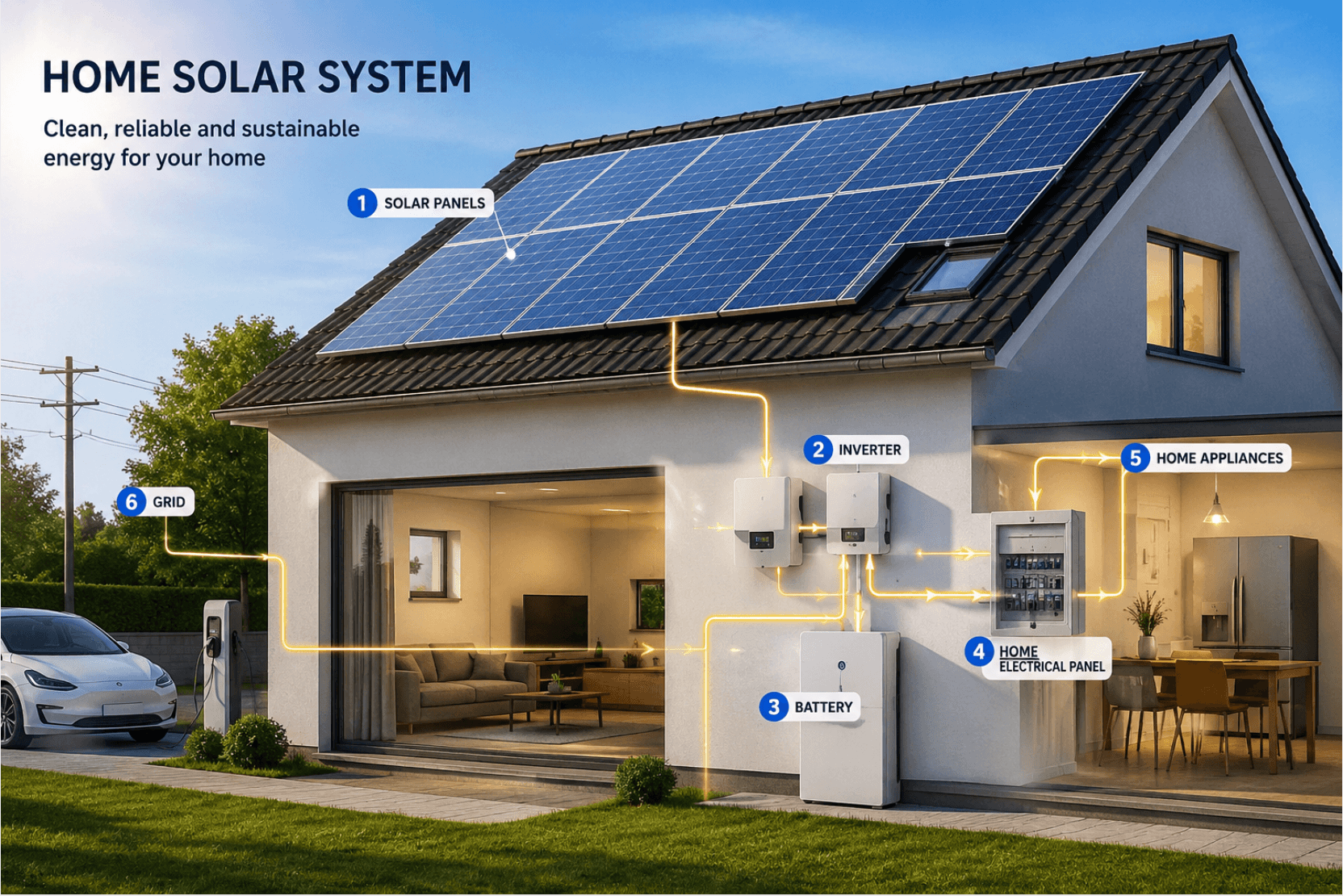
Switching to a home solar system is one of the highest-return upgrades you can make to a property, but only if you size it correctly, choose the right components, and understand what you’re actually buying.
As a certified solar technician who spent years designing and commissioning residential and commercial PV installations, I’ve seen the difference between a system that pays for itself in seven years and one that quietly underperforms for a decade.
This guide walks you through everything you need to know before you spend a peso or a dollar: how a home solar system works, what it costs, the components involved, how to size it for your house, and how to decide whether it’s worth it for you.
What Is a Home Solar System?
A home solar system is a collection of equipment that converts sunlight into usable electricity for your house.
At its simplest, sunlight hits solar panels mounted on your roof, the panels produce direct current (DC) electricity, and an inverter converts that DC into the alternating current (AC) your appliances actually run on.
Beyond that core function, modern systems can store excess energy in batteries, feed surplus power back to the grid for credit, and monitor production in real time from your phone.
The right configuration depends on your goals: lower bills, energy independence, backup during outages, or all three.
How a Home Solar System Works
The process is straightforward once you understand the energy flow.
Sunlight strikes the panels
Photovoltaic (PV) cells in each panel absorb photons and release electrons, generating DC electricity.
The inverter converts DC to AC
Your home’s wiring and appliances use AC, so the inverter is essential. Systems use either a single-string inverter, multiple microinverters (one per panel), or a hybrid inverter when batteries are involved.
Electricity powers your home
The AC flows into your electrical panel and supplies your lights, appliances, and outlets.
Surplus goes to storage or the grid
Power you don’t use immediately either charges a battery or, under net metering, exports to the utility in exchange for bill credits.
You draw from the grid or battery when needed
At night or on cloudy days, your home pulls from stored battery power or the grid.
The Main Components of a Home Solar System
Understanding the parts helps you ask better questions and avoid being oversold.
Solar Panels
The panels are the most visible component. The two dominant types are monocrystalline (higher efficiency, sleeker black appearance, slightly higher cost) and polycrystalline (lower cost, marginally lower efficiency, bluish tint).
For most homes with limited roof space, monocrystalline panels deliver more power per square meter and are worth the modest premium.
Inverter
The inverter is the brain of the system and, frankly, the component most likely to fail first. String inverters are economical for simple roofs with consistent sun exposure.
Microinverters cost more but maximize output when shading or multiple roof angles are involved, and they let you monitor each panel individually.
Mounting and Racking
Racking secures panels to your roof or to a ground mount at the optimal tilt and orientation. Quality racking is non-negotiable. It’s what keeps your array on the roof through wind and weather for 25-plus years.
Batteries (Optional)
Battery storage lets you use solar power after sunset and provides backup during outages.
Lithium-ion batteries dominate the residential market for their cycle life and depth of discharge.
Batteries add high cost, so they make the most sense if you have frequent outages or no favorable net metering.
Monitoring System
A monitoring app or device shows real-time and historical production. This is how you catch underperformance early: a panel that suddenly drops output, a failing inverter, or accumulated soiling on the array.
How Much Does a Home Solar System Cost?
Cost depends heavily on your location, system size, component quality, and whether you add batteries. As a general framework.
- System size is the biggest driver. Residential systems typically range from 3 kW to 10 kW.
- Batteries can add a substantial amount, often 30 to 50 percent on top of the panel-and-inverter cost.
- Installation labor and permitting vary widely by region and installer.
Rather than fixating on a sticker price, focus on cost per watt installed and your projected payback period, the number of years until your electricity savings equal your upfront investment.
A well-designed system in a sunny region with good net metering commonly pays back in 6 to 10 years and then produces nearly free electricity for the remainder of its 25-plus-year lifespan.
Because incentives, tax credits, and electricity rates change frequently and differ by country, confirm current local programs before budgeting. (If you’re in Mexico, for example, the net metering arrangement under your CFE contract significantly affects the math.)
How to Size a Home Solar System
Sizing is where most DIY estimates go wrong. The goal is to match your system’s annual production to your annual consumption.
Find your annual usage in kWh
Pull 12 months of electricity bills and total the kilowatt-hours.
Find your local production ratio
This is how many kWh a 1 kW system produces per year in your area, driven by sun hours, panel tilt, and orientation.
Divide usage by the production ratio to get the approximate system size in kW you need.
Adjust for roof space, shading, and budget
Real roofs rarely allow the theoretically perfect array, so refine based on what your roof can actually hold and how much sun it gets.
A south-facing roof (in the Northern Hemisphere) with minimal shading and a tilt close to your latitude will outproduce a shaded, poorly oriented one by a wide margin, sometimes 20 to 30 percent, so orientation matters as much as panel count.
On-Grid vs. Off-Grid vs. Hybrid Systems
There are three core configurations.
Grid-tied (on-grid)
Connected to the utility, no batteries. Cheapest and most common. You export surplus for credit and draw from the grid at night. The drawback: most grid-tied systems shut off during a blackout for safety.
Off-grid
No utility connection, fully battery-backed. Necessary in remote locations, but expensive and requires careful sizing to avoid running out of power.
Hybrid
Grid-tied plus battery storage. You get bill savings, backup power during outages, and flexibility. It’s the most capable and most costly setup.
For most suburban homes with reliable grid access and net metering, a grid-tied system offers the best return. Add batteries only if outages or unfavorable utility policies justify the cost.
Is a Home Solar System Worth It?
For the right house, solar is one of the few home upgrades that genuinely pays for itself. It makes the most sense when you have:
- High electricity bills and consumption
- A suitable, unshaded roof with good orientation
- Favorable net metering or feed-in arrangements
- Plans to stay in the home long enough to reach payback
It makes less sense if your bills are already low, your roof is heavily shaded, you’ll move within a few years, or local incentives and rates make the economics marginal.
The honest answer is that solar is worth it for most homeowners with meaningful consumption and decent sun, but the details of your roof, your bills, and your local utility policy determine whether it’s a great investment or merely an okay one.
Common Mistakes to Avoid
After years in the field, the recurring errors I see are oversizing to chase a bigger rebate, undersizing to save money upfront and then regretting it, skimping on inverter and racking quality, ignoring shading analysis, and neglecting maintenance.
A home solar system is largely passive, but it isn’t entirely set-and-forget; periodic cleaning and monitoring protect your return.
Final Thoughts
A home solar system is a long-term infrastructure investment, not a gadget. Get the sizing right, choose durable components, understand your local net metering rules, and the system will quietly cut your bills for decades.
Start by pulling your last 12 months of electricity bills. Everything else flows from knowing exactly how much energy your home actually uses.
Frequently Asked Questions
How long does a home solar system last?
Quality solar panels carry performance warranties of 25 years and often produce usefully beyond that. Inverters typically need replacement once during that span, usually after 10 to 15 years.
Can a home solar system power my whole house?
Yes, if it’s sized to your consumption. Whether it covers 100 percent of your usage year-round depends on your roof space, sun exposure, and whether you add battery storage for nighttime use.
Do solar panels work on cloudy days?
Yes, but at reduced output, typically 10 to 25 percent of their rated capacity, depending on cloud density. Annual production figures already account for normal weather patterns.
Do I need batteries for a home solar system?
No. Grid-tied systems work without batteries by using the grid as virtual storage through net metering. Batteries are optional and primarily add value for backup power and energy independence.
How much maintenance does a home solar system need?
Very little, occasional cleaning to remove dust and debris, plus monitoring production to catch any drops early. There are no moving parts in the panels themselves.
