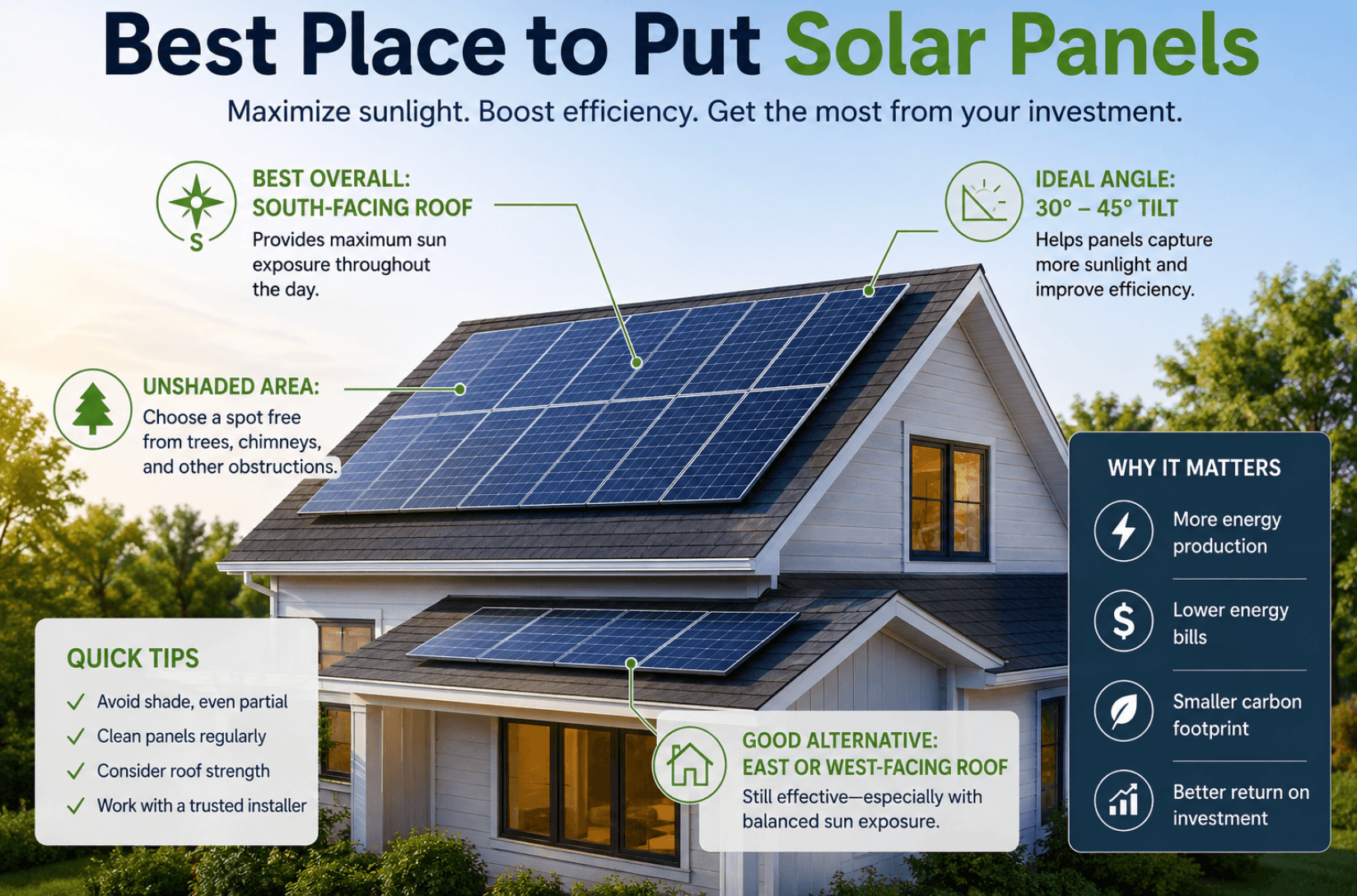
Choosing the best place to put solar panels is the single most important decision you’ll make before installation, more important than the brand of panel you buy.
A premium module in a poor location will underperform a budget panel placed correctly. After designing and installing solar systems across residential and commercial sites, I can tell you that placement is where most of the lost energy hides.
In this guide, I’ll walk you through exactly where to put your solar panels to capture the most sunlight, including roof versus ground options, the ideal direction and tilt, and the shading mistakes that quietly drain output year after year.
Quick Answer: Where Should Solar Panels Go?
The best place to put solar panels is on a south-facing surface (in the Northern Hemisphere) that is free of shade from 9 a.m. to 3 p.m., tilted at an angle roughly equal to your latitude, and structurally sound enough to hold the array for 25+ years.
For most homes, that means a south-facing roof slope. When the roof can’t deliver those conditions, a ground-mounted array is the better choice.
Why Solar Panel Placement Matters So Much
A solar panel only produces power when photons hit its cells. Anything that reduces the quantity, angle, or duration of that sunlight cuts directly into your energy production and your savings.
Poor placement can reduce a system’s annual output by 25% or more, enough to add years to your payback period.
The three factors you control through placement are.
- Orientation (azimuth): the compass direction the panels face.
- Tilt angle: how steeply the panels are pitched relative to the ground.
- Shading: anything blocking direct sunlight during peak hours.
Get these right, and even a modest system will outperform a larger one that was poorly sited.
Roof vs. Ground: Choosing the Right Foundation
Rooftop Solar Panels
For most homeowners, the roof is the best place to put solar panels. It uses otherwise unused space, keeps panels out of reach, and is usually the most cost-effective option because the mounting structure is minimal.
A roof is a strong candidate when it is.
- Faces south, southeast, or southwest.
- Has a slope between 15° and 40°.
- Is in good condition with 20+ years of life remaining.
- Stays clear of shade during midday hours.
If your roof needs replacing within a few years, do it before installing solar; removing and reinstalling an array is an expensive, avoidable cost.
Ground-Mounted Solar Panels
Ground mounts are the best place to put solar panels when your roof is shaded, north-facing, too small, structurally weak, or simply the wrong shape.
They cost more because of the racking and foundation work, but they offer advantages a roof can’t.
- You set the exact optimal tilt and orientation.
- Panels stay cooler thanks to airflow on both sides, which slightly improves efficiency.
- Cleaning and maintenance are far easier.
- You can add tracking systems that follow the sun.
If you have available land and want maximum lifetime output, a ground mount is hard to beat.
The Best Direction to Face Solar Panels
In the Northern Hemisphere, true south is the gold standard. South-facing panels capture the most consistent sunlight across the entire day and throughout the year.
That said, southeast and southwest orientations are still excellent, typically losing only a small percentage of annual production.
East- and west-facing arrays are viable too, especially if your electricity rates are higher in the morning or evening; a west-facing array can shift production toward those costly afternoon peak hours.
Avoid pure north-facing roofs (in the Northern Hemisphere) whenever possible, as they receive the least direct sunlight.
Note for readers near the equator
In tropical locations, the sun passes nearly overhead, so orientation matters less and a near-flat tilt can work well, though a slight pitch still helps panels self-clean in the rain.
The Best Tilt Angle for Solar Panels
A reliable rule of thumb is to set the tilt angle equal to your latitude. A site at 22° latitude performs well with panels tilted around 22°.
You can fine-tune from there:
- Maximize annual output: tilt ≈ your latitude.
- Favor winter production: add about 15° to your latitude.
- Favor summer production: subtract about 15°.
On a rooftop, you’re often limited to the existing roof pitch, which is usually close enough. On a ground mount, you can dial in the perfect angle.
Avoiding Shade: The Silent Output Killer
Shade is the most underestimated factor in panel placement. Because panels are wired in series, shade on a single panel can drag down the output of an entire string, not just that one module.
Watch for these shade sources
- Trees (remember they grow taller and that bare winter branches still cast shade).
- Chimneys, vents, and satellite dishes.
- Neighboring buildings and walls.
- Other rows of panels cast shadows on each other.
Map the sun’s path across all four seasons before committing to a location. If partial shade is unavoidable, microinverters or power optimizers let each panel operate independently, recovering much of the energy a string inverter would lose.
Other Placement Considerations
Proximity to the inverter and main panel:
Shorter cable runs mean lower cost and fewer losses.
Roof material and structure:
Confirm the structure can carry the load; some materials are harder to mount than others.
Accessibility for maintenance
You’ll want to clean and inspect the array safely.
Local codes and HOA rules:
Check setback requirements and any aesthetic restrictions before you design the layout.
Recommended Tools for Planning Placement
If you want to assess your own site before calling an installer, a few inexpensive tools help enormously.
- A solar compass/inclinometer to measure roof orientation and pitch.
- A solar pathfinder or shade-analysis tool to map shading across the year.
- A digital angle finder for setting ground-mount tilt accurately.
Frequently Asked Questions
What is the best place to put solar panels on a house?
A south-facing roof slope with a tilt near your latitude and no midday shading is ideal. If no roof slope qualifies, a ground-mounted array gives you full control over orientation and tilt.
Do solar panels work if they don’t face south?
Yes. East- and west-facing panels still produce strong output and can be advantageous if your utility charges more during morning or evening peak hours. Only north-facing surfaces (in the Northern Hemisphere) should generally be avoided.
How much does shade reduce solar panel output?
It depends on timing and severity, but shade during peak midday hours is the most damaging. Because panels are wired together, shade on one can reduce a whole string of microinverters or optimizers, limiting this loss.
Is a ground mount better than a roof mount?
Ground mounts produce more per panel because you control tilt and orientation, and panels stay cooler, but they cost more to install. Roof mounts are more cost-effective when the roof is well-oriented and unshaded.
What tilt angle is best for solar panels?
Setting tilt equal to your latitude maximizes year-round production. Increase it for better winter output or decrease it for summer.
Final Thoughts
The best place to put solar panels comes down to four things working together: a sunny, south-facing surface, the right tilt, minimal shading, and a sound structure. Nail those and your system will quietly pay you back for decades.
If you’re evaluating your own roof or yard, start by tracking where the sun falls across a full day. That single observation will tell you more about your best placement than any spec sheet.
