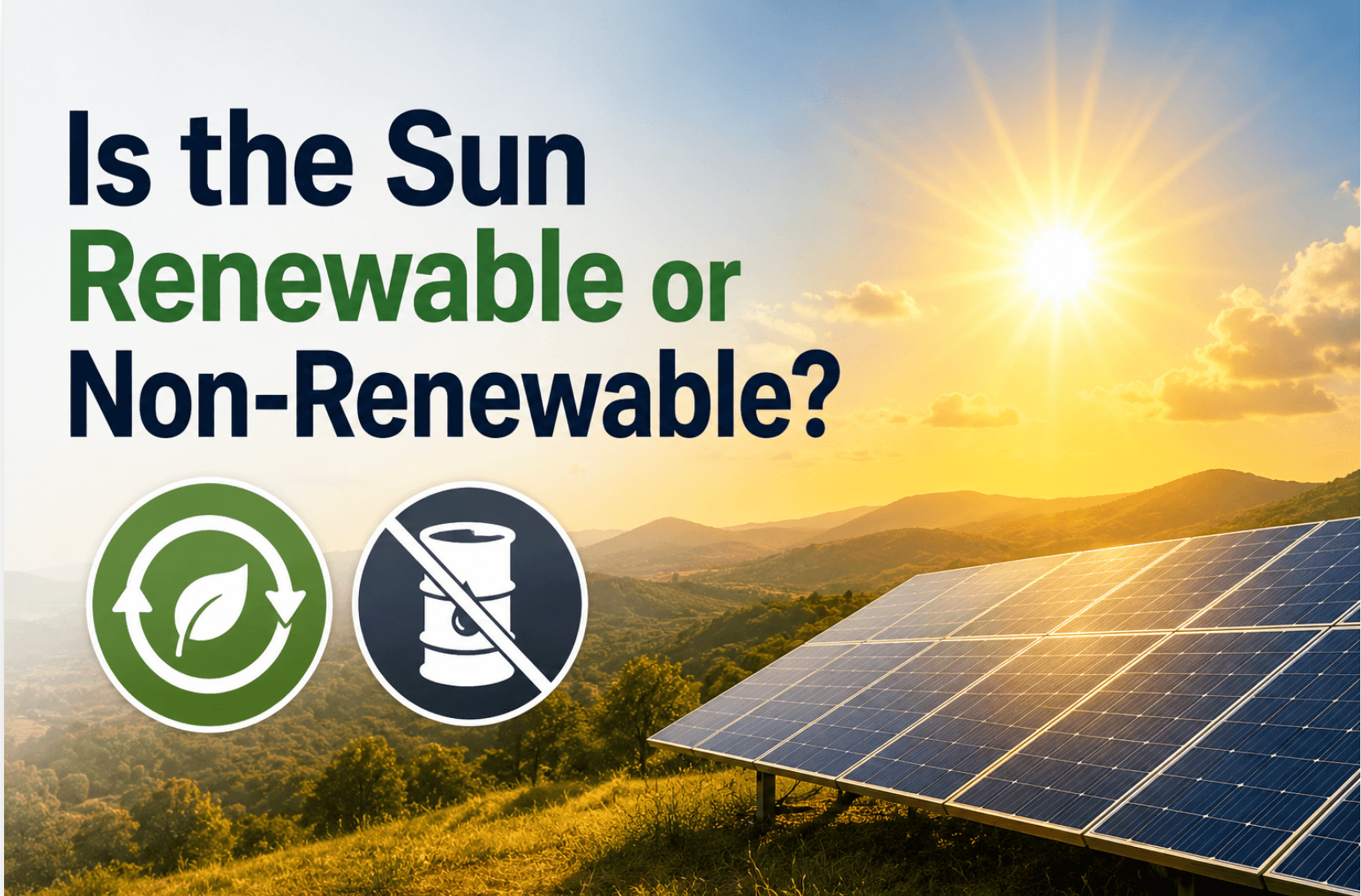
The sun is a renewable energy source. Sunlight reaches Earth continuously and won’t run out on any timescale that matters to human civilization, making solar power one of the cleanest and most sustainable energy options available today.
But there’s more nuance to this question than a one-word answer captures, and understanding it helps you appreciate why solar energy is such a smart long-term investment. Let’s break it down.
What Does “Renewable” Actually Mean?
A renewable energy source is one that naturally replenishes faster than we consume it, on a human timescale.
Sunlight, wind, flowing water, and geothermal heat all qualify because nature keeps supplying them no matter how much we use.
A non-renewable energy source, by contrast, exists in a fixed amount that took millions of years to form and is being depleted far faster than it can be replaced.
Coal, oil, and natural gas are the classic examples. Once burned, they’re gone for practical purposes.
By this definition, the sun is firmly in the renewable camp.
Why the Sun Is Considered Renewable
Here are the core reasons solar energy is classified as renewable.
Sunlight Is Continuously Replenished
Every day, the sun delivers a staggering amount of energy to Earth. In fact, the amount of solar energy striking the planet’s surface in roughly one hour is more than all of humanity consumes in an entire year.
Tomorrow it does the same thing again. There’s no depletion. We capture a tiny fraction, and the rest simply continues.
Using Solar Energy Doesn’t Reduce the Supply
When you burn a barrel of oil, that barrel is gone. When your solar panel converts sunlight into electricity, it takes nothing away from the sun and nothing away from the next panel down the street. The resource is non-rival in this sense, which is exactly what makes it sustainable.
It Will Last Billions of years
The sun is roughly 4.6 billion years old and has enough hydrogen fuel to keep shining for approximately 5 billion more years. For any human, business, or civilization planning purpose, that’s effectively infinite.
The Technical Nuance: Is the Sun Truly Infinite?
Here’s where curious readers deserve an honest answer. Strictly speaking, the sun is a giant nuclear-fusion reactor burning a finite amount of hydrogen.
One day billions of years from now, it will exhaust that fuel, expand into a red giant, and eventually fade.
So in the most literal, astronomical sense, the sun’s fuel is finite.
Does this make it non-renewable?
No. The “renewable vs. non-renewable” classification is based on human timescales, not cosmic ones.
A resource that lasts billions of years and replenishes daily is, for every practical and scientific purpose, renewable.
By the time the sun runs low, humanity’s energy concerns will be unrecognizably different (or moot).
This is why every energy agency, scientist, and engineer classifies solar as renewable without hesitation.
Solar Energy vs. Fossil Fuels at a Glance
| Feature | Solar (Sun) | Fossil Fuels |
|---|---|---|
| Renewable? | ✅ Yes | ❌ No |
| Replenishes naturally | Daily | Over millions of years |
| Depletes when used | No | Yes |
| Greenhouse gas emissions | Minimal (in operation) | High |
| Lifespan of source | ~5 billion years | Decades to a century at current use |
| Cost trend over time | Falling | Volatile / rising |
Is Solar Energy the Same as Renewable Energy?
Not exactly; solar is one type of renewable energy. The renewable family also includes the following.
- Wind energy (driven, indirectly, by the sun heating the atmosphere)
- Hydropower (driven by the sun’s role in the water cycle)
- Geothermal energy (heat from Earth’s interior)
- Biomass (plant matter that stores solar energy via photosynthesis)
Interestingly, the sun is the indirect engine behind most renewables. Wind, rain, and plant growth all trace back to solar energy. That makes the sun arguably the most important renewable resource of all.
Why This Matters for Homeowners and Businesses
Understanding that the sun is renewable isn’t just trivia—it has real financial and practical implications:
Energy security
Your fuel source can’t be embargoed, mined out, or run dry.
Predictable costs
Once you install panels, the “fuel” is free and unlimited for the system’s 25+ year lifespan.
Environmental impact
Generating power from sunlight produces no emissions during operation, unlike burning gas or coal.
Long-term value
As fossil fuels become scarcer and more expensive, a renewable source like solar only grows more attractive.
This is the foundational reason solar adoption continues to accelerate worldwide.
Frequently Asked Questions
Is solar energy renewable or non-renewable?
Solar energy is renewable. Sunlight is continuously supplied to Earth and isn’t depleted by use, making it a sustainable, long-term energy source.
Will the sun ever run out of energy?
The sun will eventually exhaust its hydrogen fuel in roughly 5 billion years. On any human or civilizational timescale, however, it’s effectively limitless, which is why it’s classified as renewable.
Why is the sun considered a renewable resource if its fuel is finite?
The renewable classification is based on human timescales. Because the sun replenishes sunlight daily and will last billions of years, it qualifies as renewable despite being technically finite in the very long-term astronomical sense.
Is solar power better than fossil fuels?
For sustainability and emissions, yes, solar is renewable and produces minimal pollution during operation, while fossil fuels are non-renewable and emit significant greenhouse gases.
Is the sun the source of other renewable energy too?
Yes. The sun indirectly powers wind, hydropower, and biomass, making it the foundation of most renewable energy on Earth.
The Bottom Line
The sun is a renewable energy source, full stop. While it technically runs on finite hydrogen fuel, it replenishes Earth with energy every single day and will continue doing so for billions of years.
For homeowners, businesses, and the planet, that makes solar one of the most reliable and sustainable energy choices available.
If you’re considering harnessing this endless resource for your own home, exploring how solar panels capture and convert sunlight is the natural next step.
Written by Seki Hudson, an ANCE-certified solar technician. Solarfuturista is dedicated to helping you make smart, informed decisions about clean energy.
