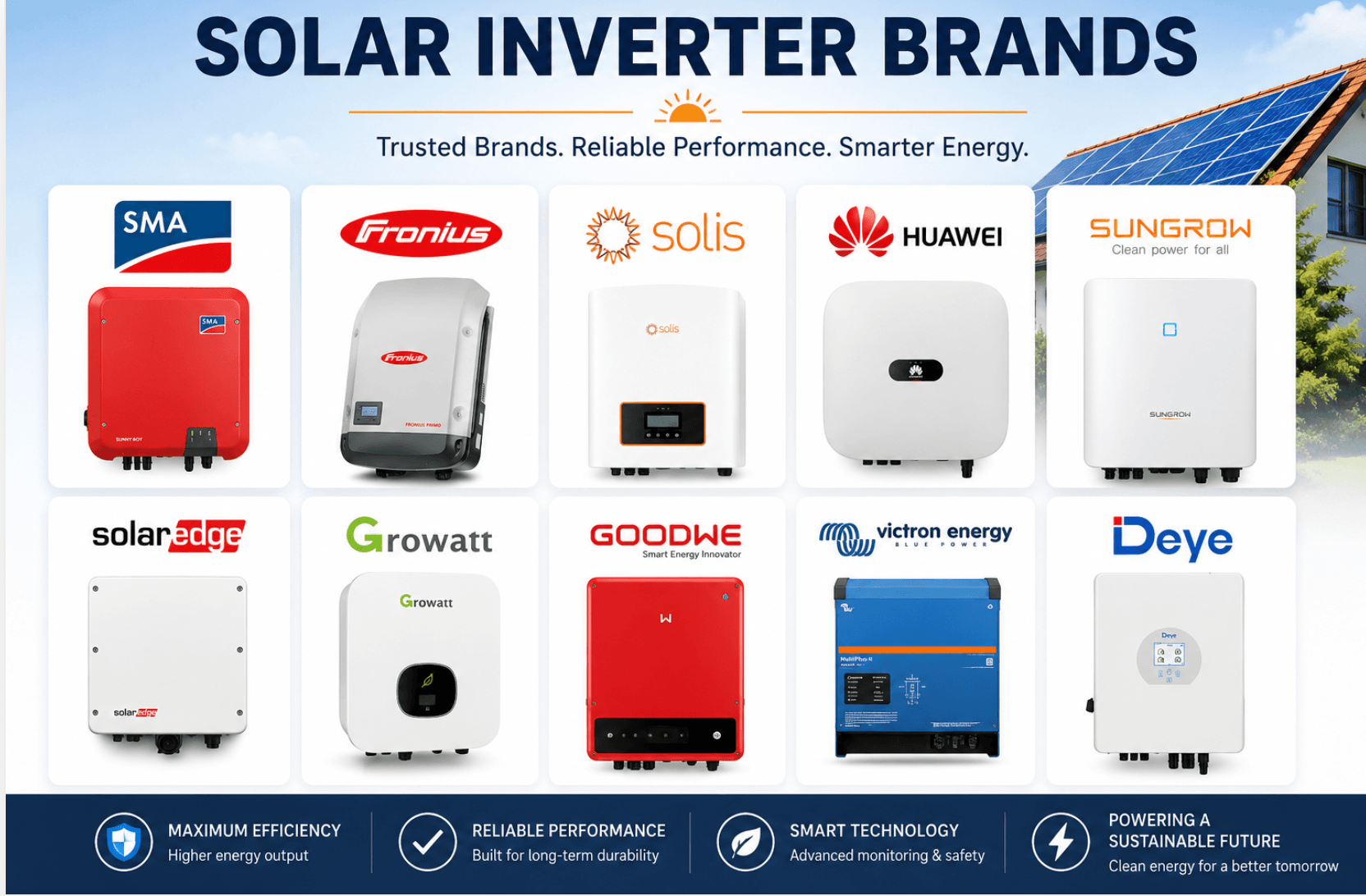
The inverter is the brain of your solar system. It converts the DC electricity your panels produce into the AC power your home runs on, and it handles monitoring, safety shutdown, and performance tracking over its 25-year life.
Choosing among the many solar inverter brands on the market is arguably more consequential than choosing the panels themselves, because an inverter from a company that disappears in ten years leaves you with no warranty support and an expensive replacement.
After two decades working in industrial automation and a career built around control and power-conversion systems, I’ve learned that brand selection comes down to three unglamorous factors: efficiency, warranty strength, and the manufacturer’s long-term financial stability.
A spec-sheet champion from a company that may not exist in 15 years is a worse buy than a slightly less efficient unit from a stable brand with local support.
This guide ranks the leading manufacturers across the three main inverter categories and tells you which brand fits which situation.
Quick take
There is no single best brand for everyone. SolarEdge and Enphase dominate residential rooftops, SMA and Fronius lead on reliability and three-phase work, and Sol-Ark, Growatt, and Sungrow are the names to watch in hybrid and energy-storage systems.
The Three Types of Solar Inverters
Before comparing brands, you need to know which category you’re shopping in, because most manufacturers specialize.
String inverters connect a series (“string”) of panels to a single central unit. They’re the most affordable option and need fewer components, which makes them ideal for simple, unshaded roofs and ground mounts.
The drawback: if one panel underperforms from shade or debris, it drags down the whole string, and expanding the system later is harder.
Microinverters sit under each panel, converting power at the module level. This gives you panel-level monitoring and means shade on one panel doesn’t affect the rest, making them the best choice for complex, multi-plane, or partially shaded roofs. They cost more and put more electronics on the roof, but they’re easy to expand later.
Hybrid inverters combine grid-tied solar conversion with battery charging and backup power in a single unit. With roughly 40% of new solar buyers wanting storage from day one, hybrid inverters are the fastest-growing category and the right pick for anyone planning a battery now or later.
How to Evaluate Solar Inverter Brands
When you compare manufacturers, weigh these five criteria rather than chasing the lowest price.
Efficiency
Look for a CEC-weighted conversion efficiency between 96% and 99%. Every percentage point is energy you paid for but never used.
Warranty length and coverage
Microinverters and premium string inverters now reach 25 years; budget units often offer 10–12. Read what’s actually covered (labor? shipping?).
Manufacturer stability
A 25-year warranty is only as good as the company behind it. Favor brands with a long track record and a strong balance sheet.
Monitoring quality
Panel-level versus system-level data, app usability, and remote diagnostics matter for catching faults early.
Local support and installer familiarity
A brand your regional installers know, and stock will be serviced faster and more cheaply than an exotic import.
The Best Solar Inverter Brands of 2026
SolarEdge: Best Overall for Complex Roofs
SolarEdge pairs a central string inverter with power optimizers on each panel, giving you module-level performance with string-inverter pricing.
Its HD Wave line is frequently rated the best inverter overall, hitting up to 99% efficiency. It’s the go-to for complicated or shaded roofs where you want optimization without going fully micro.
Check current SolarEdge HD Wave pricing on Amazon →
Enphase: Best Microinverter Brand
Enphase is the most popular inverter brand on major solar marketplaces, and for good reason. Its IQ8 microinverters deliver true panel-level conversion and monitoring, plus a class-leading 25-year warranty.
The tradeoff is cost. Enphase systems are among the most expensive per watt, and CEC efficiency sits near 97%, slightly below SolarEdge. For shaded or multi-plane roofs where reliability is the priority, it’s the benchmark.
See Enphase IQ8 microinverter options on Amazon →
SMA (Sunny Boy / Sunny Tripower): Best for Reliability and Three-Phase
The German manufacturer SMA is one of the most established names in the industry and a reliability gold standard.
Sunny Boy residential and Sunny Tripower commercial lines are favorites for three-phase and ground-mount installations where durability matters more than bells and whistles.
Fronius: Best Premium String Inverter
Austria’s Fronius rivals SMA on build quality and is prized for its smart-grid features, active cooling design, and excellent monitoring.
It’s a premium choice for homeowners and installers who want a string inverter that will run trouble-free for decades.
Sol-Ark: Best for Energy Storage and Backup
Sol-Ark has become the standout name in all-in-one hybrid inverters, combining solar generation, battery storage, and whole-home backup in flexible high-capacity units.
If battery backup and off-grid resilience are your main goals, Sol-Ark belongs at the top of your list.
Compare Sol-Ark hybrid inverter models on Amazon →
Tesla: Best for an Integrated Powerwall Ecosystem
Tesla’s solar inverter is designed to work seamlessly with the Powerwall battery and the Tesla app. The integration and clean monitoring experience are excellent, but the standard 10-year warranty trails the 25-year coverage of Enphase and others, so factor a likely mid-life replacement into your numbers.
SolaX Power: Best Hybrid Value
SolaX has carved out a strong position with high-efficiency hybrid inverters and all-in-one storage systems aimed at modern smart homes.
Its broad lineup spans balcony-sized residential units up to commercial systems, backed by a growing network of certified distributors.
Sungrow: Best Global Workhorse
Sungrow is one of the largest inverter makers in the world by volume and has improved dramatically in reliability.
It offers strong value across residential, commercial, and utility-scale projects and is increasingly common on installer line cards worldwide.
Growatt: Best Budget Hybrid
Growatt delivers affordable string and hybrid inverters with solid app monitoring, making it a popular entry point for cost-conscious off-grid and hybrid builds. It isn’t yet at the reliability tier of SMA or Fronius, but the value proposition is hard to beat.
Hoymiles: Best Budget Microinverter Alternative
Hoymiles offers microinverters at a lower price than Enphase and has gained meaningful global market share.
It’s a sensible choice for budget-minded module-level installs, though installer familiarity varies by region.
Huawei (FusionSolar): Best Smart-Home Integration
Huawei’s FusionSolar inverters bring advanced smart controls, IoT modules, and automatic restart features that bring power back online on their own when the sun or the grid returns. Availability and policy considerations vary by market, so check local support before committing.
EcoFlow: Best for Plug-and-Play and Portable Solar
EcoFlow has moved from portable power stations into home inverter and storage territory, offering approachable plug-and-play systems for homeowners who want simplicity over maximum customization.
Solar Inverter Brands Comparison Table
| Brand | Best For | Type | Typical Warranty | Efficiency |
|---|---|---|---|---|
| SolarEdge | Complex/shaded roofs | Optimized string | 12–25 yrs | Up to 99% |
| Enphase | Reliability, module-level | Microinverter | 25 yrs | ~97% |
| SMA | Three-phase, ground mounts | String | 10+ yrs | ~97–98% |
| Fronius | Premium string | String | 10+ yrs | ~97–98% |
| Sol-Ark | Battery backup/off-grid | Hybrid | 10+ yrs | ~97% |
| Tesla | Powerwall ecosystem | String | 10 yrs | ~98% |
| SolaX | Hybrid value | Hybrid | 10+ yrs | ~97–98% |
| Sungrow | Global value | String/Hybrid | 10+ yrs | ~98% |
| Growatt | Budget hybrid | String/Hybrid | 5–10 yrs | ~97% |
| Hoymiles | Budget microinverter | Microinverter | 12–25 yrs | ~96–97% |
| Huawei | Smart-home integration | String/Hybrid | 10 yrs | ~98% |
| EcoFlow | Plug-and-play | Hybrid | 10 yrs | ~97% |
Efficiency and warranty figures vary by specific model and region; confirm on the current spec sheet before purchase.
Which Solar Inverter Brand Should You Choose?
Match the brand to your situation rather than reaching for the most hyped name.
- Simple, sunny roof on a budget → SMA or Sungrow string inverter.
- Complex or partially shaded roof → SolarEdge optimizers or Enphase microinverters.
- You want batteries and backup → Sol-Ark, SolaX, or Tesla (if you’re in the Powerwall ecosystem).
- Maximum long-term reliability → SMA or Fronius.
- Lowest upfront cost → Growatt or Hoymiles, accepting shorter warranties.
Frequently Asked Questions
What is the most reliable solar inverter brand?
SMA and Fronius are widely regarded as the most reliable string inverter brands, while Enphase leads among microinverters thanks to its 25-year warranty and module-level redundancy.
Are microinverters worth the extra cost?
For shaded, complex, or multi-plane roofs, yes, the per-panel optimization and easy future expansion usually justify the premium. For a simple, unshaded roof, a quality string inverter delivers similar output for less.
How long do solar inverters last?
String inverters typically last 10–15 years and may need one replacement during a system’s 25-year life. Premium microinverters and optimized systems are now warrantied for the full 25 years.
Which brand is best for off-grid or battery systems?
Sol-Ark leads for all-in-one hybrid and backup applications, with SolaX and Growatt as strong value alternatives.
Final Verdict
If you want one safe default, SolarEdge for optimized rooftops and Enphase for microinverters are the residential standards in 2026, while SMA and Fronius remain the reliability benchmarks for string systems, and Sol-Ark owns the battery-backup category.
Whatever you choose, prioritize warranty strength and manufacturer stability over a few points of efficiency.
The brand that’s still around to honor its warranty in 15 years is the one that protects your investment.
Seki Hudson is an ANCE-certified solar energy technician and industrial automation engineer specializing in power conversion and safety systems. He writes about practical solar design and equipment selection at solarfuturista.com.
Disclosure: This article contains affiliate links. If you purchase through them, we may earn a commission at no extra cost to you.
