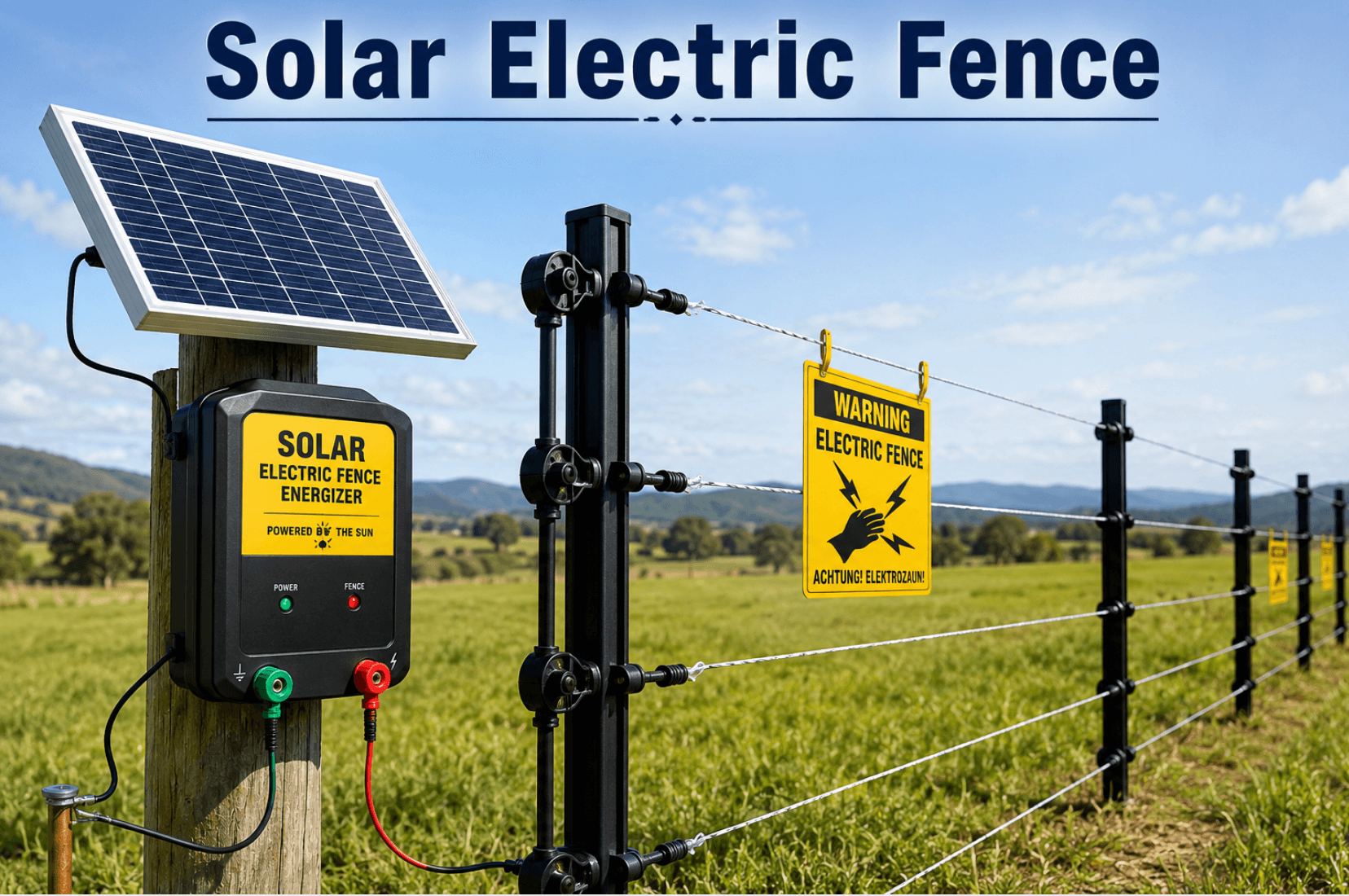
A solar electric fence uses sunlight to power the energizer that sends pulses through your fence wire: no grid connection, no extension cords, and no monthly electricity cost.
For ranchers, hobby farmers, and rural property owners, it’s often the single most practical way to keep livestock in and predators out across land that mains power will never reach.
This guide walks through how a solar electric fence works, what components you need, how to size the system correctly, installation steps, and how to choose a kit that won’t leave your animals unprotected when the weather turns.
As someone who spent years on solar systems engineering before moving into industrial safety, I’ll keep the technical parts honest.
There’s a lot of marketing fluff in this space, and undersized energizers cause more failed fences than anything else.
What Is a Solar Electric Fence?
A solar electric fence is a fencing system powered by a solar panel and battery rather than mains electricity.
A solar panel charges a deep-cycle battery during daylight; the battery feeds an energizer (also called a charger or fencer); and the energizer delivers short, high-voltage, low-current pulses through the fence wire.
Anything that touches the wire and the ground at the same time completes the circuit and receives a sharp but safe shock.
The shock is a psychological barrier, not a physical one. Animals learn quickly to respect the fence after one or two contacts, which is why even a lightweight solar fence can contain large livestock.
How Does a Solar Electric Fence Work?
The system runs on a simple energy chain. Understanding it helps you troubleshoot later when something stops working.
- A solar panel captures sunlight and converts it to DC electricity.
- A charge controller (built into most modern units) regulates the current flowing into the battery to prevent overcharging.
- Battery stores energy so the fence stays live overnight and through cloudy days.
- Energizer draws from the battery and converts stored power into rhythmic high-voltage pulses, typically about one per second.
- Fence wire carries the pulse around the perimeter.
- The grounding system completes the circuit when an animal makes contact.
The grounding system is the most misunderstood part. A fence that won’t shock is, nine times out of ten, poorly grounded, not low on battery. More on that below.
Components of a Solar Electric Fence System
Solar Panel
Sized in watts, the panel must generate enough daily energy to replace what the energizer consumes, plus a buffer for cloudy stretches. Small garden units use 5–10W panels; serious livestock fences use 20–40W or more.
Battery
A 12V deep-cycle battery is standard. Deep-cycle batteries tolerate repeated discharge far better than car batteries, which fail quickly in this role. Capacity is rated in amp-hours (Ah); more Ah means more days of autonomy without sun.
Energizer (Charger)
Rated in joules, the single most important spec. Output joules determine how much fence the unit can power and how it performs in heavy vegetation. Buy more joules than you think you need.
Fence Wire, Posts, and Insulators
Options include polywire, polytape, and galvanized steel wire. Insulators isolate the live wire from posts so the charge stays in the fence instead of leaking to the ground.
Grounding Rods
Galvanized rods driven into the soil. A common rule is one meter (3 feet) of ground rod per output joule of the energizer. Sandy or dry soil needs more grounding than damp clay.
How to Size a Solar Electric Fence
Sizing failures are the number-one reason solar fences disappoint. Work through these factors before buying.
Fence length
Total wire run, including every strand. A three-strand fence around a 1 km perimeter is 3 km of wire.
Animal type
Cattle need less voltage than wool-covered sheep or thick-coated predators. Match the energizer’s recommended species.
Vegetation load
Weeds and grass touching the wire drain power. In overgrown areas, double your joule estimate.
Sun exposure
Cloudy or northern locations need larger panels and batteries for the same fence.
As a rough starting point, match energizer output to fence length: lighter-duty units (around 0.5J) suit short garden fences, while multi-acre livestock perimeters often need 2J or more.
When in doubt, oversize the energizer and the panel. The cost difference is small, and the reliability gain is large.
How to Install a Solar Electric Fence: Step by Step
Plan the layout
Map the perimeter, mark corners and gate points, and calculate total wire length.
Set the posts
Install sturdy corner and end posts first; these take the tension, then space line posts evenly.
Drive the ground rods
Install your grounding rods near the energizer location, spaced about 3 meters apart, connected with ground wire.
Mount the panel and energizer
Position the solar panel facing the equator (south in the Northern Hemisphere, north in the Southern Hemisphere) at an angle roughly equal to your latitude, with no shading.
Run and tension the wire
Attach insulators, string the wire, and tension it without over-straining lightweight materials.
Connect everything
Wire the panel to the controller/battery, the battery to the energizer, and the energizer’s fence terminal to the live wire and its ground terminal to the ground rods.
Test with a fence-voltage tester
Healthy livestock fences usually read 4,000–6,000+ volts on the wire. A low reading points to grounding problems, vegetation contact, or a wire short.
Solar Electric Fence vs. Mains-Powered Fence
Both deliver the same shock; the difference is the power source. Mains fences offer unlimited, consistent power and lower upfront cost where an outlet exists.
Solar fences win on remote land, eliminate ongoing electricity bills, and keep working through grid outages.
For most rural perimeters beyond the reach of an outlet, solar isn’t a compromise. It’s the only viable option, and it pays back the equipment cost over a few seasons of avoided trenching and wiring.
Common Problems and How to Fix Them
Low or no voltage
Almost always grounding. Add ground rods, especially in dry soil. Then check for vegetation contact and wire breaks.
The battery dies on cloudy days
The panel or battery is undersized. Upsize the panel, add battery capacity, or reduce the energizer’s load.
Panel underperforming
Check for shading and dirt, and confirm the panel angle and orientation.
Animals escaping
Voltage too low for the species, wire spacing wrong for the animal’s height, or the fence isn’t yet “trained” into the herd.
Frequently Asked Questions
Do solar electric fences work at night?
Yes. The battery stores daytime energy and keeps the fence alive around the clock. A correctly sized battery holds enough charge to run through several days of poor weather.
Are solar electric fences safe for animals and people?
Yes. Energizers deliver high voltage but extremely low current in brief pulses, producing a sharp but harmless shock. They’re designed to deter, not injure.
How long do solar electric fence batteries last?
A quality deep-cycle battery typically lasts three to five years before it needs replacing, depending on climate, depth of discharge, and how often the system runs flat.
What size solar electric fence do I need for my property?
Base it on total wire length, animal type, vegetation, and sun exposure. As a default, oversize both the energizer (joules) and the panel (watts) to cover cloudy spells and growing-season weed load.
Can I run an existing electric fence on solar power?
Often yes. If you already have a 12V DC energizer, you can frequently add a solar panel, charge controller, and deep-cycle battery to convert it to solar — as long as the panel can keep up with the energizer’s draw.
Final Thoughts
A solar electric fence is one of the most cost-effective ways to secure remote land, and the technology has matured to the point where an all-in-one kit can run reliably for years with almost no maintenance.
The two things that separate a fence that works from one that frustrates you are correct sizing and proper grounding.
Get those right and oversize where you’re unsure, and the system will quietly do its job through every season.
Ready to choose a system? Compare solar electric fence kits and energizers sized for your perimeter and livestock.
