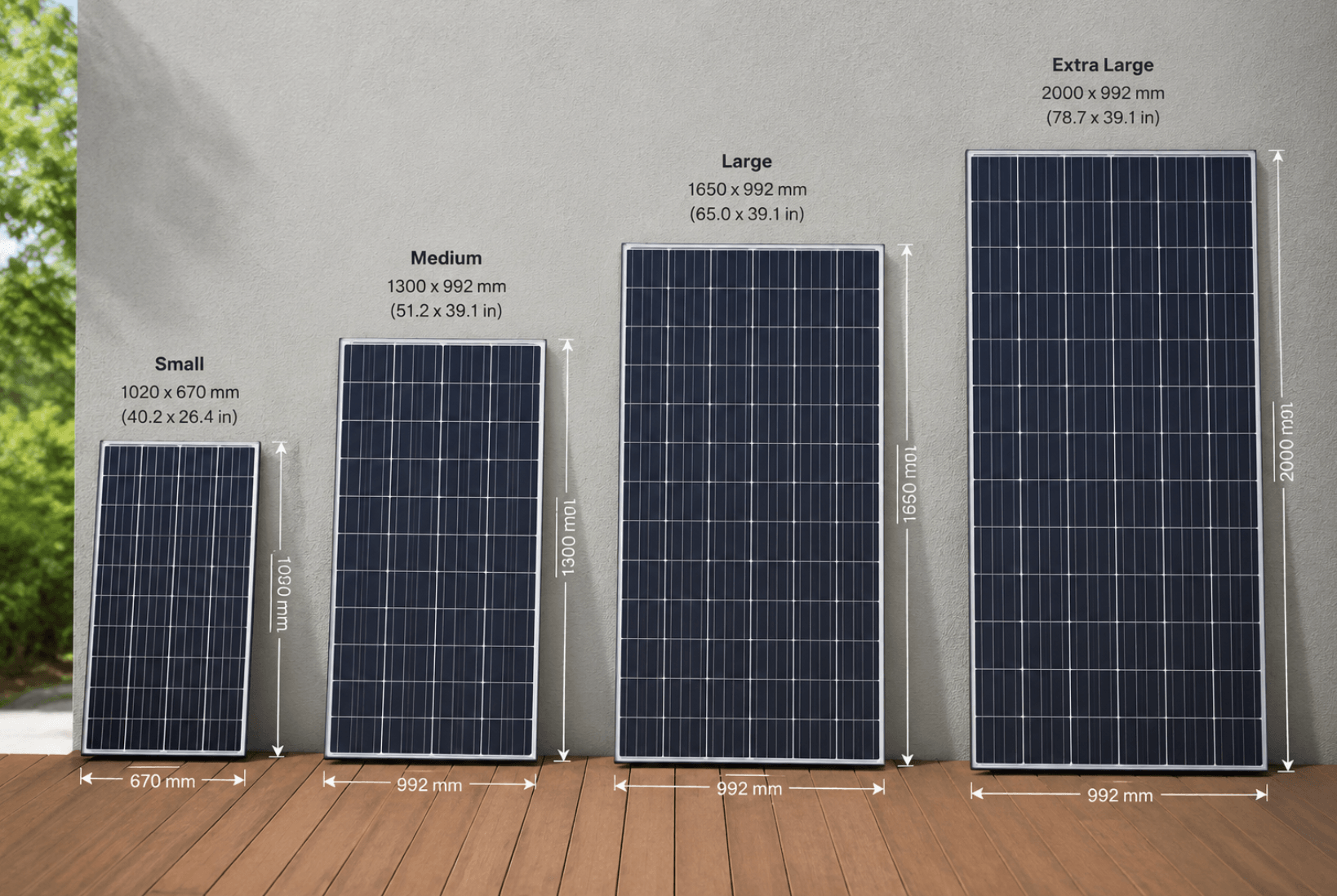
When I first started designing solar systems years ago, the question I heard most from clients wasn’t about wattage or efficiency; it was simply, “Will these fit on my roof?”
Solar panel dimensions decide everything downstream: how many modules you can install, how much power you can generate, and whether your roof layout actually works.
In this guide, I’ll walk you through the standard sizes, what drives the variation, and how to translate dimensions into real planning numbers.
Quick Answer: Standard Solar Panel Dimensions
Most modern solar panels fall into two broad categories
Residential panels (60/120-cell)
roughly 1.7 m x 1.0 m (about 65 x 39 inches), or 5.4 x 3.25 feet.
Commercial panels (72/144-cell)
roughly 2.0 m x 1.0 m (about 78 x 39 inches), or 6.5 x 3.25 feet.
The width is remarkably consistent at around 1 meter (39 inches) across almost every manufacturer. It’s the length that changes based on how many cells the panel holds.
Why Solar Panel Sizes Vary
The single biggest factor in panel dimensions is cell count. A solar panel is just a grid of individual photovoltaic cells wired together, and each standard cell is about 156–166 mm square (or split in half on modern “half-cut” designs).
| Panel Type | Cell Count | Typical Dimensions (L x W) | Common Wattage |
|---|---|---|---|
| Residential | 60 (or 120 half-cut) | 1.65–1.70 m x 1.0 m | 350–420 W |
| Commercial | 72 (or 144 half-cut) | 2.0–2.1 m x 1.0 m | 450–550 W |
| Compact/specialty | 36–48 | varies | 100–250 W |
Two trends have nudged sizes up in recent years. First, larger wafer formats (the shift from M2 to larger M10 and G12 cells) made individual cells bigger, so high-output commercial panels grew slightly.
Second, half-cut cell technology doubled the cell count without changing physical size much; a “120-cell” panel is dimensionally the same as the old 60-cell unit because each cell was simply cut in two.
Solar Panel Thickness and Weight
Dimensions aren’t just length and width. Two often-overlooked specs matter for installation.
Thickness
Typically 30–40 mm (1.2–1.6 inches), set mostly by the aluminum frame depth. Frameless and thin-film panels can be much thinner.
Weight
Residential panels weigh about 18–23 kg (40–50 lbs); larger commercial panels run 27–32 kg (60–70 lbs).
Weight is a real structural consideration. A typical residential array adds roughly 12–18 kg per square meter (2.5–3.7 lbs/sq ft), including mounting hardware, well within the capacity of most sound roofs, but worth verifying on older structures.
How Much Roof Space Do You Need?
This is where dimensions become genuinely useful. A practical rule of thumb:
You need roughly 6–8 m² (65–85 sq ft) of usable roof area per kilowatt (kW) of solar capacity.
Here’s how that scales for common system sizes, assuming ~400 W residential panels.
| System Size | Approx. Panels Needed | Approx. Roof Area |
|---|---|---|
| 3 kW | 7–8 | 13–17 m² |
| 5 kW | 12–13 | 22–28 m² |
| 8 kW | 20 | 35–45 m² |
| 10 kW | 25 | 45–55 m² |
Remember to budget for spacing and setbacks. Fire codes and maintenance access usually require gaps around the array edges, so your usable roof area is always smaller than your total roof area.
Calculating Panel Layout for Your Roof
To work out how many panels fit, do this simple exercise:
- Measure your usable roof area (length x width of the clear, unshaded section).
- Pick a panel and note its exact dimensions from the spec sheet; never assume.
- Decide orientation, portrait (panels stand tall) or landscape (panels lie wide). This changes how rows pack onto your roof.
- Divide and round down. Divide the available area by the single-panel area, then subtract a panel or two for spacing and obstructions like vents and chimneys.
A worked example
A usable roof of 6 m x 4 m = 24 m². With a residential panel at 1.7 m² each, that’s a theoretical 14 panels, but realistically plan for around 12 once you account for spacing and roof obstructions.
Do Bigger Panels Mean More Power?
Not necessarily, and this trips people up. A larger panel usually produces more watts simply because it has more cells, but efficiency (watts per square meter) is the metric that matters when roof space is tight. A compact, high-efficiency panel can outproduce a larger, cheaper one in the same footprint.
If your roof is generous, larger commercial panels reduce the number of modules and connections you need.
If your roof is small or oddly shaped, prioritize high-efficiency residential panels that squeeze maximum output from every square meter.
Frequently Asked Questions
What are the standard solar panel dimensions?
A standard residential solar panel is about 1.7 m x 1.0 m (65 x 39 inches), while commercial panels are about 2.0 m x 1.0 m (78 x 39 inches). Width stays near 1 meter across brands; length depends on cell count.
How thick is a solar panel?
Most framed panels are 30–40 mm (1.2–1.6 inches) thick, determined mainly by the aluminum frame.
How much does a solar panel weigh?
Residential panels weigh roughly 18–23 kg (40–50 lbs); larger commercial panels weigh 27–32 kg (60–70 lbs).
How many solar panels fit on a roof?
It depends on the usable area. As a guide, plan for about 6–8 m² per kW, then subtract space for setbacks, vents, and access paths.
Are all solar panels the same size?
No. Cell count, wafer format, and panel type (residential vs. commercial vs. specialty) all change dimensions, though width is fairly standardized.
Final Thoughts
Solar panel dimensions are deceptively simple but central to good system design. Once you know the standard sizes, roughly 1.7 m for residential and 2.0 m for commercial panels, both about a meter wide, you can estimate roof capacity, panel count, and structural load with confidence.
My advice from the field: always pull the exact dimensions from the manufacturer’s spec sheet before finalizing a layout, because even a few centimeters can change how many panels fit a row. Measure twice, design once.
