Choosing a solar inverter might not be the most exciting part of going solar, but it’s one of the most important decisions you’ll make.
The inverter is the brain of your solar system. It converts the DC electricity your panels produce into the AC electricity your home actually uses.
And right now, two technologies dominate the residential solar market: string inverters and microinverters.
Both work. Both have happy customers. But they perform very differently depending on your roof, your budget, and your long-term goals.
This guide breaks down everything you need to know about string inverters vs. microinverters so you can make a confident, informed decision before you sign a single contract.
How to Choose the Right Solar Inverter for Your Home or Business
What Is a String Inverter?
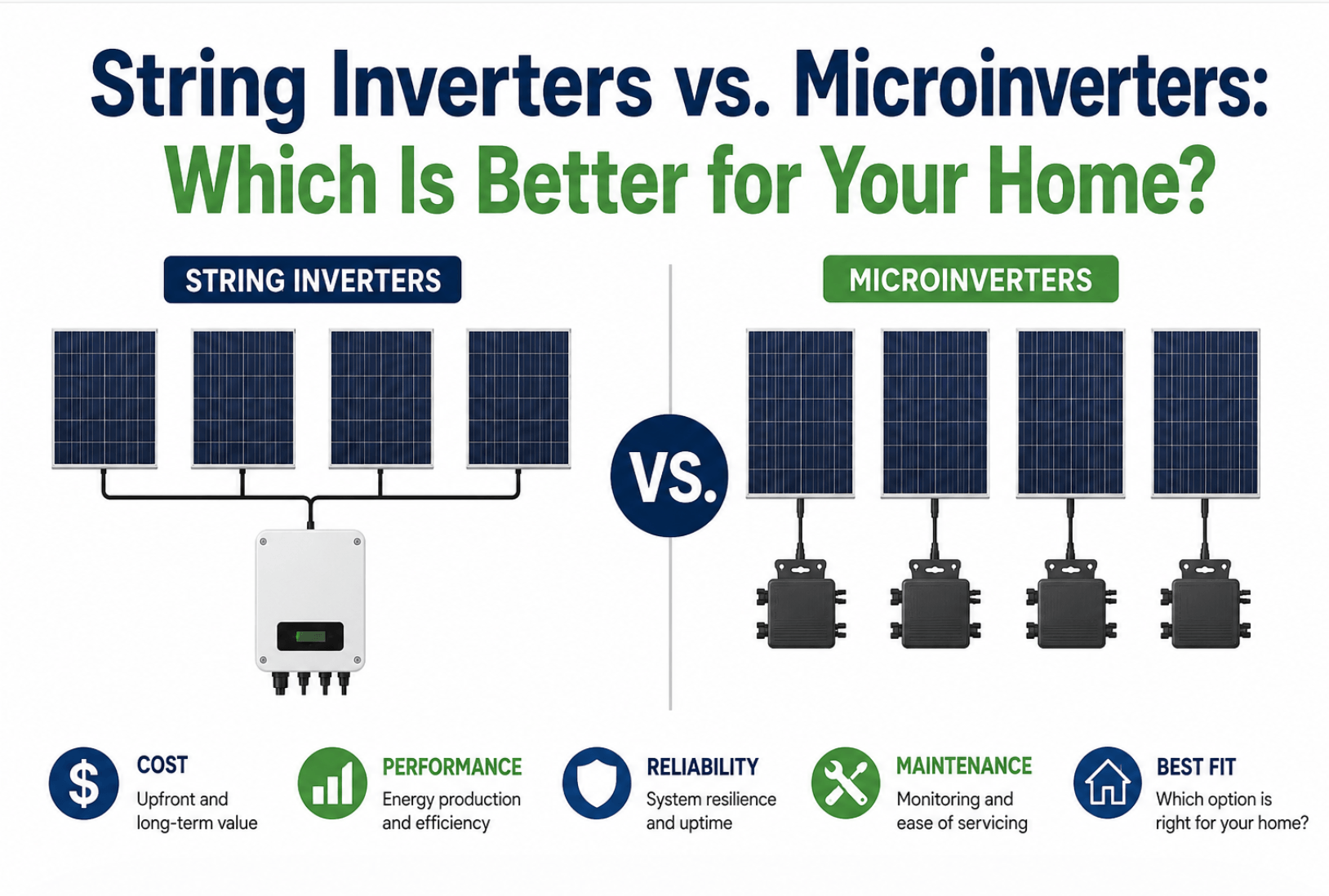
A string inverter is a single, centralized device that handles the DC-to-AC conversion for your entire solar array.
Your solar panels are wired in series, called a “string,” and that string feeds into a single inverter, typically mounted on an exterior wall near your electrical panel.
String inverters have been the industry standard for decades. They’re simple, well-understood, and widely serviced. Most residential installations in the 5–15 kW range still use them.
How String Inverters Work
Each panel in a string produces DC power. That power travels along the string to the inverter, which converts the combined output into usable AC electricity.
Because all panels feed into a single unit, the inverter processes the entire array’s output in one place.
The catch
The string is the weakest link. If one panel is shaded, dirty, or underperforming, the output of every panel in that string is dragged down to match it. This is the defining limitation of string inverter technology.
What Is a Microinverter?
A microinverter is a small inverter attached directly to each solar panel, one per panel. Instead of converting DC to AC at a central point, the conversion happens right at the panel itself.
Enphase Energy pioneered this technology and remains the dominant player. Today, microinverters are standard on millions of residential installations worldwide.
How Microinverters Work
Each panel operates independently. Its microinverter handles the DC-to-AC conversion on the spot, and AC power flows from each panel directly into your home’s electrical system. Because there’s no shared string, one underperforming panel has zero effect on its neighbors.
String Inverters vs. Microinverters: Side-by-Side Comparison
| Feature | String Inverter | Microinverter |
|---|---|---|
| Cost | Lower upfront | Higher upfront (~20–30% more) |
| Efficiency (ideal conditions) | 96–98% | 96–97% |
| Shading tolerance | Poor | Excellent |
| Panel-level monitoring | No (add-on required) | Yes (built-in) |
| Installation complexity | Simpler | More labor-intensive |
| Lifespan | 10–15 years | 25 years (matches panels) |
| Maintenance | Single unit to service | Multiple units per roof |
| Scalability | More complex to expand | Easy to add panels |
| Safety | High-voltage DC on roof | Low-voltage AC (safer) |
| Warranty | 5–12 years typical | 25 years (Enphase IQ8) |
Performance: Where Each Technology Shines
String Inverters Perform Best When…
- Your roof faces a single direction (ideally south in the Northern Hemisphere)
- Your roof has little to no shading throughout the day
- All your panels are the same model and age
- You want the maximum output-per-dollar on a clean, unobstructed installation
Under these conditions, a quality string inverter like the SolarEdge HD-Wave or Fronius Primo will perform within a fraction of a microinverter system’s cost.
Microinverters Perform Best When…
- Your roof has multiple orientations (east/west split, L-shaped roof)
- There is partial shading from trees, chimneys, vents, or neighboring buildings
- You plan to expand your system over time
- You want panel-level data for monitoring and troubleshooting
In shaded or complex installations, microinverters can outperform string inverters by 10–25% in annual energy production. That gap is real, and it compounds over the years.
Cost Comparison: What Will You Actually Pay?
For a typical 8 kW residential system:
String Inverter System (with SolarEdge or Fronius):
- Inverter cost: $1,000 – $1,800
- Total installed system: $18,000 – $22,000 (before incentives)
Microinverter System (with Enphase IQ8):
- Microinverter cost: $2,500 – $3,500
- Total installed system: $21,000 – $26,000 (before incentives)
The price gap is real, typically $2,000 to $4,000 more for a microinverter system of equivalent capacity. Whether that premium is justified depends entirely on your specific roof and site conditions.
Important note
Many string inverter quotes now include power optimizers (like SolarEdge’s DC optimizers), which partially solve the shading problem. This creates a middle-ground option worth considering, but more on that below.
Lifespan and Warranty: The Long Game
This is where microinverters have a clear structural advantage.
A traditional string inverter lasts 10 to 15 years. Your solar panels are warrantied for 25–30 years.
That means almost every homeowner with a string inverter will face a mid-life inverter replacement, typically costing $1,000–$2,500 installed.
Microinverters from Enphase come with a 25-year warranty, matching your panels exactly. If your system is sized correctly, you could install it today and not touch the inverters for the life of the array.
When you factor in replacement costs over a 25-year horizon, the total cost of ownership between the two technologies becomes much closer than the upfront price difference suggests.
Monitoring and Visibility
Microinverters win this category without contest.
With a microinverter system, you get panel-level performance monitoring through apps like Enphase Enlighten.
You can see exactly how each panel is performing in real time, which means you’ll immediately notice if one panel is underperforming due to dirt, shading, or failure.
String inverters give you system-level data only. You’ll see total output, but you won’t know which panel is the problem unless you add a separate monitoring solution or power optimizers.
For homeowners who want visibility and control over their system, microinverters offer a significantly better monitoring experience.
Safety Considerations
This is an underappreciated difference between the two technologies.
String inverters carry high-voltage DC electricity (300–600V) from your rooftop panels down to the inverter. That high-voltage wiring runs across your roof and through your walls.
Microinverters convert power to low-voltage AC right at each panel. There is no high-voltage DC on your roof or in your conduit. This is meaningfully safer for installers, firefighters, and homeowners alike.
The National Electrical Code (NEC) has increasingly incorporated “rapid shutdown” requirements specifically to address the risks of high-voltage DC in string inverter systems. Microinverter systems are inherently compliant with rapid shutdown requirements.
What About Power Optimizers? (The Middle Option)
If you’re torn between the two, there’s a third path worth knowing about: DC power optimizers, most commonly offered by SolarEdge.
Power optimizers are small devices attached to each panel, similar to microinverters in placement, but they don’t do the DC-to-AC conversion on the roof.
Instead, they optimize each panel’s DC output individually before sending it to a central string inverter.
What optimizers solve.
- Shading and mismatch problems (each panel is optimized independently)
- Panel-level monitoring
- Rapid shutdown compliance
What optimizers don’t fully solve
- You still have a single central inverter that will eventually need replacement
- Not as modular as a full microinverter system
SolarEdge’s HD-Wave optimizer-plus-inverter system is one of the most popular residential configurations in the market today.
It offers most of the microinverters’ performance benefits at a price point closer to a traditional string inverter.
Which Is Better for Your Home? A Decision Framework
Rather than declaring one technology universally superior, here’s how to think through your specific situation:
Choose a String Inverter If
- Your roof has a single south-facing pitch with no shading
- You’re working with a tight budget and have a clean installation site
- You want a simpler system with fewer components on the roof
- You’re comfortable planning for a mid-life inverter replacement
Choose Microinverters If
- Your roof has multiple orientations or faces east/west
- There is shading from trees, chimneys, dormers, or neighboring structures during any part of the day
- You want the longest possible warranty with no planned mid-life replacement
- You plan to add panels over time (expansion is plug-and-play with microinverters)
- Safety and detailed monitoring are priorities
Consider Power Optimizers If
- You have some shading, but want to keep costs between the two options
- Your installer is a SolarEdge-certified partner with strong experience in optimizer systems
- You want panel-level monitoring without the full microinverter price premium
Top Brands to Know
String Inverters
- SolarEdge: Market leader in the US; excellent build quality and monitoring
- Fronius: Premium Austrian brand; excellent efficiency and support
- SMA: German engineering; highly regarded for commercial and residential use
Microinverters
- Enphase IQ8 Series: Industry standard; 25-year warranty; grid-forming capability (can work without grid power with Enphase IQ Battery)
- APsystems: Budget-friendly microinverters; widely installed globally
- Hoymiles: Growing market share; competitive pricing
Frequently Asked Questions
Are microinverters worth the extra cost?
For most homeowners with any shading, complex roofs, or long-term investment thinking, yes.
The 25-year warranty, panel-level monitoring, and elimination of mid-life replacement costs make the premium reasonable. For a clean, unshaded south-facing roof, a quality string inverter system may offer better value.
How long do microinverters last?
Enphase IQ microinverters carry a 25-year warranty and are designed to match the lifespan of the panels they’re attached to. Field data support the reliability of microinverter technology across decades of installation.
Can I mix string inverters and microinverters?
Not in a standard installation. The two technologies have fundamentally different wiring architectures. However, you can add microinverter-equipped panels to an existing microinverter system easily.
Do microinverters work during a power outage?
Standard microinverters shut down during grid outages (a safety requirement). However, Enphase IQ8 microinverters have a unique “grid-forming” capability.
When paired with Enphase IQ Batteries and the IQ System Controller, they can provide backup power during outages without additional hardware.
Is it harder to repair a microinverter system?
In one sense, yes, there are more components. But because each microinverter operates independently, a single failure doesn’t take down your system.
And since each unit is directly under its panel, the failed unit is precisely identified through the monitoring app, making diagnosis simple.
The Bottom Line
String inverters and microinverters are both proven, reliable technologies, but they serve different homes and different needs.
String inverters are the right call for simple, unshaded, budget-conscious installations where long-term ownership planning includes inverter replacement.
Microinverters are the right call for complex roofs, shaded environments, homeowners who want maximum visibility and flexibility, and anyone who values a truly maintenance-free 25-year system.
If you’re getting multiple quotes, ask every installer to specify the inverter brand and model, explain why they’re recommending it for your specific roof, and include monitoring in the proposal. The inverter decision deserves as much attention as the panels themselves.
Your solar system is a 25-year investment. Make sure the brain of that system is chosen as carefully as the rest.
