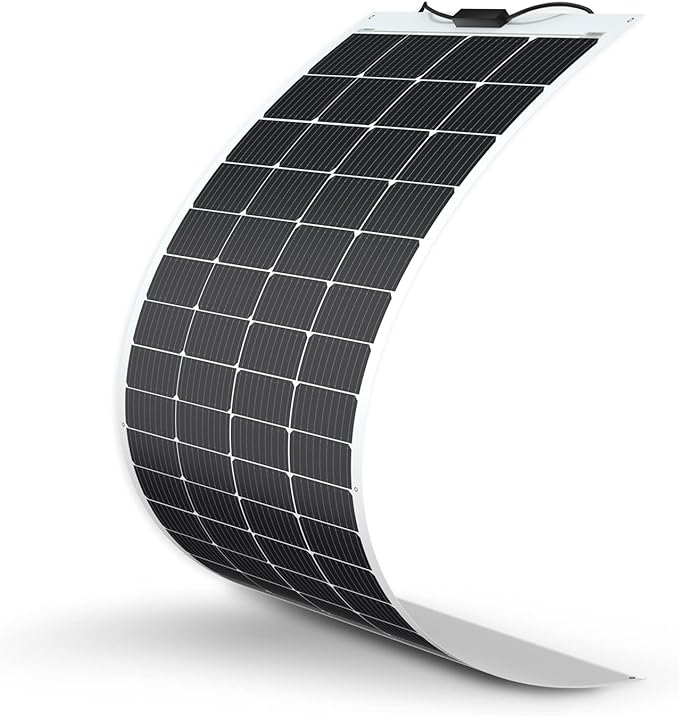
Flexible solar panels are transforming the way people think about solar energy. While traditional rigid panels dominate rooftop installations, flexible panels have carved out a unique niche powering RVs, boats, camper vans, tents, and surfaces that no conventional panel could ever reach.
If you have been wondering whether flexible solar panels are the right choice for your off-grid or mobile energy setup, this guide will give you every answer you need.
From how they work to how they compare with rigid panels, and from real-world use cases to the top products available in 2026, consider this your definitive reference.
What Are Flexible Solar Panels?
Flexible solar panels are photovoltaic (PV) modules built without a rigid glass front sheet or an aluminum frame. Instead, the solar cells are laminated between thin polymer layers, typically an ETFE (ethylene tetrafluoroethylene) front coat and a TPT or second ETFE back sheet, creating a module that can bend and conform to curved surfaces.
The key distinction is this: what makes a flexible panel flexible is not a different type of solar cell; it is the encapsulation material and the absence of glass.
Most high-performance flexible panels use the same monocrystalline silicon cells found in premium rigid panels.
The cells are interconnected with thin busbars and embedded in EVA or POE adhesive, which allows the stack to bend without cracking.
The result is a panel that is lightweight, thin (typically 2–4 mm), and able to conform to rooftops, hulls, and irregular surfaces that would otherwise be inaccessible to solar energy.
How Do Flexible Solar Panels Work?
Flexible solar panels operate on the same photovoltaic principle as any other solar panel. When sunlight strikes the silicon cells, photons knock electrons loose, creating an electric current.
This direct current (DC) electricity can then be used to charge batteries or run appliances through an inverter.
The construction differs from rigid panels in the following ways.
- Front layer: ETFE coating: UV-stable for 25+ years, hydrophobic, and scratch-resistant
- Cell layer: Monocrystalline or thin-film silicon cells connected by thin busbars
- Encapsulant: EVA or POE adhesive that binds the cell layer and allows controlled flexing
- Back layer: TPT polymer or a second ETFE sheet
This layered polymer sandwich allows the panel to follow the gentle curves of a van roof, a boat deck, a tent fly, without the electrical connections cracking.
However, there is a limit: most flexible panels can bend safely to between 30 and 260 degrees of arc, depending on the model and build quality.
Flexible vs. Rigid Solar Panels: Key Differences
Understanding where flexible panels win and where they do not is essential before making a purchase decision.
Weight and Profile
Rigid panels made from tempered glass and aluminum typically weigh 40 lbs or more per panel. Flexible panels weigh 70–80% less, with a 100W flexible panel often coming in at just 4–5 lbs.
Their thickness of 2–4 mm versus 35–40 mm for rigid panels also means minimal wind resistance and a near-flush profile on the mounting surface.
Efficiency
Rigid panels currently lead in efficiency. Premium monocrystalline rigid panels reach 22–23% efficiency in residential products, with research-grade perovskite-silicon tandem cells certified at 34.85% in lab conditions.
Flexible panels typically operate in the 18–23% range, with top-of-the-line N-type monocrystalline flexible panels now exceeding 23% efficiency in 2026.
The practical performance gap, however, is wider than the spec sheet suggests. Flexible panels mounted flush against a surface have no air gap beneath them, which causes heat buildup.
A 5 mm air gap during installation can recover 3–5% of output, a detail rarely mentioned in product listings.
Durability and Lifespan
This is where rigid panels have a significant advantage. Tempered glass is an extremely durable material.
Some glass-panel installations from 50 years ago are still generating power. The ETFE polymer surface of flexible panels, while UV-stable and hydrophobic, is far thinner and more susceptible to damage from punctures, heavy impacts, and prolonged UV exposure in extreme climates like Arizona or Texas.
Typical lifespans are: 25–30 years for rigid panels vs. 5–20 years for flexible panels, depending on installation quality and environmental conditions.
Marine environments with constant salt spray and movement tend to shorten flexible panel service life further.
Mounting
Rigid panels require racking systems, bolted rails, and flat or nearly flat surfaces. Flexible panels can be installed with marine-grade adhesive tape (such as 3M VHB), silicone-based adhesives, pre-drilled grommet holes, zip ties, or Velcro, no drilling required in many cases. This non-penetrating installation is a major advantage for waterproofing vehicle roofs.
Cost
Flexible panels typically cost 50–100% more per watt than comparable rigid panels. This premium reflects the specialized manufacturing process, the ETFE materials, and the niche nature of the market.
For most flat-roof residential applications, rigid panels deliver a better return on investment over a 20-year horizon.
For curved or weight-sensitive surfaces, flexible panels are often the only viable option, making the cost comparison irrelevant.
Advantages of Flexible Solar Panels
Flexible solar panels offer a set of benefits that rigid panels simply cannot match for specific applications:
- Works on curved surfaces: Boat decks, curved fiberglass RV rooftops, aircraft fuselages, and tent structures become viable solar installation surfaces.
- Extremely lightweight: At 4–5 lbs per 100W, they do not affect vehicle fuel economy or axle ratings the way heavier rigid panels would.
- Low profile and aerodynamic: The near-flush installation eliminates the wind drag that rigid panels create on moving vehicles.
- Non-penetrating installation: Adhesive mounting protects the waterproof membrane on RV and van rooftops.
- Portable options: Some flexible panels double as roll-up solar mats for camping, hiking, and emergency power kits.
- Versatile sizing: Flexible panels range from compact 20W portable blankets to 400W+ semi-rigid marine panels.
Disadvantages of Flexible Solar Panels
No technology is without trade-offs. Here are the honest limitations.
- Shorter lifespan: 5–20 years versus 25–30 years for glass panels.
- Heat sensitivity: Flush mounting without an air gap can significantly reduce output in warm conditions.
- Lower impact resistance: Thin plastic surfaces can be damaged by foot traffic, hail, or sharp objects, though some marine-grade models are built for light foot traffic.
- Higher cost per watt: You pay a premium for the flexibility advantage.
- Cannot be combined in large arrays efficiently: Their lower individual wattage and lifespan make them impractical as a replacement for a home rooftop array.
Who Should Use Flexible Solar Panels?
RV and Camper Van Owners
This is the sweet spot for flexible solar panels. Curved fiberglass RV rooftops, weight-conscious van builds, and height-sensitive vehicles (parking in low garages or under bridges) all benefit from flexible panels.
The non-penetrating adhesive installation protects the roof membrane, and the low profile reduces aerodynamic drag at highway speeds.
Boaters and Marine Enthusiasts
Flexible panels fit the curved decks of sailboats and powerboats where rigid panels would require expensive custom framing.
Some marine-grade flexible panels, such as those with IP67 or IP68 waterproof ratings, are built to withstand salt spray and the mechanical stress of a moving vessel.
Frequent inspections are recommended in this environment, as salt and constant motion accelerate wear.
Overlanders and Off-Road Adventurers
For vehicles that go off-road, the low-profile flexible panel eliminates the risk of a raised rigid panel catching on branches or obstacles. The lightweight construction is also an advantage for roof-rack weight budgets.
Campers and Hikers
Roll-up flexible solar mats and solar blankets are ideal for backcountry trips. They pack down small, weigh very little, and can charge a portable power station or battery bank directly from sunlight during the day.
Specialty and Commercial Applications
Commercial fleets, emergency response vehicles, agricultural machinery, and specialty structures are growing markets for flexible panels.
MIT researchers have developed ultralight fabric solar cells thinner than a human hair that generate 18 times more power per pound than glass-encased modules, pointing to a future where flexible solar is integrated into everyday objects.
Lenovo even unveiled a concept laptop in 2025 with 84 flexible solar cells built into the lid at over 24% conversion efficiency.
Types of Flexible Solar Panels
Monocrystalline Flexible Panels
These use the same high-efficiency monocrystalline silicon cells found in rigid panels, laminated into a flexible polymer body.
In 2026, premium monocrystalline flexible panels, especially those using N-type TOPCon and IBC (Interdigitated Back Contact) cell technology, are achieving efficiencies above 23%.
N-type cells also exhibit zero LID (Light Induced Degradation), which extends effective panel lifespan compared to older P-type technology.
Thin-Film Flexible Panels
Thin-film panels use alternative semiconductor materials, most commonly CIGS (copper indium gallium selenide) or amorphous silicon, deposited on a flexible substrate.
They are the most malleable type, capable of tighter bend radii than monocrystalline flexible panels.
The trade-off is lower efficiency (typically 10–19% for CIGS, lower for amorphous silicon) and a less mature supply chain. Premium CIGS flexible panels now reach around 19% efficiency.
Semi-Flexible (Semi-Rigid) Panels
Semi-flexible panels occupy the middle ground: they can bend slightly (typically up to 30 degrees) but offer more structural rigidity than fully flexible panels.
This additional stiffness improves wind resistance when mounted on an RV roof and makes them more resistant to impact damage. They are a popular choice when the installation surface is only mildly curved.
Key Specifications to Evaluate
Wattage
Flexible panels range from 20W to 400W+. For RV and marine use, the 100W–250W range per panel is most practical. Multiple panels can be wired in series or parallel to reach your target system capacity.
Efficiency
Look for monocrystalline flexible panels at 20%+ efficiency. The best in 2026 exceed 23%. Higher efficiency means more watts from the same surface area.
Bend Radius
Most flexible panels can safely bend between 30 degrees (semi-flexible) and 258–260 degrees (fully flexible monocrystalline). Check the manufacturer’s specification to ensure it matches your mounting surface curvature.
IP Rating
Ingress Protection ratings matter enormously for outdoor use. Look for IP67 (dust-tight, immersion to 1m) at a minimum. IP68 (continuous submersion beyond 1m) is the standard for serious marine applications.
Front Surface Coating
ETFE is the superior choice over standard PET plastic. ETFE is UV-stable for 25+ years, hydrophobic, and more scratch-resistant. Its self-cleaning surface means less maintenance in dusty environments.
Cell Technology
N-type monocrystalline cells (TOPCon or IBC) represent the current state of the art for flexible panels: higher efficiency, zero LID, and better temperature performance. P-type monocrystalline cells are still widely available and perform well at a lower price point.
Warranty
Quality flexible panels offer a 25-year power output warranty and a 5–10 year product warranty. The product warranty covers physical defects; the power output warranty guarantees a minimum performance level over time.
How to Install Flexible Solar Panels
Step 1: Plan Your Layout
Measure the installation surface and calculate the total wattage you need based on your daily energy consumption.
Account for the efficiency loss from flush mounting (no air gap) by sizing your system slightly larger than the calculation suggests.
Step 2: Clean the Surface
The mounting surface must be clean, dry, and free of grease, wax, or old adhesive residue. Wipe down with isopropyl alcohol and allow to dry completely before proceeding.
Step 3: Choose Your Mounting Method
- Adhesive (recommended for smooth curved surfaces): Marine-grade double-sided acrylic foam tape (such as 3M VHB) or silicone-based adhesives like SG20 or Fix8. Provides a clean, non-penetrating installation
- Grommets and screws: For panels with pre-drilled grommet holes, suitable for flat or nearly flat surfaces where drilling is acceptable
- Zip ties: Quick and portable, ideal for temporary installations on tent frames or portable structures
- Velcro: Good for removable installations where you want to take panels down when not in use
Step 4: Leave an Air Gap if Possible
If the surface geometry allows, create a small air gap (5 mm is sufficient) between the back of the panel and the mounting surface.
This simple step can recover 3–5% of output by allowing heat to dissipate rather than building up behind the panel.
Step 5: Wire the System
Connect your panels to a charge controller using MC4 connectors (the standard connector type on most flexible panels).
Wire panels in series to increase voltage, or in parallel to increase current. Always match the charge controller to your battery bank chemistry: lithium, AGM, or flooded lead acid.
Step 6: Turn Off Before Cleaning
Remember that your panels generate electricity whenever exposed to light. Always power down the system before cleaning.
Use a gentle flow of water and a soft cloth, no chemicals. Clean in the early morning or evening to avoid cleaning hot panels in direct sunlight.
Top Flexible Solar Panel Brands in 2026
Renogy
One of the most recognized names in portable and flexible solar, Renogy offers a 200W flexible monocrystalline panel with an IP67 rating and MC4 connectors that is widely used in the RV and van-build community.
Their products come with complete kits including cables and junction boxes, lowering the barrier to entry for first-time installers.
Sungold Solar
Sungold has positioned itself as a leading manufacturer of high-performance flexible panels for marine, RV, and industrial applications.
Their 2026 TF Series features N-type monocrystalline cells exceeding 23% efficiency with an IP68 waterproof rating.
Their integrated lamination process eliminates the air gaps where salt crystals typically form, a critical advantage for ocean-going vessels.
ALLPOWERS
The ALLPOWERS SF200 is a notable competitor in the 200W class, with an ultra-thin 3 mm profile, 13 lb weight, 25% claimed efficiency using back-contact cell technology, and IP68 waterproofing. The ETFE coating and pre-drilled mounting holes make it a strong option for DIY installers.
EcoFlow
EcoFlow’s flexible panels are designed to integrate tightly with their portable power station ecosystem.
Their 100W flexible panel weighs just 5.1 lbs, bends up to 258 degrees, achieves 23% conversion efficiency with integrated bypass diodes for shade tolerance, and carries an IP68 rating.
Dokio
Dokio offers semi-flexible panels at a more accessible price point. Their 100W semi-flexible panel uses monocrystalline cells, outputs 18V for compatibility with 24V systems, weighs 4.8 lbs, and carries a 25-year power output warranty.
A solid choice for budget-conscious adventurers who want more durability than a fully flexible panel provides.
Flexible Solar Panels and the Future of Solar Technology
The flexible solar panel market is not standing still. In 2026, the shift from P-type to N-type TOPCon and IBC cell technology is redefining what flexible panels can achieve.
Higher efficiency, zero LID, and better temperature stability are closing the gap with rigid panels faster than many expected.
Beyond conventional silicon, perovskite-silicon tandem cells have been certified at 34.85% efficiency in research settings and have begun shipping commercially for utility-scale projects.
When this technology matures into flexible form factors, which researchers are actively pursuing, it could fundamentally change the economics of mobile solar.
MIT’s ultralight fabric solar cells, thinner than a human hair, already generate 18 times more power per pound than glass-encased panels.
Roll-up solar mats, solar-integrated clothing, building-integrated flexible PV, and consumer electronics with built-in solar cells are all moving from concept to product. Flexible solar is no longer a niche workaround. It is becoming a category in its own right.
Frequently Asked Questions
Are flexible solar panels as efficient as rigid panels?
Premium flexible panels in 2026 reach 23%+ efficiency using N-type monocrystalline cells, which is comparable to high-end rigid panels.
However, heat buildup from flush mounting can reduce real-world output by 3–8% compared to spec sheet ratings. A small air gap during installation helps close this gap.
How long do flexible solar panels last?
Typical lifespan is 5–20 years, depending on build quality, installation method, and environment. Marine environments and extremely hot, sunny climates shorten service life.
Rigid panels last 25–30 years by comparison. Quality flexible panels carry a 25-year power output warranty, though physical product warranties are typically 5–10 years.
Can flexible solar panels get wet?
Yes, models rated IP67 or IP68 are water-resistant and suitable for rain and marine splash. IP68-rated panels can withstand continuous submersion beyond 1 meter. Always verify the waterproof rating before purchasing for a boat or outdoor application.
Can I walk on flexible solar panels?
Some marine-grade models are built to withstand light foot traffic. Most flexible panels are not designed for this. Check the manufacturer’s specifications and warranty terms before walking on any flexible panel.
Do flexible solar panels work on cloudy days?
Yes, flexible solar panels generate power from ambient light on cloudy days, though output drops significantly compared to direct sunlight. They are still useful for maintaining a battery charge in low-light conditions.
Can flexible solar panels be used with any charge controller?
Most flexible panels output standard 12V or 18V and connect via MC4 connectors, making them compatible with MPPT and PWM charge controllers.
Always match the charge controller to your battery chemistry and verify the input voltage range covers your panel array voltage.
Are flexible solar panels the same as thin-film panels?
No. While both are sometimes described as ‘flexible,’ they use different technologies. Thin-film panels deposit semiconductor materials on a substrate and are the most malleable type.
Flexible monocrystalline panels use crystalline silicon cells (the same cell type as rigid panels) embedded in a polymer laminate. Thin-film panels generally have lower efficiency than monocrystalline flexible panels.
Final Verdict: Are Flexible Solar Panels Right for You?
Flexible solar panels are the right choice when your installation surface is curved, weight-restricted, or height-constrained, or when you need a truly portable solar solution.
They are not the right choice when your goal is maximum output per dollar over a 20-year horizon on a standard flat rooftop; in that scenario, rigid panels win every time.
If you are building out a van, outfitting a sailboat, adding supplemental power to an RV, or going off-grid on a camping adventure, flexible solar panels are not just an option for many surfaces; they are the only practical solution.
The technology has matured significantly in 2026, with N-type monocrystalline panels pushing past 23% efficiency and IP68 waterproofing becoming the standard at the premium tier.
Choose a panel with an ETFE front coat, an IP rating that matches your environment, and a bend radius that fits your surface. Install it with a small air gap if geometry allows, wire it into a quality MPPT charge controller, and you will have a reliable off-grid power source that fits where nothing else will.
