When people ask me whether a solar kit for home use is worth it, I never give a one-size-fits-all answer.
I spent two years engineering and installing solar systems before moving into industrial automation.
The single most common mistake I see is people buying a kit based on the wattage number on the box rather than the load they actually need to power. This guide fixes that.
Below, I’ll walk you through how home solar kits actually work, how to size one for your house, what separates a good kit from a box of disappointment, and a few specific kits I’d recommend depending on your goal.
What Is a Solar Kit for Home Use?
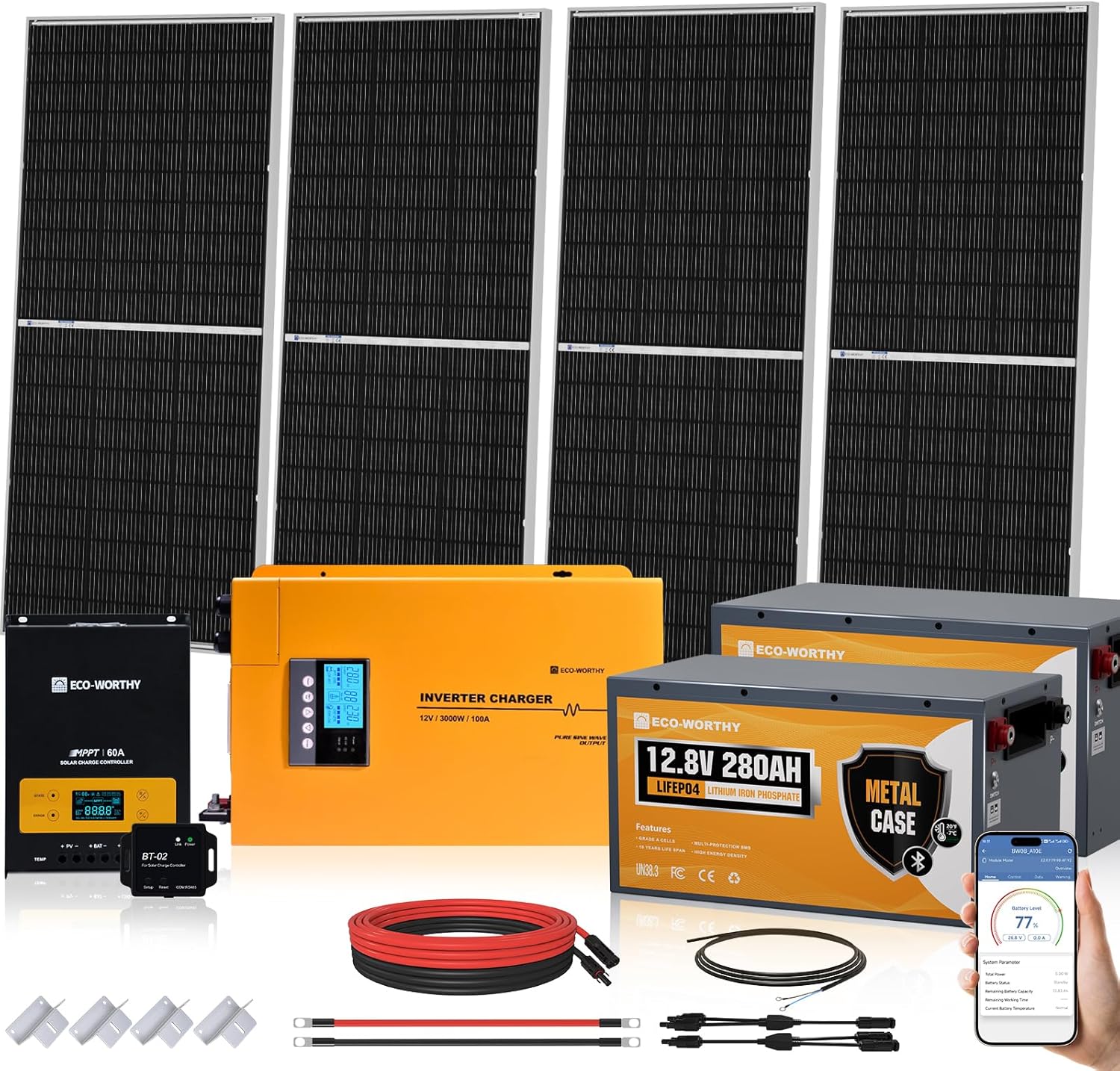
A solar kit is a pre-packaged bundle that includes most of the core components you need to generate electricity from sunlight, sold as a single unit so you don’t have to source each part separately. A typical home solar kit includes.
- Solar panels (the modules that convert sunlight into DC electricity)
- An inverter (converts DC into the AC your home appliances use), either a string inverter or microinverters
- A charge controller (in off-grid and hybrid kits, to protect the battery bank)
- Mounting hardware and racking
- Wiring, connectors, and sometimes a monitoring device
Some kits include batteries; many grid-tied kits do not. Knowing which components are missing from a kit is just as important as knowing what’s included, and it’s where most buyers get caught off guard.
The Three Types of Solar Kits (Pick This First)
Before you look at a single product, decide which category you’re in. This determines everything else.
Grid-tied kits
These connect to your utility grid and have no batteries. They’re the cheapest per watt and the best return on investment if your goal is simply to lower your electricity bill.
The trade-off: when the grid goes down, your system shuts off too (an anti-islanding safety requirement).
Off-grid kits
These include a battery bank and charge controller, designed for cabins, RVs, sheds, or homes with no utility connection.
They are more expensive, have more components, and they require careful load calculation. Undersize the battery, and you’ll be sitting in the dark by 9 p.m.
Hybrid kits
These connect to the grid and include battery backup. You get bill savings plus power during outages. They’re the most flexible and, unsurprisingly, the most expensive.
If you’re in Mexico or much of Latin America, where net metering rules and utility reliability vary by region, a hybrid setup often makes the most practical sense, though grid-tied remains the fastest payback in stable-grid areas.
How to Size a Solar Kit (The Part Most Guides Skip)
Here’s the engineer’s approach. Don’t buy by panel wattage; buy by your daily energy consumption in kilowatt-hours (kWh).
Find your daily kWh usage
Pull your last 12 months of electricity bills, add the kWh, and divide by 365. Say you average 20 kWh per day.
Find your peak sun hours
These are not daylight hours; it’s the equivalent of the hours of full-strength sun your location receives. Much of Mexico sees roughly 5–6 peak sun hours; check a solar irradiance map for your specific area.
Do the math
Divide daily kWh by peak sun hours, then add ~25% for system losses (inverter inefficiency, wiring, dust, and temperature): (20 kWh ÷ 5.5 sun hours) × 1.25 ≈ 4.5 kW system
That tells you you’d need roughly a 4.5 kW (4,500 W) kit, for example, around twelve 400 W panels. A kit advertised as “2000W” would cover only a fraction of that home’s needs, no matter how impressive the listing photos look.
For off-grid setups, you’ll also size the battery bank to your nighttime load plus a day or two of autonomy for cloudy stretches.
That’s a longer calculation. Leave a comment if you want me to write a dedicated piece on battery sizing.
What to Look For in a Quality Kit
From the installation side, here’s what actually matters once you’re holding the components:
- Monocrystalline panels over polycrystalline for better efficiency in limited roof space.
- Microinverters or optimizers: If any part of your roof gets shade, a single shaded panel on a string inverter drags down the whole string.
- Reputable inverter brand with a real warranty (10+ years). The inverter is the component most likely to fail first.
- Certification marks look for UL listing (or the relevant standard for your country) on panels and inverters. This is a safety and insurance issue, not a marketing nicety.
- Clear documentation and support. Off-grid and hybrid kits especially live or die by good wiring diagrams.
Recommended Solar Kits for Home
These are starting points across the three categories. Always verify current specs and your own sizing math before buying and confirm whether batteries are included.
Best for Beginners / Small Loads: Renogy 200W Starter Kit
A solid entry point for sheds, RVs, or a single-circuit backup. Comes with panels, a charge controller, and the cabling to get started. This won’t run a whole house, but it’s a low-risk way to learn the fundamentals hands-on.
Best Off-Grid Kit: ECO-WORTHY 1kW–2kW Off-Grid Kit
Includes panels, a charge controller, and an inverter, with battery options available. Good for cabins or a backup power station for essential circuits. Pair it with a properly sized lithium (LiFePO₄) battery bank.
Best for Whole-Home Grid-Tied: Grid-Tie Kits with Microinverters
For real home offset, look at larger grid-tied bundles (4 kW and up) built around microinverters such as Enphase.
These handle shading gracefully and scale panel-by-panel. Expect to involve a licensed electrician for the grid interconnection.
A Word on Installation and Safety
I’ll be direct, because I’ve wired these systems myself: DC solar arrays carry voltages that can seriously injure you, and a grid interconnection done wrong can endanger utility workers.
Small off-grid and RV kits are reasonable DIY projects for a careful person. Whole-home grid-tied and hybrid systems should involve a licensed electrician and proper permits, both for your safety and to keep your insurance and utility agreement valid. A good kit makes the job easier; it doesn’t replace doing it correctly.
Frequently Asked Questions
Can a solar kit power my entire house?
Yes, but only if it’s sized to your actual annual consumption and (for backup) paired with adequate battery storage.
Most “home” kits sold online are partial-offset or backup systems, not whole-home solutions. Read the wattage against your kWh math.
Do solar kits include batteries?
Not always. Grid-tied kits usually don’t. Off-grid and hybrid kits may include batteries or sell them separately. Always check the component list.
Are solar kits cheaper than a professional installation?
The hardware is cheaper because you skip the installer’s margin and labor. But factor in your time, the cost of any electrician you hire for interconnection, and permits. For small systems the savings are real; for whole-home systems the gap narrows.
How long until a solar kit pays for itself?
For grid-tied systems with good sun and decent electricity rates, typical payback runs several years, after which the energy is effectively free for the panels’ remaining 20+ year life. Off-grid kits are usually about energy independence rather than pure payback.
Disclosure: This article contains affiliate links. If you purchase through them, we may earn a commission at no extra cost to you. Recommendations are based on the author’s professional experience.
