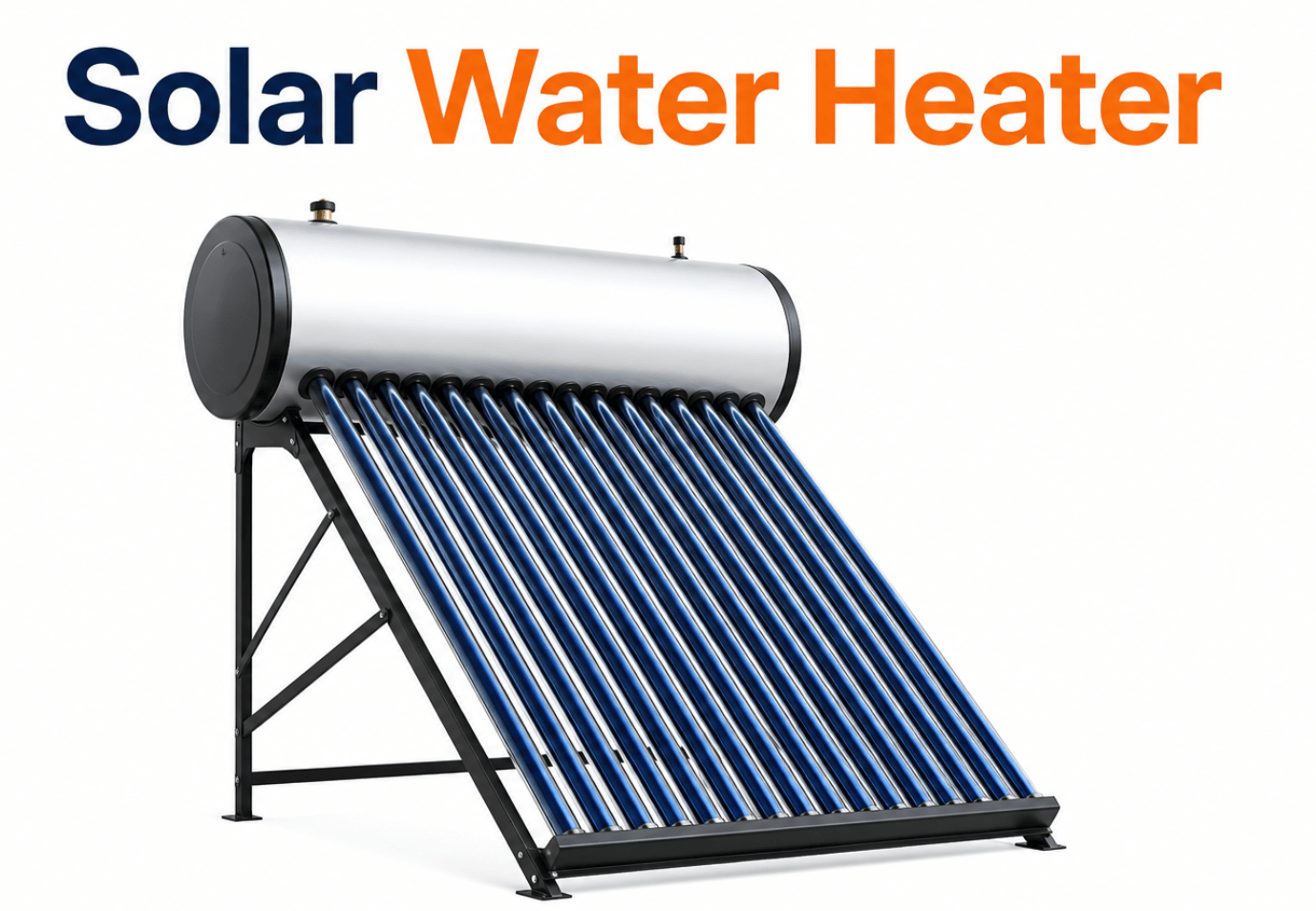
Your water heater is quietly responsible for 14–18% of your home’s total energy bill every single month. That hot shower, that dishwasher cycle, that load of laundry: all of it adds up.
Now imagine cutting that cost by 50% to 80% using nothing but the sun. That’s exactly what a solar water heater can do.
Solar water heaters have matured into one of the most cost-effective renewable energy upgrades a homeowner can make.
They’re simpler than solar PV panels, have fewer moving parts, and often pay for themselves in as little as 3–7 years. Yet most homeowners know very little about them.
In this guide, you’ll learn exactly how a solar water heater works, which type fits your climate and budget, what installation really costs, how much you can realistically save, and what it takes to keep your system running for 20+ years.
What Is a Solar Water Heater?
A solar water heater (also called a solar thermal system or solar hot water system) is a device that uses energy from sunlight to heat water for residential or commercial use.
Unlike solar PV panels, which convert sunlight into electricity, solar water heaters convert sunlight directly into heat, a much more thermally efficient process.
The heated water is stored in an insulated tank and used for showers, dishwashing, laundry, and space heating.
In most climates, a solar water heater can meet 50–80% of a household’s hot water demand year-round, with a conventional backup heater covering the rest.
Solar water heaters are one of the oldest forms of solar technology. Modern systems, however, are highly engineered, capable of achieving efficiencies above 70%, operating reliably for two decades, and withstanding extreme weather conditions.
How Does a Solar Water Heater Work?
The operating principle is straightforward: sunlight heats a fluid (water or antifreeze) inside a collector panel mounted on the roof or a sun-facing surface. That heat is then transferred to your storage tank, giving you hot water on demand.
There are two main approaches to circulating the fluid through the system.
Active Systems (Pumped)
Active systems use an electric pump to circulate the heat-transfer fluid between the collector and the storage tank.
A controller monitors temperature differences between the collector and the tank, activating the pump only when solar gain is available.
Active systems are more flexible, work in a wider range of climates, and are more efficient, but they have a few more components that can require maintenance.
Passive Systems (Thermosiphon)
Passive systems have no pump. Instead, they rely on the natural convection principle: hot water rises, cool water sinks.
As the fluid in the collector heats up, it naturally rises into the tank. This elegant simplicity means fewer components, lower cost, and near-zero maintenance.
The trade-off is that the tank must be mounted above the collector, which affects aesthetics and is only practical in certain roof configurations.
Direct vs. Indirect Loop
In a direct (open-loop) system, potable water circulates directly through the collector. This works well in frost-free climates but risks pipe damage in freezing temperatures.
In an indirect (closed-loop) system, a non-toxic antifreeze solution circulates through the collector and transfers heat to the potable water via a heat exchanger.
This protects the system in cold climates and is the standard approach in North America and Europe.
Types of Solar Water Heaters: Comparison Table
Not all solar water heaters are built the same. Here’s a breakdown of the main types and how they compare.
| Type | Efficiency | Best For | Avg. Cost (USD) | Lifespan |
| Flat Plate Collector | 50–70% | Warm/mild climates | $1,000–$2,500 | 20–25 years |
| Evacuated Tube Collector | 70–90% | Cold or cloudy climates | $1,500–$4,000 | 20+ years |
| Thermosiphon (Passive) | 60–75% | Sunny, frost-free regions | $800–$1,800 | 15–20 years |
| Pumped (Active) System | 65–85% | Large households | $2,000–$5,000 | 20+ years |
| Integral Collector Storage | 50–60% | Mild climates, low demand | $600–$1,500 | 10–15 years |
Flat Plate Collectors
These are the most common types worldwide. A flat, insulated box contains a dark absorber plate (usually copper) with tubes through which the fluid flows.
A glass cover reduces heat loss. They are durable, proven, and moderately priced, excellent in temperate to warm climates.
Evacuated Tube Collectors
A series of glass tubes, each containing an absorber element in a vacuum. The vacuum insulation drastically reduces heat loss, making evacuated tube systems highly efficient even in cold or overcast conditions. They’re the better choice for colder climates, but come at a higher upfront cost.
Integral Collector Storage (ICS / Batch Systems)
In ICS systems, the collector and tank are one unit, dark-colored water tanks inside a glazed box. Simplest and cheapest of all, but heat loss overnight can be significant. Best suited for mild, frost-free regions with consistent sun.
Solar Water Heater Cost: What to Expect in 2026
The total installed cost of a solar water heater in 2025 depends on system type, home size, local labor rates, and whether a backup heater is needed. Here are general benchmarks:
- Basic passive thermosiphon system (DIY-friendly, warm climate): $800–$1,800
- Flat plate active system (installed): $2,000–$4,000
- Evacuated tube system (installed): $3,000–$6,000
- Large commercial systems: $8,000–$20,000+
Many homeowners qualify for significant incentives. In the United States, the federal Residential Clean Energy Credit offers a 30% tax credit on the full cost of solar water heater systems installed through 2032.
Many states and utilities stack additional rebates on top. In Mexico and Latin America, SENER and state-level energy programs have offered subsidies in various periods. Always check local availability.
After incentives, the net cost for a residential system often falls to $1,400–$3,500, making payback timelines competitive with most home improvement investments.
How Much Can You Save with a Solar Water Heater?
A properly sized solar water heater in a sunny location (4–6 peak sun hours daily) can offset 50–80% of your annual water heating costs. Let’s put that in concrete numbers.
- The average U.S. household spends $400–$600/year on water heating
- Solar savings of 65%: approximately $260–$390/year
- Over 20 years (at a conservative $300/year saved): $6,000 in cumulative savings
- In hot, sunny climates (like central Mexico or Arizona), 80%+ offset is realistic
The simple payback period, the time it takes for cumulative savings to equal your upfront cost, typically ranges from 3 to 8 years for residential systems.
After that, you’re generating free hot water for the remaining 12–17 years of the system’s lifespan.
Compare that to a conventional gas water heater (lifespan: 8–12 years, no energy savings) or an electric resistance heater (cheap upfront, expensive to run). Solar thermal wins on total lifetime cost in most scenarios.
Solar Water Heater Installation: What the Process Looks Like
Understanding the installation process helps you prepare and ask the right questions when hiring a contractor.
Step 1: Site Assessment
A qualified installer will evaluate your roof orientation, tilt angle, available area, shading from trees or structures, and local solar irradiance data. South-facing roofs with a 30–45° tilt are ideal in the Northern Hemisphere.
Step 2: System Sizing
The system is sized based on the number of household members, average daily hot water consumption, and local climate.
A common rule of thumb is 20 gallons of storage per person and 1 square foot of collector area per gallon of daily demand.
Step 3: Permitting
Most municipalities require a building permit for solar thermal installations. Your installer typically handles this. Timelines vary from a few days to a few weeks, depending on local authorities.
Step 4: Installation Day
Installation typically takes 1–3 days. This includes mounting the collector on the roof, connecting to the plumbing system, installing the storage tank, mounting the controller (for active systems), and testing the complete loop for leaks and proper circulation.
Step 5: Commissioning & Backup Integration
The system is tested under live conditions. The installer will verify the differential thermostat controller settings and confirm proper integration with your backup water heater (whether gas, electric, or heat pump water heater).
7. Pros and Cons of Solar Water Heaters
✅ Advantages
- Dramatically reduces monthly energy bills (50–80% water heating savings)
- Long system lifespan: quality systems last 20–25 years
- Lower carbon footprint compared to gas or electric water heaters
- Eligible for substantial tax credits and rebates in many regions
- Proven, mature technology with well-established supply chains
- Works even on partly cloudy days (especially evacuated tube systems)
- Adds home resale value
❌ Disadvantages
- Higher upfront cost than conventional water heaters
- Requires suitable roof orientation and adequate sun exposure
- Performance drops in cold, cloudy, or high-latitude climates
- Needs a backup heater for extended cloudy periods
- Passive systems require a tank above the collector (aesthetic and structural implications)
- Antifreeze in closed-loop systems needs periodic replacement
Maintenance Tips to Maximize Lifespan
Solar water heaters are low-maintenance by design, but a few annual tasks will keep your system running efficiently for its full 20+ year lifespan.
- Inspect collector glazing annually for cracks, condensation, or dirt accumulation. Clean with water and a soft brush.
- Check antifreeze concentration (for indirect systems) every 3–5 years and replace if degraded. Glycol breaks down over time and loses freeze protection.
- Inspect pump operation and controller settings at least once a year (active systems).
- Flush the storage tank annually to remove sediment, especially in hard water areas.
- Check all pipe insulation, particularly at fittings and joints exposed to UV.
- Have a qualified technician inspect the system every 3–5 years for a full checkup.
Many issues, like an air-locked pump or a sticky thermostat, are simple fixes when caught early. Don’t wait for no hot water to investigate your system.
Is a Solar Water Heater Right for You?
A solar water heater is an excellent investment if your situation matches most of the following criteria:
- You live in a region with 4+ peak sun hours per day (most of the Americas, southern Europe, Africa, Southeast Asia, Australia)
- Your current water heating cost is $300/year or more
- You plan to stay in your home for at least 5–7 years
- Your roof is south-facing (or east/west with adequate area) and largely free of shading
- You qualify for federal or state tax credits or rebates
- You’re committed to reducing your household carbon footprint
It may not be the right fit if you live in a consistently cloudy, cold climate (though evacuated tube systems narrow this gap), have a very small household, are planning to move soon, or your roof requires significant repair before adding any mounted equipment.
When in doubt, request a free site assessment from a certified solar thermal installer. Most reputable companies offer these at no charge and can give you a project-specific payback analysis.
Frequently Asked Questions
How long does a solar water heater last?
Quality residential solar water heaters typically last 20–25 years. The storage tank may need replacement after 10–15 years, depending on water hardness and maintenance. Evacuated tubes can often be replaced individually, extending overall system life.
Can a solar water heater work in winter?
Yes, indirect (closed-loop) systems with antifreeze work reliably in freezing temperatures. Evacuated tube collectors in particular perform well in cold, cloudy conditions due to their vacuum insulation. You’ll still use more backup energy in winter, but the system contributes year-round.
What size solar water heater do I need?
A common guideline is 20 gallons of tank storage per person and roughly 1 sq ft of collector per gallon of daily hot water use. A family of four typically needs an 80-gallon tank and 32–40 sq ft of collector area.
Do solar water heaters work without direct sunlight?
Yes, partially. Solar thermal collectors can capture diffuse radiation on cloudy days, though output is reduced.
Evacuated tube collectors are particularly effective in low-light conditions. Your backup heater handles the deficit.
What’s the difference between solar water heaters and solar panels (PV)?
Solar PV panels generate electricity; solar water heaters generate heat. Solar thermal systems are significantly more efficient at converting sunlight to heat (60–90%) than PV is at converting sunlight to electricity (15–22%).
For water heating specifically, solar thermal is usually the more cost-effective technology unless you already have excess solar PV capacity.
Is a solar water heater worth it in 2026?
Yes, for most homeowners in moderate to sunny climates. With federal tax credits covering 30% of costs and strong component prices, payback periods have shortened.
The combination of rising utility rates and long system lifespans makes the economics compelling.
Final Thoughts
A solar water heater is one of the quietest, most dependable renewable energy upgrades you can make to your home. No inverters, no net metering negotiations, no complex electronics, just sunlight turning into the hot water your family uses every day.
The technology is proven, the savings are real, and the environmental impact is immediate. Whether you’re drawn to the economics, the sustainability, or simply the satisfaction of making your home more self-sufficient, a solar water heater deserves serious consideration.
Start by getting a professional site assessment and a detailed quote for your region. The data will tell the story.
